
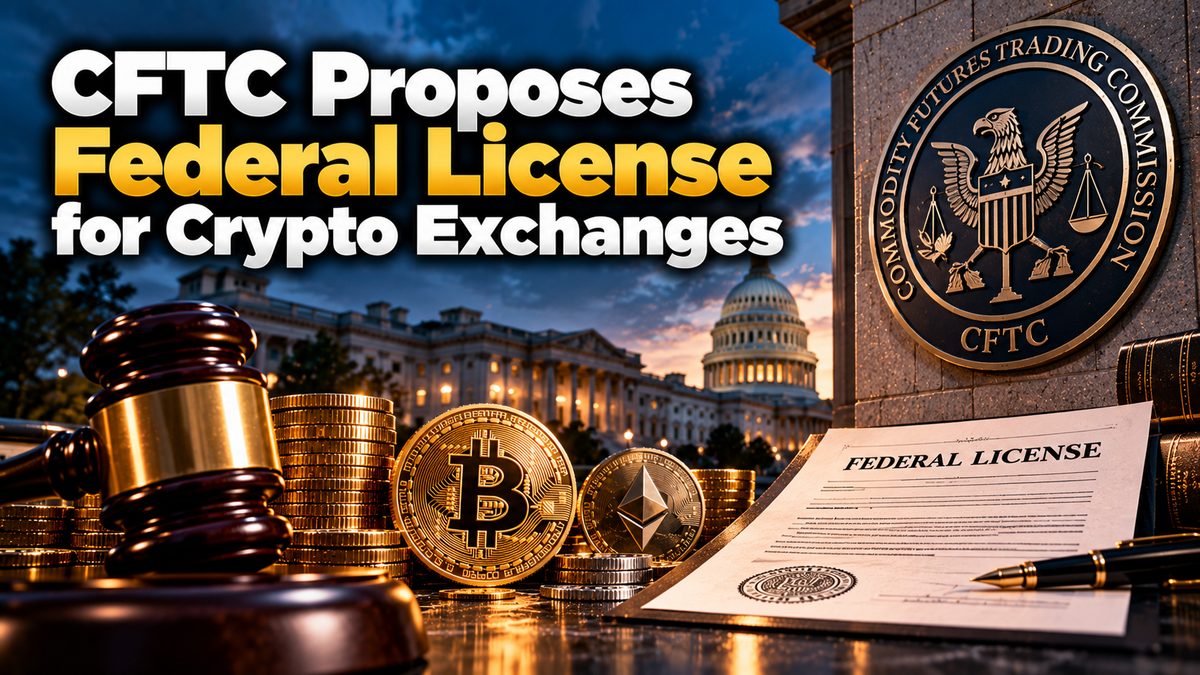
The CFTC is asking for public comment on a plan to bring crypto exchanges under a new federal licensing framework. Notably, offering leverage is what would trigger this oversight. If this moves forward, it could reshape how exchanges structure products in the US. Worth watching how the industry responds during the comment period.
CFTC Opens Comment Period on New Exchange License
The Commodity Futures Trading Commission, the US federal agency that oversees derivatives and commodity markets, has unveiled a plan to bring crypto exchanges under its direct oversight, as reported by Decrypt. The agency is seeking public comment on a framework that would establish a new federal license specifically for crypto exchanges.
This matters because, up to now, crypto exchanges operating in the US have largely navigated a patchwork of state licenses and existing financial rules rather than a single federal standard built for digital assets. A dedicated federal license would give the CFTC a clearer legal hook to supervise these platforms directly.
Leverage as the Trigger Point
According to the proposal, the detail that puts an exchange under this new oversight is whether it offers leverage. In trading, leverage refers to borrowing funds or using credit to control a larger position than your own capital would normally allow. Regulators tend to pay closer attention to leverage because it can amplify both gains and losses, and it introduces counterparty and systemic risks that simple cash markets don't carry.
By tying oversight to leverage offerings rather than to the existence of an exchange itself, the CFTC appears to be drawing a line between platforms that simply let people buy and hold crypto and those that let traders take on borrowed exposure. That distinction could become a defining feature of how the US crypto exchange landscape is organized going forward.
A Public Process, Not a Finished Rule
Because this is a request for public comment rather than a finalized regulation, nothing is locked in yet. Comment periods are standard steps in US rulemaking where industry participants, exchanges, legal experts, and the public can weigh in before an agency decides how to proceed. The eventual shape of any federal license, and how exchanges respond to it, will depend heavily on that feedback process.
What It Could Mean for Spot Traders
For someone trading crypto on the spot market, meaning buying and holding actual coins rather than borrowed positions, this proposal is not something that demands immediate action. It's a regulatory process still in its early, consultative stage. That said, it's worth watching because clearer federal rules around exchanges can affect which platforms operate in the US, how they're structured, and what compliance requirements they must meet over time.
As with most regulatory developments, the practical approach for spot traders is patience rather than reaction. Sudden headlines about proposed oversight don't change the fundamentals of an asset overnight, and traders who build positions gradually over time, rather than trying to time news cycles, tend to be less exposed to short-term noise around regulatory announcements like this one. The real impact, if any, will likely unfold slowly as the comment period plays out and any final rules take shape.