
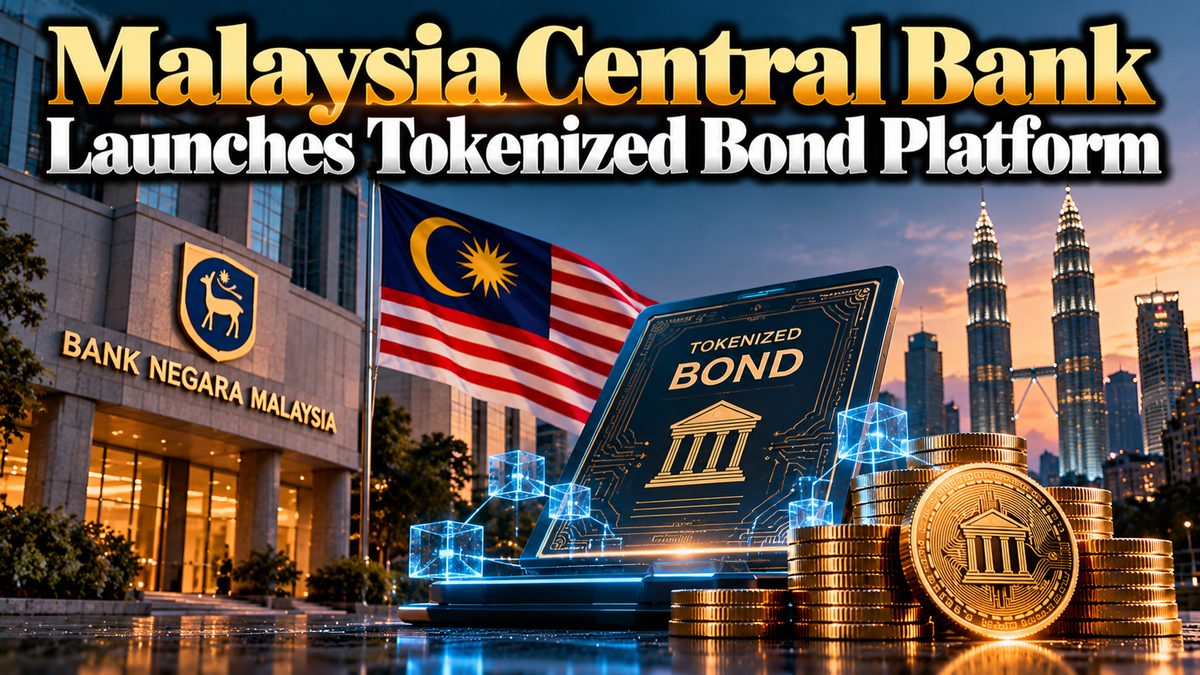
Another central bank quietly builds real infrastructure instead of chasing headlines. Tracking tokenized securities ownership and tying settlement directly into RENTAS+ for central bank money means this isn't a sandbox experiment — it's plumbing meant to actually handle bond transfers. Worth watching how fast other central banks follow this playbook.
A New Rail for Tokenized Bonds
Malaysia's central bank has launched a distributed ledger technology (DLT) platform designed to track ownership and transfers of tokenized securities, as reported by Cointelegraph. Rather than existing as a standalone pilot, the platform is directly linked to RENTAS+, Malaysia's system for settling payments in central bank money. That link is the key detail: it means transfers of tokenized bonds on this new platform can be settled with real, final payment through the national settlement system, not just recorded on a ledger disconnected from actual money movement.
What DLT and Central Bank Money Mean Here
Distributed ledger technology is the broader category of tech that blockchains belong to — a shared, continuously updated record that multiple parties can verify without relying on a single central database. Applying it to bonds means ownership records and transfer history can be tracked digitally and more transparently than through traditional paper-based or siloed systems.
Central bank money refers to funds that are liabilities of the central bank itself, as opposed to commercial bank deposits. Settling a trade in central bank money is considered the safest and most final form of settlement, since it removes the risk that a commercial bank involved in the transaction could fail before payment clears. By tying the tokenized securities platform to RENTAS+, Malaysia's central bank is ensuring that whenever ownership of a tokenized bond changes hands, the corresponding payment settles through this high-assurance channel rather than a separate, less secure process.
Why This Differs From a Sandbox Test
Many central banks have experimented with blockchain concepts in limited, controlled environments that never touch live infrastructure. What stands out here is the direct integration with an existing, functioning settlement system. That suggests the platform is built with the intention of handling actual bond transfers, not just demonstrating that tokenization is technically possible. Infrastructure built this way tends to be slower to roll out but more consequential once it does, since it plugs into systems that financial institutions already rely on daily.
What It Means for a Spot Trader
For spot traders, this development sits at the intersection of traditional finance and blockchain infrastructure rather than directly involving retail-traded cryptocurrencies. It doesn't change anything about token prices or market conditions today, but it is a signal of how deeply blockchain-based settlement concepts are being absorbed into mainstream financial plumbing. Watching how central banks approach tokenization can offer useful context on where institutional trust in this technology is heading over time.
This kind of institutional adoption doesn't call for any shift in spot trading approach. For traders who favor patience and building positions gradually over time, news like this is best treated as background context rather than a trigger for action. It's a reminder that blockchain's use cases are expanding beyond speculative assets, even if that expansion doesn't show up directly in short-term price movements.