
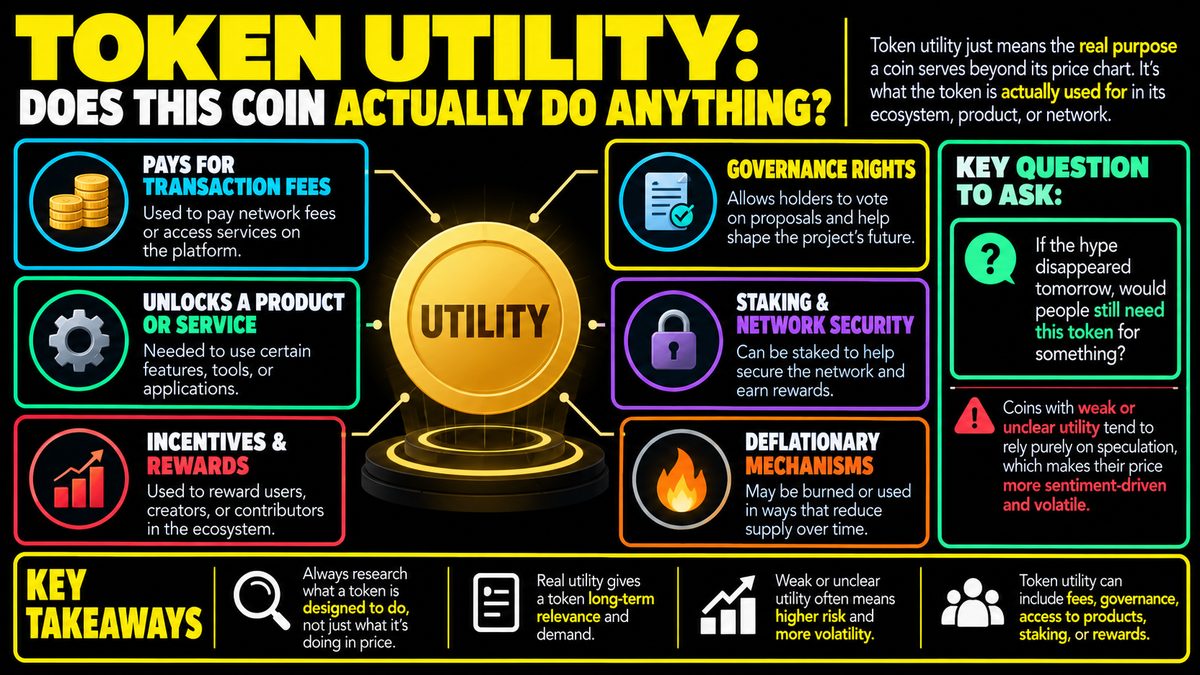
Token utility just means the real purpose a coin serves beyond its price chart — maybe it pays for transaction fees, grants voting rights in a project's decisions, unlocks a product or service, or gets "staked" to help secure a network in exchange for rewards. The key question to ask before trading or holding any token long-term is: if the hype disappeared tomorrow, would people still need this token for something? Coins with weak or unclear utility tend to rely purely on speculation, which makes their price more sentiment-driven and volatile. Always research what a token is designed to do, not just what it's doing in price.
What Utility Actually Means
When people talk about a token's utility, they mean the concrete job it performs inside its own ecosystem, separate from whatever price it happens to trade at on a given day. A token with utility is a tool, not just a ticket. It might be required to pay network fees, it might unlock access to a piece of software, it might represent a vote in how a project is run, or it might be locked up ("staked") to help validate transactions on a blockchain in exchange for rewards. The common thread is that the token is doing something functional, and that function creates a reason for it to exist beyond being bought and sold.
Contrast that with a token that has no clear job. If removing the token from its project would change nothing about how that project actually works, the token is likely serving as a speculative vehicle rather than a functional piece of infrastructure. That doesn't automatically make it worthless, but it does change what is actually driving its price.
How Utility Forms in a Project
Utility is usually designed in from the start, written into how a blockchain or application is built. A network might require its native token to pay for computing power, similar to how fuel is needed to run an engine. A decentralized application might require the token to participate in governance votes, where holders decide on upgrades or rule changes. Staking mechanisms give token holders a way to lock their coins to support network security, earning rewards for doing so, which also reduces how many tokens are freely circulating.
Sometimes utility is added later, after a token has already built a community, as a project matures and finds new uses for its token. Other times a project promises future utility that never fully materializes, which is why checking actual function matters more than checking stated intentions.
Reading Utility as a Trader
Traders often look at utility as one piece of a broader picture, not a standalone signal to act on. A token used constantly for real transactions or staking tends to have ongoing organic demand tied to actual usage, which can make its price behavior somewhat different from a token whose only demand comes from people hoping to resell it higher. Imagine a hypothetical coin that is required to pay fees on a widely used network, versus a hypothetical coin that exists purely because a community found it entertaining. Both can experience sharp price moves, but the underlying forces pushing those moves are different.
Checking utility usually means reading a project's own documentation, looking at whether the token is actually required for anything, and seeing whether real activity exists on the network rather than taking marketing claims at face value.
Common Mistakes and Limitations
A frequent mistake is assuming that stated utility equals actual demand. A token can be technically required for a feature that almost nobody uses, which means the utility exists on paper but barely matters in practice. Another mistake is assuming utility alone protects against volatility; even tokens with genuine function can swing heavily in price due to broader market sentiment, liquidity conditions, or speculation layered on top of real usage.
Utility is also not a guarantee of success or value. Projects can have excellent utility and still fail for unrelated reasons, such as competition, poor execution, or changing market conditions.
Fitting Utility Into a Research Process
Utility works best as one input among several, alongside factors like how the token is distributed, how active the network is, and general market conditions. No single feature should be treated as a reason to put money at risk. Keeping position sizes reasonable, avoiding concentration in any single token, and viewing utility as a research filter rather than a prediction tool are all part of approaching this responsibly. Understanding what a token does is a starting point for informed research, not a shortcut to certainty.