
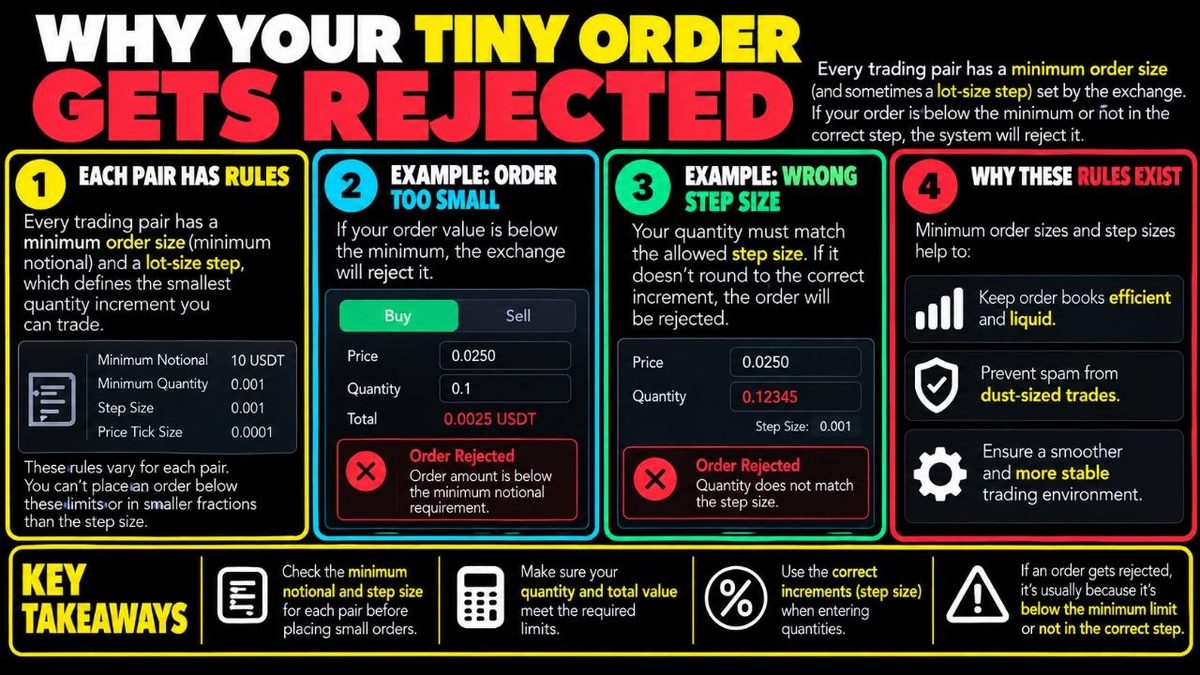
Every trading pair has a minimum order size (and sometimes a "lot size" step) set by the exchange, meaning you can't buy or sell below a certain quantity or in fractions smaller than a defined increment. If your order value falls under that threshold, or your quantity doesn't round to the allowed step, the system rejects it instead of executing. This exists to keep order books efficient and prevent spam from dust-sized trades. Always check a pair's minimum notional and step size before placing small orders.
What minimum order rules actually are
Every trading pair on an exchange comes with a small set of technical rules attached to it, even though most traders never notice them until an order fails. Two of the most common are minimum notional value and lot size step. Minimum notional value is the smallest total worth an order is allowed to have, usually expressed in the quote currency, which is the second asset in a trading pair, like the dollars in a coin-to-dollar pair. Lot size step is the smallest increment of quantity you are allowed to trade, meaning your order quantity has to land on an allowed step rather than any random decimal number you choose.
Why exchanges enforce these limits
Order books, the running list of buy and sell orders waiting to be matched, work best when the orders in them are meaningful enough to actually move toward a trade. If an exchange allowed orders worth a fraction of a cent or quantities with twenty decimal places, the order book could fill with what is often called dust, meaning trade sizes so tiny they add clutter without adding real liquidity, which is the ease of buying or selling without shifting the price much. Minimum notional and step size rules are a simple way to keep the matching engine, the system that pairs buyers with sellers, running efficiently and to discourage spam-like order flow that serves no practical purpose.
How rejection actually happens
Say a hypothetical coin is trading at 100 units of a quote currency, and the exchange sets a minimum notional of 10 units. If you try to buy an amount worth 7 units, the order will not be accepted, even if your account has sufficient funds, because the total value falls under the threshold. Separately, imagine the step size for that pair is 0.01. If you enter a quantity of 0.015, the system will likely reject it or round it, because that number does not land cleanly on the allowed increment. These two checks are independent, so an order can fail either one even if it passes the other.
Reading the fine print before you trade
Every pair usually publishes its trading rules somewhere in the interface or in documentation, often listed as filters or limits specific to that pair. Before placing a very small order, it is worth checking both the minimum notional value and the step size, since these can differ meaningfully from one pair to another, especially between a well established coin and a newer or lower priced one. A few seconds spent checking these numbers can save the frustration of a repeatedly rejected order and the mistaken assumption that something is wrong with your account or connection.
Common mistakes and how this fits your bigger picture
A frequent mistake is assuming that if you have enough balance to cover a trade, the order will go through, without realizing that notional and step rules are separate gates that funds alone do not satisfy. Another is testing a strategy with extremely small amounts and getting confused by rejections, when the real issue is simply sizing below the pair's threshold. These limits are not a signal about market direction, they say nothing about where a price might go, and they are not a trading strategy in themselves. They are closer to plumbing, the background rules that make the system function. Respecting them matters for execution, but it does not replace thinking through your own risk management, including how much of your capital you are willing to risk on any single trade and at what size that risk still makes sense for your account.