
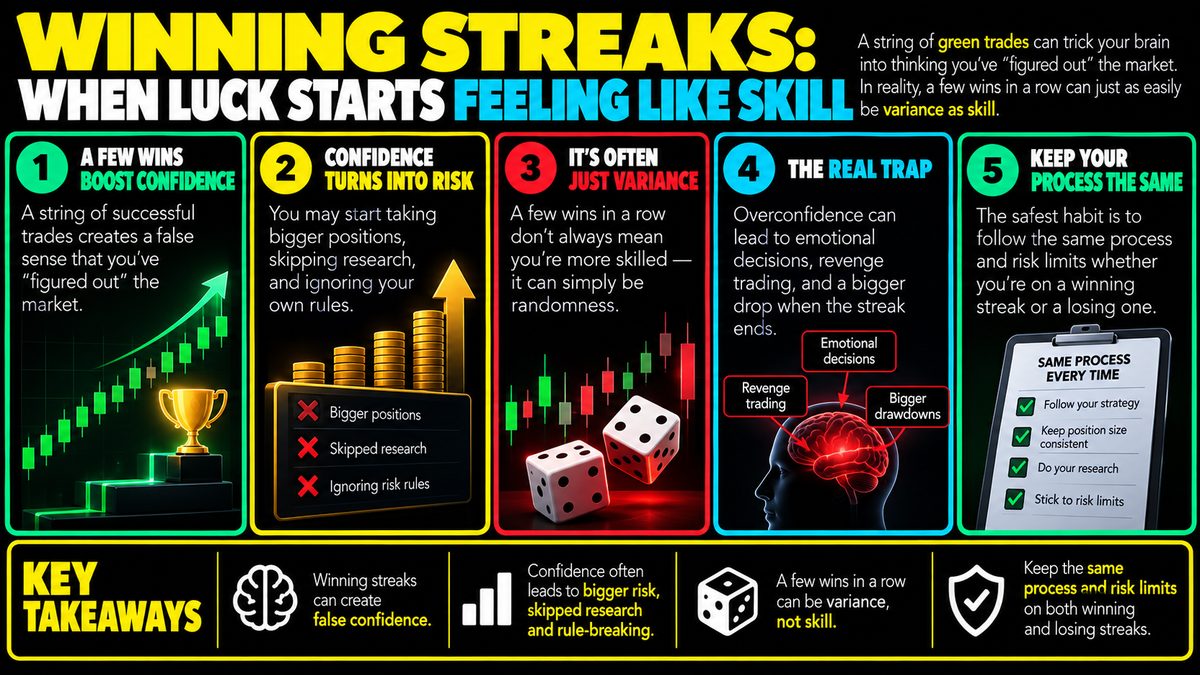
A string of green trades can trick your brain into thinking you've "figured out" the market. That confidence often leads to bigger position sizes, skipped research, and ignoring your own risk rules. In reality, a few wins in a row can just as easily be variance as skill. The safest habit is to keep your process and risk limits identical whether you're on a hot streak or a cold one.
Why Winning Streaks Feel Meaningful
The human brain is wired to find patterns, even in random noise. When you place a few trades in a row that turn out profitable, it is natural to look for a reason why. Maybe you believe you have spotted a signal that works, or you feel you have developed an instinct for timing the market. This feeling can be powerful, but it is important to understand that a short sequence of wins does not, by itself, prove anything about skill. In any activity that involves probability, including trading, strings of good outcomes can and do happen purely by chance.
Variance, a term that describes the natural ups and downs in results even when the underlying odds or strategy have not changed, is a normal part of trading. A trader with a mediocre or even poor long-term strategy can still experience a streak of wins simply because markets move unpredictably in the short term. The opposite is also true: a solid strategy can produce a string of losses without anything being wrong with it. Streaks, in either direction, are not reliable evidence of whether a method is working.
How Confidence Changes Behavior
The real danger of a winning streak is not the streak itself but what it does to decision-making afterward. As confidence builds, many traders start increasing their position sizes, meaning the amount of money or number of units committed to each trade. A win that once felt exciting at a small size can start to feel almost guaranteed at a larger one, which quietly raises the risk being taken without a matching increase in skill or information.
Overconfidence also tends to shrink the amount of research or analysis a trader does before entering a position. Steps that once felt necessary, like checking multiple sources, reviewing a trade plan, or waiting for a specific setup, can start to feel unnecessary when recent results have been good. This is often when risk management rules, such as predetermined stop points or maximum position sizes, start getting bent or ignored entirely, usually with the justification that "this time is different."
Reading Streaks Without Overreacting
A useful habit is to treat every trade as an independent event rather than part of a story. Imagine a hypothetical trader who wins five trades in a row using a coin flip style strategy with no real edge. Statistically, this is entirely possible, even likely, over enough attempts. The fifth win does not make the sixth trade safer or more predictable. Judging a strategy fairly usually requires looking at a much larger sample of trades over time, not just a handful of recent outcomes.
Keeping Process Consistent
The safest practical habit is to keep position sizing, research steps, and risk limits identical regardless of whether you are on a winning or losing run. This might mean setting a fixed percentage of your portfolio you are willing to risk per trade and sticking to it no matter how the last few trades went. It can also help to write down your trading plan in advance, so decisions are not made emotionally in the moment a streak is happening.
Fitting This Into a Broader Approach
No single habit, indicator, or mindset guarantees success, and streak awareness is no exception. It works best alongside broader risk management practices, such as diversification, clear position sizing rules, and realistic expectations about uncertainty. Treating confidence as a signal to double check your process, rather than a signal to abandon it, is a small shift that can meaningfully reduce avoidable losses over time.