
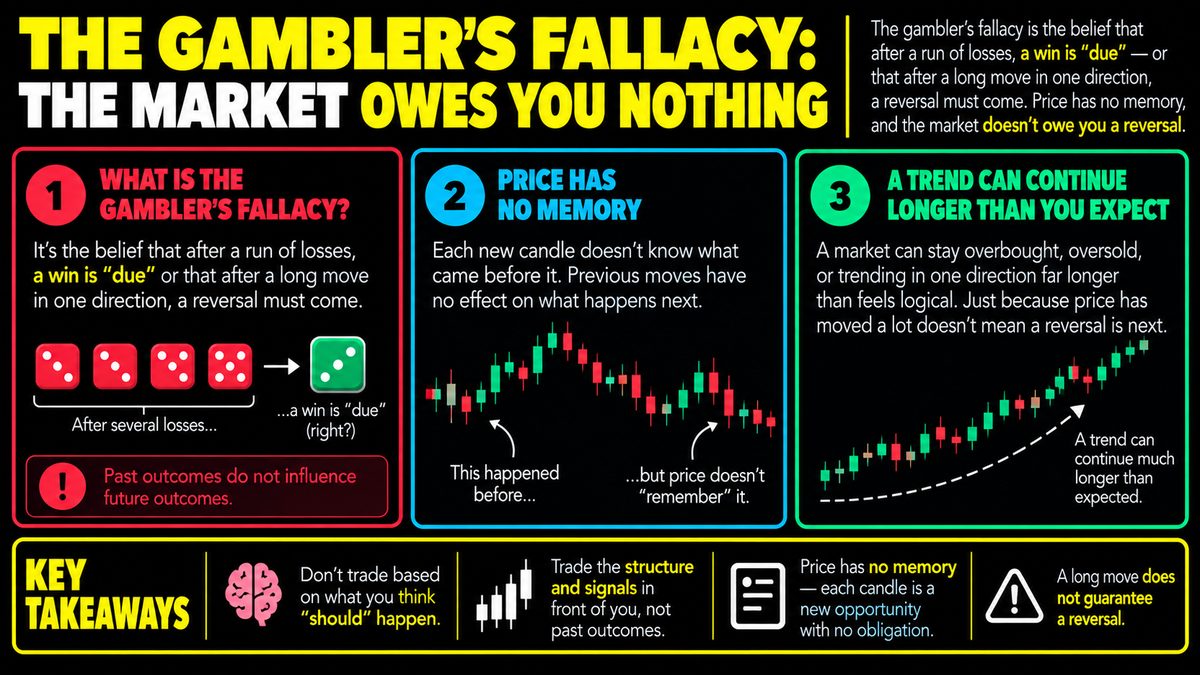
The gambler's fallacy is the belief that after a run of losses, a win is "due" — or that after a long move in one direction, a reversal must come. Price has no memory; each new candle doesn't know what came before it. A market can stay overbought, oversold, or trending far longer than feels logical. Trade the structure and signals in front of you, not a story about what "should" happen next.
What the Gambler's Fallacy Actually Is
The gambler's fallacy is a thinking error where someone assumes that past independent events influence future independent ones. The classic example is a coin flip: after five heads in a row, many people feel tails is "due." In reality, a fair coin has no memory. Each flip is a fresh fifty-fifty event, completely unaffected by what came before.
Markets tempt traders into the same error. After a coin has fallen for ten straight candles, it feels intuitively true that a bounce must be close. After a long rally, it feels obvious that gravity will pull price back down. These feelings are not analysis. They are the same mental shortcut that makes a losing gambler bet bigger, convinced a win is finally coming.
How This Shows Up on a Chart
Imagine a hypothetical coin that has dropped for eight consecutive one-hour candles, moving from 100 down to 80. A trader watching this might think "it can't keep falling, I'll buy here expecting a reversal." But price has no awareness of its own candle count. The ninth candle does not know the previous eight happened. If sellers are still in control, momentum can continue, sometimes much further than feels reasonable.
The same applies to indicators like the Relative Strength Index, or RSI, which measures how fast and how far price has moved to flag potentially "overbought" or "oversold" conditions. A reading above 70 is often labeled overbought, and below 30 oversold. These labels get misread as "reversal guaranteed." In practice, a strong trend can hold an overbought or oversold reading for a long stretch of time while price keeps moving in the same direction.
Why Traders Fall for It
Humans are pattern-seeking by nature. A long streak feels like it is building toward something, because in everyday life, streaks often do even out over time. But financial markets are not simple repeated coin flips. Price moves are influenced by shifting supply, demand, news, and the behavior of other participants, so there is no fixed probability that guarantees balance will return on any particular time frame.
There is also an emotional pull. After several losing trades, it is tempting to believe the next one "has to" work out, which can lead to increasing position size to chase a win that is not actually more likely. This is one of the more damaging versions of the fallacy because it ties emotion directly to risk management.
Trading What Is There Instead of What Feels Due
A more grounded approach is to focus on observable structure: support and resistance levels, volume, trend direction, and whatever signals a trader's own strategy is built around. Reversals do eventually happen, but they tend to come from an actual shift in buying or selling pressure, not from the mere passage of time or candle count. Waiting for confirmation of that shift, rather than anticipating it out of a feeling that a move is overdue, keeps decisions closer to evidence.
Limitations and Risk Management
No structural signal or indicator removes uncertainty entirely. Trends can reverse right after they look most "due," or they can extend well past the point of apparent exhaustion. This is exactly why position sizing, stop-losses, and not over-committing to any single idea matter regardless of how convincing a setup looks.
Recognizing the gambler's fallacy will not predict the next candle. What it can do is stop a trader from treating a losing or winning streak as information it is not, keeping decisions anchored to present evidence rather than a story about what the market "owes" next.