
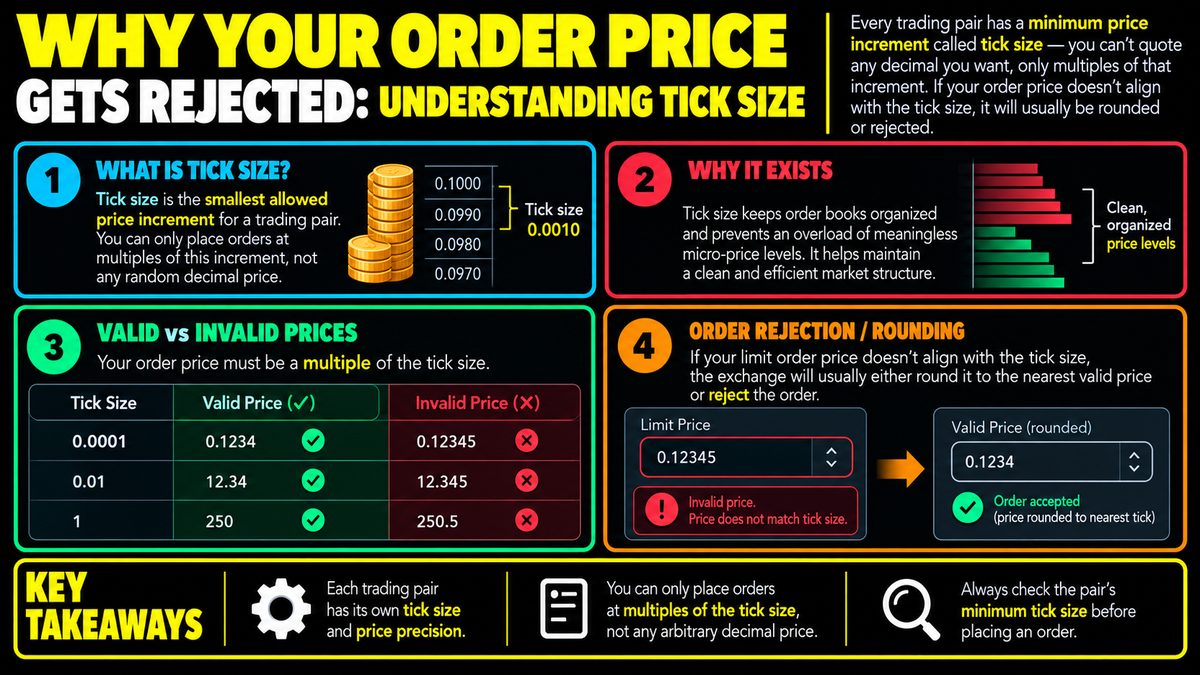
Every trading pair has a minimum price increment called tick size — you can't quote any decimal you want, only multiples of that increment. This exists to keep order books organized and prevent an overload of meaningless micro-price levels. If your limit order price doesn't align with the tick size, the exchange will usually round it or reject it. Precision rules also vary by asset, so always check the pair's minimum tick before placing an order.
What Tick Size Actually Means
Tick size is the smallest allowed gap between two price levels for a given trading pair. Think of it like a ruler that only has marks at certain intervals — you cannot place a price between those marks, only on them. If a hypothetical pair has a tick size of 0.01, valid prices might be 100.00, 100.01, or 100.02, but something like 100.005 simply does not exist on that ruler. Every exchange sets this increment separately for each pair, and it is usually tied to the price range and typical trading activity of that asset.
A limit order is an instruction to buy or sell only at a specific price you choose, rather than whatever the current market price happens to be. Because limit orders require you to type in an exact number, tick size directly affects what numbers are even valid to submit. Market orders, which execute immediately at the best available price, are less affected since you are not choosing the exact price yourself.
Why Exchanges Enforce It
Without a minimum increment, traders could theoretically submit prices with unlimited decimal places, creating an enormous number of tiny, nearly identical price levels. This would clutter the order book, the live list of buy and sell orders waiting to be matched, making it harder for software and humans alike to read supply and demand clearly. Tick size keeps the order book organized into meaningful steps so liquidity, meaning the volume of orders available to trade against, clusters at recognizable levels instead of spreading too thin.
Tick size also reduces a tactic sometimes called price stepping, where someone places an order just a fraction above or below another to jump the queue without offering any real improvement. A sensible increment makes that kind of micro-maneuvering less effective and keeps competition between orders more meaningful.
How Rejections and Rounding Happen
When you submit a limit order, the exchange checks your price against the allowed tick size for that pair. If your price does not land exactly on a valid increment, one of two things typically happens: the system automatically rounds your price to the nearest valid tick, or it rejects the order outright and asks you to resubmit. Which behavior you get depends on the exchange and sometimes the specific interface you are using, such as a website versus an automated trading script.
This matters most when you are placing orders programmatically or copying a price from somewhere else, such as a chart tool that displays more decimal places than the exchange actually allows. A price that looks fine visually can still fail validation if it does not conform to the tick increment.
Tick Size Varies by Asset and Price Range
There is no single tick size across all trading pairs. A coin trading around 1 might have a tick size of 0.0001, while a coin trading around 50000 might use a tick size of 1 or more. Exchanges generally scale tick size to the asset's typical price so that the increment remains a reasonable fraction of the total value, rather than being either meaninglessly small or uncomfortably large.
Because these rules differ and can occasionally change, it is good practice to check the specific precision requirements for a pair before placing an order, especially if you are new to it or using an automated strategy.
Keeping This in Perspective
Tick size is a structural detail of how markets operate, not a trading signal or strategy on its own. Understanding it will not tell you where price is headed, but it helps you avoid frustrating order rejections and keeps your risk management, such as setting precise stop levels or position sizes, grounded in prices the exchange will actually accept. As with any mechanical rule, it works best alongside careful order placement habits rather than as something to trade around.