
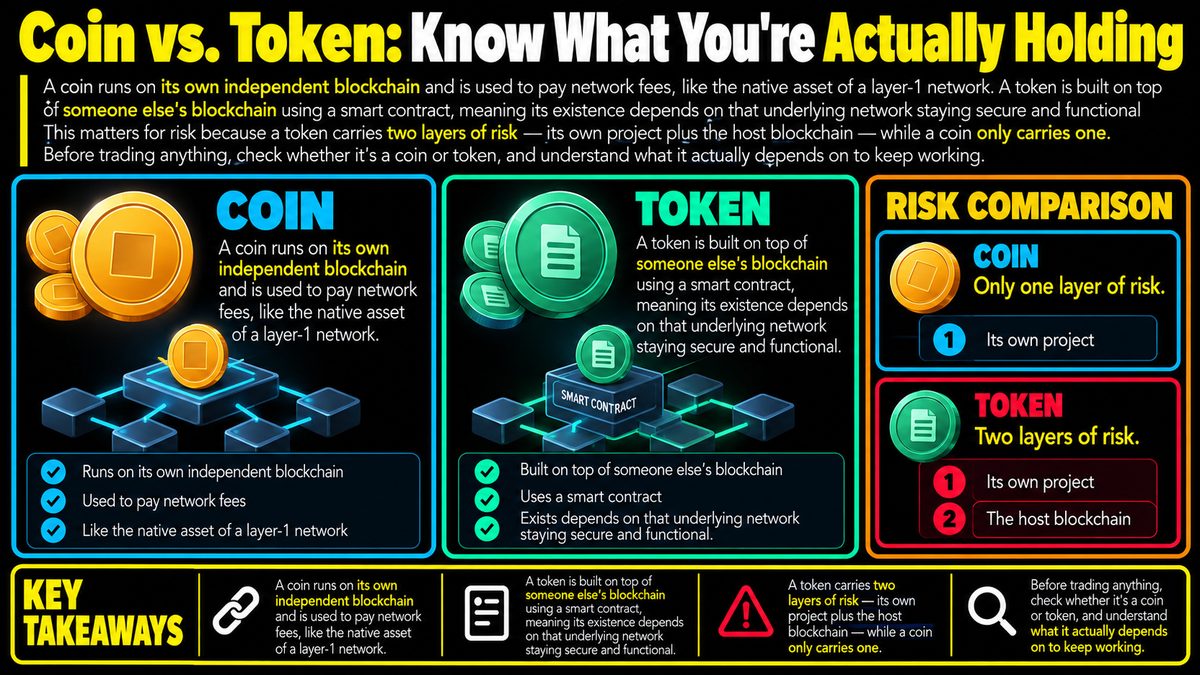
A coin runs on its own independent blockchain and is used to pay network fees, like the native asset of a layer-1 network. A token is built on top of someone else's blockchain using a smart contract, meaning its existence depends on that underlying network staying secure and functional. This matters for risk because a token carries two layers of risk — its own project plus the host blockchain — while a coin only carries one. Before trading anything, check whether it's a coin or token, and understand what it actually depends on to keep working.
What Makes Something a Coin
A coin is the native asset of its own independent blockchain, meaning it has its own ledger, its own network of computers validating transactions, and its own rules for how new units are created. Think of a hypothetical network called "Chain X" that processes transactions and charges a small fee for every transfer. The asset used to pay that fee, and often used to reward the people or machines that keep the network running, is the coin of that chain. Because the coin is baked into the base layer of the blockchain, it generally cannot exist without that blockchain, and that blockchain generally cannot function without it.
Layer-1 is a term you will hear often. It simply refers to a blockchain that operates independently rather than running on top of another one. A coin, in most cases, is the layer-1 network's native asset. Examples of this structure are easy to imagine: a brand new blockchain launches, and it needs some way to pay validators and meter network usage, so it creates its own coin for that purpose.
What Makes Something a Token
A token is different. Rather than running on its own blockchain, a token is created using a smart contract, which is a piece of self-executing code deployed on someone else's blockchain. Imagine a project called "Project Y" that wants to issue a digital asset representing loyalty points or voting rights, but does not want to build an entire blockchain from scratch. Instead, Project Y writes a smart contract on an existing layer-1 network and issues its token there, relying entirely on that host network to process transactions, store balances, and secure the ledger.
This means a token's existence is conditional. If the host blockchain stops functioning correctly, becomes congested, or suffers a security failure, the token built on top of it is directly affected, even if the token's own project team has done nothing wrong. The token is, in a sense, a tenant, while the coin is the landlord's own property.
Why the Distinction Matters for Risk
This difference is not just technical trivia, it changes the risk profile of what you are holding. A coin carries the risks of its own single network, things like how secure its validators are, how decentralized it is, and how reliable its software upgrades are. A token carries that same category of risk from its host chain, plus an entirely separate layer of risk from the token's own smart contract code, its project team, and its specific use case.
Two layers of dependency mean two separate points of failure. A smart contract could have a coding bug, the project behind the token could mismanage its own development, or the underlying blockchain could face unrelated problems that still ripple through to every token sitting on top of it. Neither layer protects against the other.
How to Check What You Are Holding
Before trading or holding any digital asset, it is worth asking a simple question, does this run on its own blockchain, or is it a smart contract on someone else's. Project documentation, often called a whitepaper, usually states this clearly, and blockchain explorers, which are tools for viewing on-chain activity, will often show whether an asset lives natively on a chain or exists as a contract address on it.
Understanding this does not tell you whether something is a good or bad trade, and it is not a signal to buy or sell anything. It is simply a foundational fact that shapes what other risks are relevant to research further.
Fitting This Into Broader Risk Management
No classification system replaces careful research or sound position sizing, which means not risking more than you can afford to lose on any single asset. Knowing whether something is a coin or a token is one input among many, alongside factors like liquidity, team transparency, and how long a network has operated without major incidents. Treat this knowledge as a starting checklist item, not a conclusion, and remember that every digital asset, regardless of its structure, carries risk and no outcome is guaranteed.