
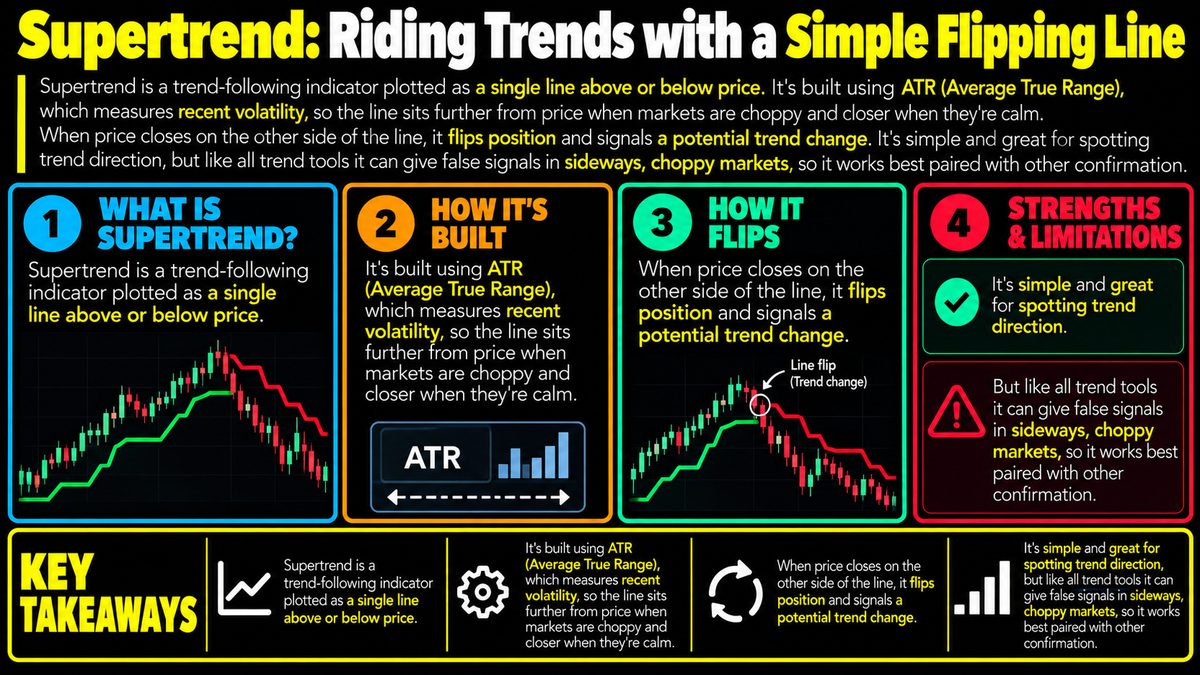
Supertrend is a trend-following indicator plotted as a single line above or below price. It's built using ATR (Average True Range), which measures recent volatility, so the line sits further from price when markets are choppy and closer when they're calm. When price closes on the other side of the line, it flips position and signals a potential trend change. It's simple and great for spotting trend direction, but like all trend tools it can give false signals in sideways, choppy markets, so it works best paired with other confirmation.
What Supertrend Actually Is
Supertrend is a visual indicator that plots a single line directly on a price chart, sitting either above or below the current price. When the line is below price, it suggests the trend is up. When it sits above price, it suggests the trend is down. Because it only has two states, it is easy to read at a glance, which is part of why many beginners gravitate toward it.
The indicator belongs to a family of tools called trend-following indicators. These are built on the idea that once a market starts moving in a direction, it tends to keep moving that way for a while, and the goal is to catch and stay with that movement rather than guess the exact top or bottom.
How It Is Built Using Volatility
Supertrend is calculated using something called ATR, short for Average True Range. ATR measures how much an asset typically moves over a given period, regardless of direction, so it is essentially a volatility gauge rather than a direction gauge. Supertrend takes this volatility reading and uses it to decide how far away from price the line should sit.
When volatility is high, meaning price is swinging around a lot, the line sits further away from price. This is meant to avoid reacting to normal noise. When volatility is low and price is moving calmly, the line sits closer to price, making it more sensitive to small shifts. Imagine a coin trading around 100 where recent moves have been wild; the Supertrend line might sit at 90. If the same coin calms down, that line might move up to 97, hugging price more tightly.
Reading the Flips
The core signal from Supertrend is the flip. As long as price stays on one side of the line, the indicator assumes the existing trend is intact and the line simply trails along, adjusting with volatility. Once price closes on the opposite side of the line, Supertrend flips to the other position, suggesting the trend may be reversing.
Many traders use these flips as a simple visual cue for trend direction rather than as a standalone trigger. A flip from below price to above price is often read as a caution sign that upward momentum may be fading, and the reverse flip is read as a caution sign in a downtrend. It is worth remembering this is a reaction to past price action, not a forecast of what comes next.
Common Mistakes and Limitations
The biggest weakness of Supertrend, like most trend-following tools, shows up in sideways or choppy markets. When price is bouncing within a range rather than trending, the line can flip back and forth repeatedly, generating signals that quickly reverse and lead to confusion or frustration if treated as automatic signals.
Another common mistake is using Supertrend in isolation, as if a single flip confirms a trade decision. Since it is a lagging tool built from past price and volatility data, it will always confirm a move after it has already begun, never before. No indicator, including this one, can guarantee future direction or protect against sudden sharp moves.
Fitting It Into a Broader Approach
Because of these limitations, Supertrend tends to work better as one input among several rather than a sole decision-maker. Traders often pair it with tools that measure momentum or market structure, or with a view of overall trend context from longer timeframes, to filter out weak signals during choppy conditions.
Risk management remains essential regardless of which indicator is used. Position sizing, predefined risk limits, and acceptance that any single signal can fail are all part of using a tool like Supertrend responsibly rather than treating its line flips as certainties.