
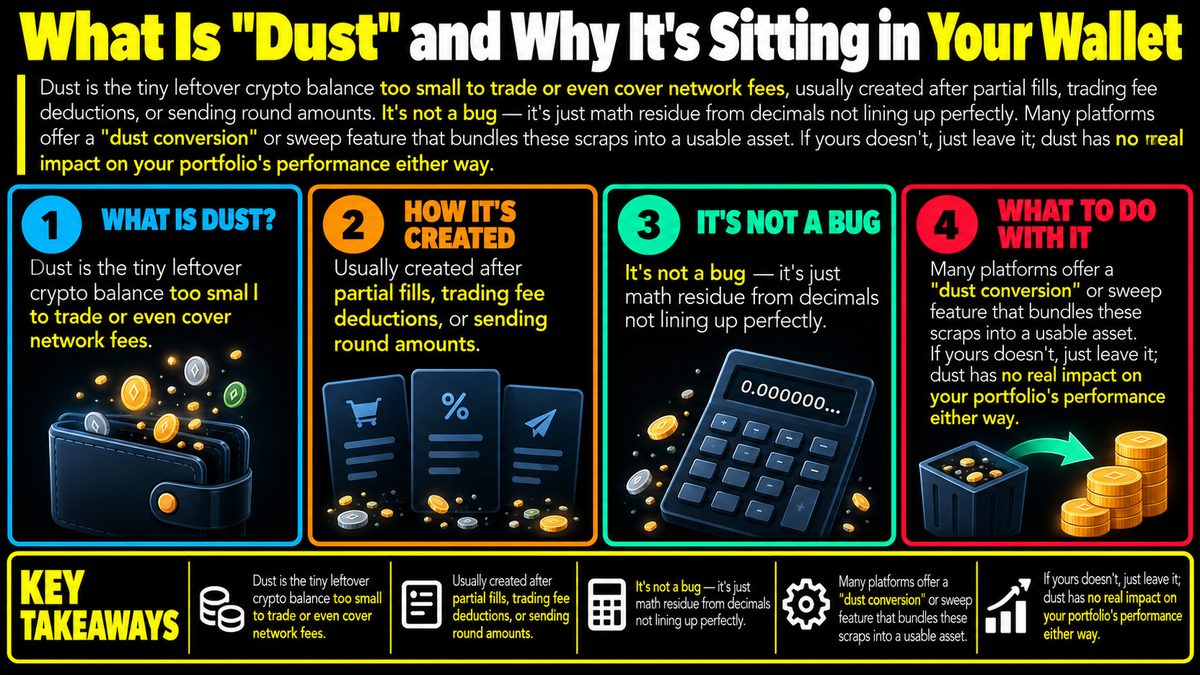
Dust is the tiny leftover crypto balance too small to trade or even cover network fees, usually created after partial fills, trading fee deductions, or sending round amounts. It's not a bug — it's just math residue from decimals not lining up perfectly. Many platforms offer a "dust conversion" or sweep feature that bundles these scraps into a usable asset. If yours doesn't, just leave it; dust has no real impact on your portfolio's performance either way.
What Counts As Dust
Dust is the name traders use for a crypto balance so small it is practically unusable. It might be a fraction of a coin worth less than a cent, or an amount too tiny to meet a platform's minimum trade size. You will often see several different dust balances scattered across your wallet or exchange account, each belonging to a different coin you may have only touched once or twice.
The term is not technical, it is just descriptive. There is no special blockchain category called "dust." It simply means the leftover amount is small enough that trading it, moving it, or even noticing it is barely worth the effort.
How Dust Gets Created
Dust usually appears as a side effect of normal trading activity rather than any error. If you place an order for a round number of coins but the trade is filled in several smaller pieces, called partial fills, rounding differences between those pieces can leave a sliver behind. Trading fees are another common source, since fees are often deducted in the same coin you are trading, and the subtraction rarely lines up to a clean number.
Sending or receiving crypto can also create dust. Imagine you own 10.456789 of a hypothetical coin and send exactly 10 to someone else. The 0.456789 remainder sits in your wallet, and if that coin's price is low, the leftover might be worth almost nothing. Network fees, currency conversions, and swapping between assets can all produce similar residue. None of this reflects a flaw in the system, it is simply what happens when decimals from different transactions do not divide evenly.
Why It Usually Doesn't Matter
From a portfolio standpoint, dust is immaterial. If a leftover balance is worth a fraction of a cent, it has no meaningful effect on your total holdings, your gains, or your losses. It is not hidden money you are missing out on, and it is not a sign that something went wrong with a trade.
The practical issue with dust is friction, not value. Many networks charge a transaction fee to move coins, and that fee can be larger than the dust itself. In those cases, trying to move or sell the dust can actually cost you more than it is worth, which is why most traders simply ignore it.
Dust Conversion and Sweep Tools
Some platforms offer a feature, often called dust conversion or a dust sweep, that gathers up all your tiny odd balances across different coins and converts them into a single larger, more useful asset in one batch transaction. This can tidy up your account view and occasionally recover a small amount of otherwise stranded value.
These tools are optional and not universally available. If your platform does not offer one, leaving the dust alone is a perfectly reasonable choice. There is generally no urgency to deal with it.
Common Misunderstandings
A frequent mistake is assuming dust represents a mistake, theft, or a bug in the exchange's system. In reality it is just arithmetic residue from decimals, fees, and partial fills not aligning perfectly. Another mistake is spending excessive time or paying high network fees trying to consolidate dust that is worth less than the cost of moving it.
Dust is also sometimes used in a technique called a dust attack, where small amounts of crypto are sent to many wallets to try to trace who controls them. This is a privacy consideration worth being aware of, though it is unrelated to the ordinary dust created by your own trading activity and does not affect the value of your holdings either way.