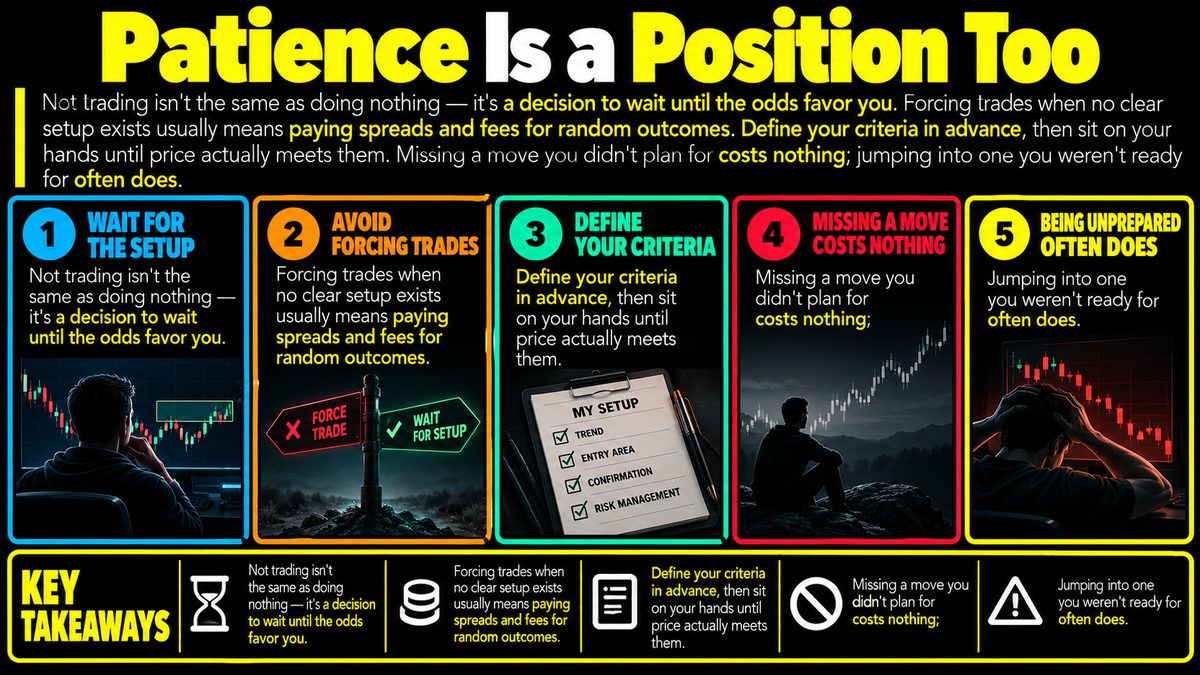
Not trading isn't the same as doing nothing — it's a decision to wait until the odds favor you. Forcing trades when no clear setup exists usually means paying spreads and fees for random outcomes. Define your criteria in advance, then sit on your hands until price actually meets them. Missing a move you didn't plan for costs nothing; jumping into one you weren't ready for often does.
Why Waiting Counts As An Action
Many new traders treat time spent not in a trade as wasted time. In reality, choosing to stay out of the market is just as much a decision as choosing to enter one. Every position carries risk, and every trade costs something, whether that is the spread (the small gap between the price you can buy at and the price you can sell at) or a transaction fee charged by the platform you use. When you hold cash or stay flat, you are not failing to participate, you are simply choosing not to pay those costs until you see a reason that justifies them.
This reframing matters because it changes what "doing something" means. A trader who sits patiently while watching a market that does not meet their criteria is actively managing risk. A trader who jumps in out of boredom or fear of missing out is the one actually taking an unmanaged gamble, even though it feels like action.
How Forced Trades Erode An Account
Imagine a coin trading around 100 that bounces between 98 and 102 for days with no clear direction. A trader who feels they must be in a position might buy at 101, get stopped out near 99, then buy again at 100 only to see it drift to 98. Each of these entries pays a spread or fee, and because there was no real edge, the outcomes are essentially random noise. Over many such trades, the small costs compound, and the account bleeds slowly even if no single loss looks dramatic.
This is the hidden danger of overtrading. It is rarely one catastrophic trade that damages an account, it is a steady drip of mediocre entries taken without a real reason, each one slightly tilted against the trader by fees and spreads.
Defining Criteria Before You Watch Price
The antidote is to decide, in advance and away from the heat of a moving chart, what conditions would actually make a trade worth taking. This might include a specific chart pattern completing, a price level being tested and holding, or a combination of signals from different tools lining up. The key is that these criteria are written down or clearly held in mind before you start watching the market, not invented in the moment to justify an impulse.
Once criteria exist, the trader's job during market hours becomes simple to describe, even if hard to practice: watch, and only act when price actually meets the predefined conditions. If it does not, the correct action is no action at all.
The Asymmetry Between Missing And Forcing
A move you did not plan for and therefore did not take costs you nothing beyond the discomfort of watching it happen without you. A move you forced your way into without real justification can cost you money, confidence, and clarity for the next decision. These two outcomes are not equivalent, even though missing a big move often feels far worse in the moment than taking a small avoidable loss.
Recognizing this asymmetry is part of building emotional discipline. Fear of missing out pushes traders toward action, but the actual math of trading rewards selectivity far more than it rewards constant participation.
Patience As Part Of A Larger System
Patience is not a standalone strategy, it works alongside other tools such as risk management rules, position sizing, and whatever method you use to analyze charts or markets. None of these guarantee a profitable outcome, and no pattern or signal works every time. What patience does is reduce the number of low quality decisions you make, leaving room for your other tools to be applied when conditions are actually favorable rather than constantly diluted by noise.