
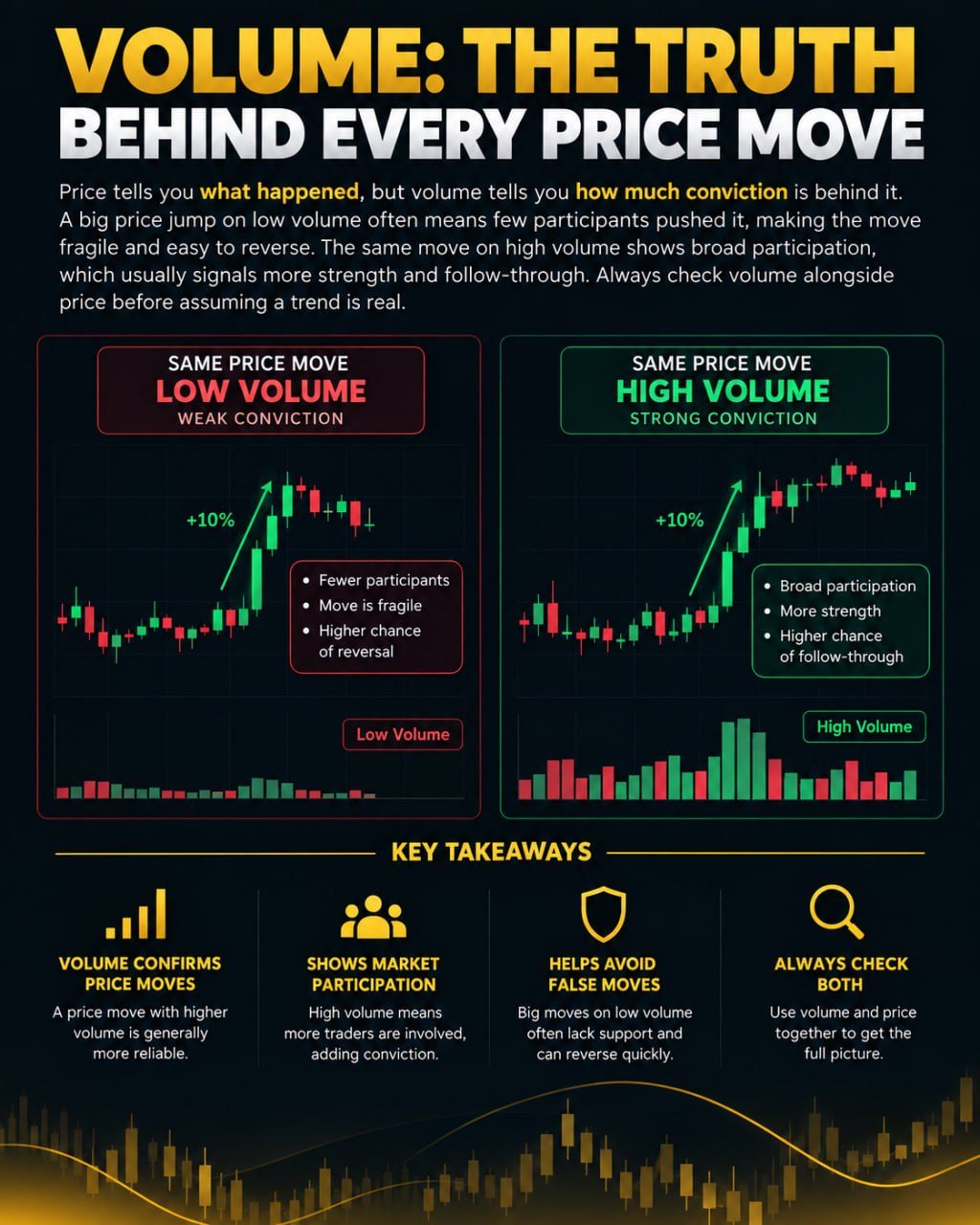
Price tells you what happened, but volume tells you how much conviction is behind it. A big price jump on low volume often means few participants pushed it, making the move fragile and easy to reverse. The same move on high volume shows broad participation, which usually signals more strength and follow-through. Always check volume alongside price before assuming a trend is real.
What Volume Actually Measures
Volume is simply a count of how many units of a coin changed hands over a given period, like an hour, a day, or a week. It says nothing about direction on its own. Instead, it tells you the intensity of activity behind whatever price did during that period. Think of price as the story and volume as the number of people who showed up to write it.
Every trade needs a buyer and a seller, so volume never tells you whether "buyers" or "sellers" won in some absolute sense. What it tells you is how many participants were willing to transact at the prices being offered. When volume is high, a lot of people agreed to trade at those levels. When volume is low, only a handful did, and the resulting price move may not reflect what the broader market actually thinks.
Why Low Volume Moves Can Be Fragile
Imagine a coin trading calmly around 100, then suddenly jumping to 110 in an hour on very thin volume, meaning very few units actually traded. That jump could be caused by just one or two large orders hitting an order book that had little depth at that moment. Because so few participants were involved, there is no strong evidence that the broader market agrees the coin is worth 110. A single seller could push it back down just as easily as the original move happened.
This is why traders often treat low volume rallies or drops with skepticism. The move might be real information, or it might just be noise created by a temporary imbalance in a thin order book. Without volume confirmation, it is hard to tell which one you are looking at.
Why High Volume Moves Carry More Weight
Now imagine that same move from 100 to 110, but this time it happens with a large number of participants trading throughout the move. That tells a different story: many independent buyers were willing to pay increasingly higher prices, and many sellers were willing to let go of their coins at those levels too. Broad participation like this suggests the new price level reflects a genuine shift in how the market values the asset, at least for now.
High volume does not guarantee the move continues, but it does suggest the move was not an accident of a thin order book. Traders often look for volume to expand during breakouts from a trading range or a chart pattern, treating that expansion as a rough form of confirmation that the move has real backing.
Common Ways Traders Use Volume
Many traders compare current volume to a recent average to judge whether activity is unusually high or low. Others watch for volume spikes at key support or resistance levels, since a breakout on heavy volume is generally read differently than one on light volume. Volume is also used to spot divergences, such as a price making a new high while volume shrinks, which some traders interpret as weakening momentum.
Limitations and Common Mistakes
Volume data can vary in quality and coverage across different trading venues, and combining figures from multiple sources without care can be misleading. Volume also does not explain why people traded, so it cannot tell you if activity was driven by news, automated strategies, or something else entirely. Treating any single volume reading as a guarantee of future direction is a common and costly mistake.
Fitting Volume Into a Broader Approach
Volume works best as one input among several, alongside price structure, broader trend context, and a trader's own risk management rules, such as position sizing and stop losses. No indicator, including volume, can predict the future with certainty, and every trader should be cautious about treating patterns as guarantees rather than probabilities.