
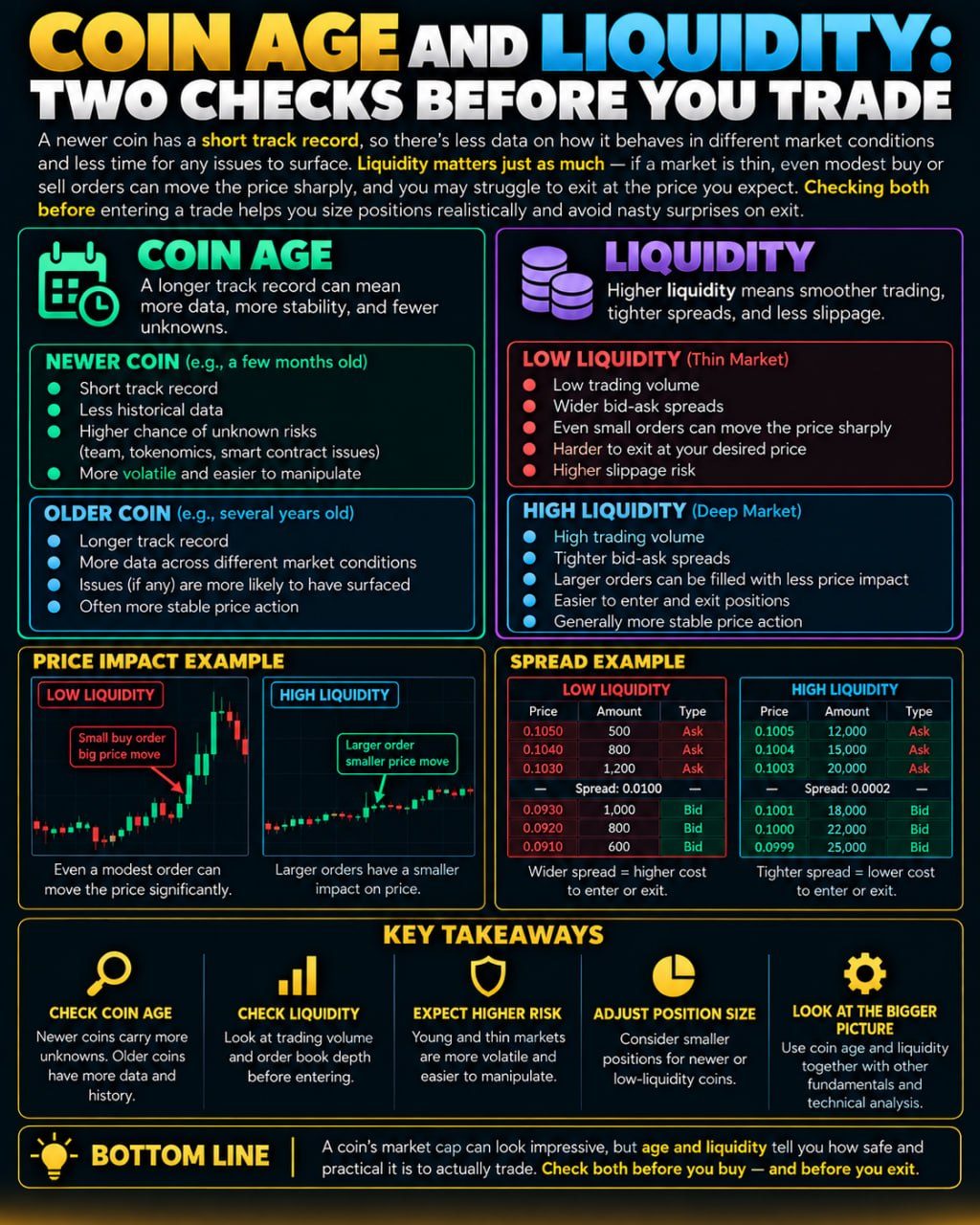
A newer coin has a short track record, so there's less data on how it behaves in different market conditions and less time for any issues to surface. Liquidity matters just as much — if a market is thin, even modest buy or sell orders can move the price sharply, and you may struggle to exit at the price you expect. Older, more liquid markets tend to have tighter spreads and steadier price action, while thin, young markets carry more slippage risk. Checking both before entering a trade helps you size positions realistically and avoid nasty surprises on exit.
Why Coin Age Matters
When a coin has only existed for a few weeks or months, there simply hasn't been enough time to see how it behaves across different market conditions. A coin that launched during a calm, rising market has never been tested during a sharp downturn or a period of panic selling. This isn't necessarily a red flag, but it means you're trading with less historical evidence to lean on than you would with something that has survived multiple market cycles.
Age also gives problems time to surface. Bugs in the underlying code, weaknesses in how the project is governed, or issues with how tokens are distributed among early holders often take months or years to become visible. A newer project simply hasn't had that window. That doesn't mean an older coin is automatically safe either, just that it has had more opportunities to reveal issues, and hasn't yet shown the ones we know about.
Understanding Liquidity
Liquidity describes how easily an asset can be bought or sold without significantly moving its price. In a liquid market, there are lots of buyers and sellers with orders sitting close to the current price, so a typical trade gets filled near where you expected. In a thin or illiquid market, there may be very few orders on either side, so even a modest trade can push the price noticeably higher when buying or lower when selling.
Imagine a coin trading at 100, but the order book only has enough sell orders to fill your buy up to 105 before running out. If you place a larger order, you end up paying an average price well above 100, simply because your own trade consumed the available supply. This gap between the price you expected and the price you actually got is called slippage, and it tends to be worse in thin markets and larger position sizes.
How Age and Liquidity Tend to Connect
Generally, coins that have been trading longer have had more time to attract a broad base of buyers and sellers, which tends to produce deeper order books and tighter spreads, meaning a smaller gap between the highest buy offer and the lowest sell offer. Newer coins often start with thin liquidity because there are fewer participants and less capital committed to trading them yet.
This is a tendency, not a rule. Some older coins remain thinly traded for years, and some new coins attract heavy trading volume quickly. That's why checking both age and liquidity separately, rather than assuming one implies the other, gives you a clearer picture before entering a position.
Practical Checks Before Trading
Before entering a trade, it helps to look at the trading volume over recent days, the depth of the order book at various price levels, and the size of the spread. If your intended trade size is large relative to what's typically traded, you're more likely to experience slippage on both entry and exit. Sizing your position to fit comfortably within normal market depth is a simple way to reduce this risk.
It's also worth remembering that liquidity can change quickly. A market that looks deep during calm conditions can thin out fast during high volatility, when many participants pull their orders at once. This means even careful checks are only a snapshot, not a guarantee of how conditions will look when you actually try to exit.
Fitting This Into Risk Management
Coin age and liquidity checks are just two inputs among many, alongside position sizing, diversification, and having a clear plan for both entry and exit. Neither factor predicts future price direction, and neither can protect you from the underlying volatility and uncertainty of crypto markets generally. Treat them as basic due diligence steps that reduce avoidable surprises, not as signals that guarantee a favorable outcome.