
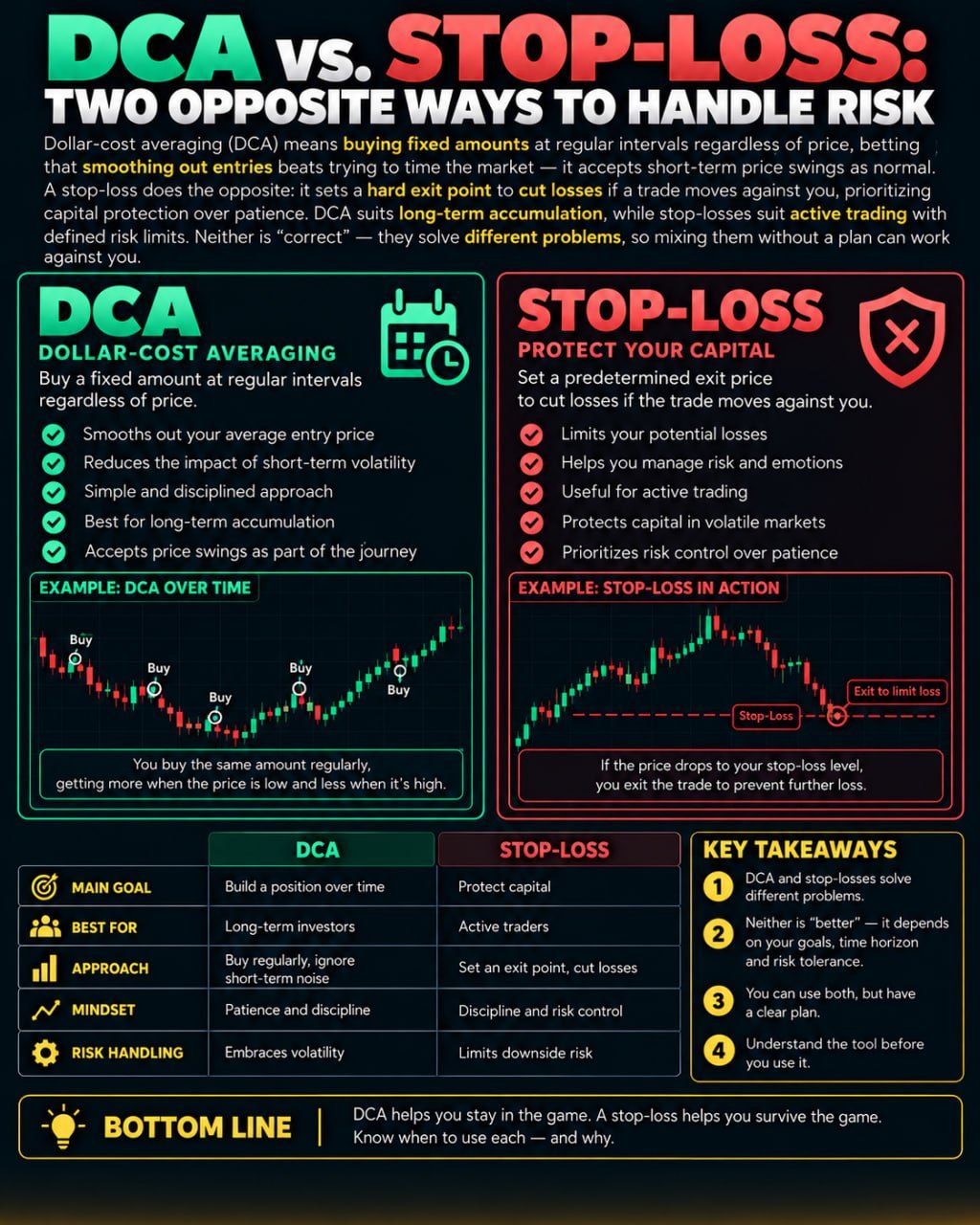
Dollar-cost averaging means buying fixed amounts at regular intervals regardless of price, betting that smoothing out entries beats trying to time the market — it accepts short-term price swings as normal. A stop-loss does the opposite: it sets a hard exit point to cut losses if a trade moves against you, prioritizing capital protection over patience. DCA suits long-term accumulation, while stop-losses suit active trading with defined risk limits. Neither is "correct" — they solve different problems, so mixing them without a plan can work against you.
What Each Approach Actually Does
Dollar-cost averaging, often shortened to DCA, is a method where you buy a fixed amount of an asset at set time intervals, such as a small sum every week or month, no matter what the price is doing at that moment. The idea is that over many purchases, your average entry price smooths out, so you avoid the risk of putting all your money in at a single bad moment. It is fundamentally a strategy about entries and accumulation over time.
A stop-loss is different in purpose. It is an order or rule that automatically closes a position once the price falls to a level you chose in advance, limiting how much you can lose on that specific trade. Where DCA is about building a position patiently, a stop-loss is about defending capital once a position already exists and something has gone wrong.
Why They Exist for Different Problems
DCA assumes that short-term price swings, sometimes called volatility, are normal and unpredictable, and that trying to guess the perfect entry point is often a losing game. By spreading purchases out, a trader accepts they will buy some amounts at higher prices and some at lower prices, without needing to forecast anything.
A stop-loss assumes the opposite kind of uncertainty: once you are in a trade, you cannot know whether it will recover or keep falling, so you decide in advance how much downside you are willing to tolerate before walking away. It is a risk-limiting tool for active positions, not a way to find good entries.
How Traders Typically Use Them
Someone practicing DCA usually has a longer time horizon and treats each purchase as one piece of a larger plan, largely ignoring day-to-day price movement. For example, a trader might decide to buy a fixed hypothetical amount, like putting in 50 units of currency every two weeks, regardless of whether the asset is up or down that day.
A trader using stop-losses is usually more active, often holding a position for a shorter period and watching it closely. Before entering, they might decide that if the price drops a certain percentage below their entry, say a hypothetical 10 percent, they will exit automatically to cap the damage rather than hoping for a reversal.
Common Mistakes and Limitations
A frequent mistake is applying DCA to money a person cannot actually afford to hold through prolonged downturns, turning a calm long-term plan into a source of stress. DCA also does not protect against an asset losing most or all of its value over the long run; it only smooths entry prices, it does not guarantee a profitable outcome.
Stop-losses carry their own pitfalls. Setting them too tight can mean normal, harmless price wiggles trigger an exit before the trade has a chance to work, while setting them too loose defeats their purpose of limiting losses. In fast-moving or thin markets, the price can also skip past a stop level, meaning the actual exit price is worse than planned.
Combining Them Without Working Against Yourself
Mixing the two without a clear plan can cause confusion, such as setting a stop-loss on a position that was meant to be a long-term DCA holding, which may force an unwanted early exit during ordinary volatility. Traders who want both approaches generally separate their capital and intentions clearly, treating long-term accumulation and active trading as distinct activities with their own rules.
Neither DCA nor a stop-loss removes risk or guarantees a result. Both are tools for managing uncertainty in different contexts, and their usefulness depends on matching the tool to the goal, the time horizon, and how much loss a trader is genuinely prepared to accept.