
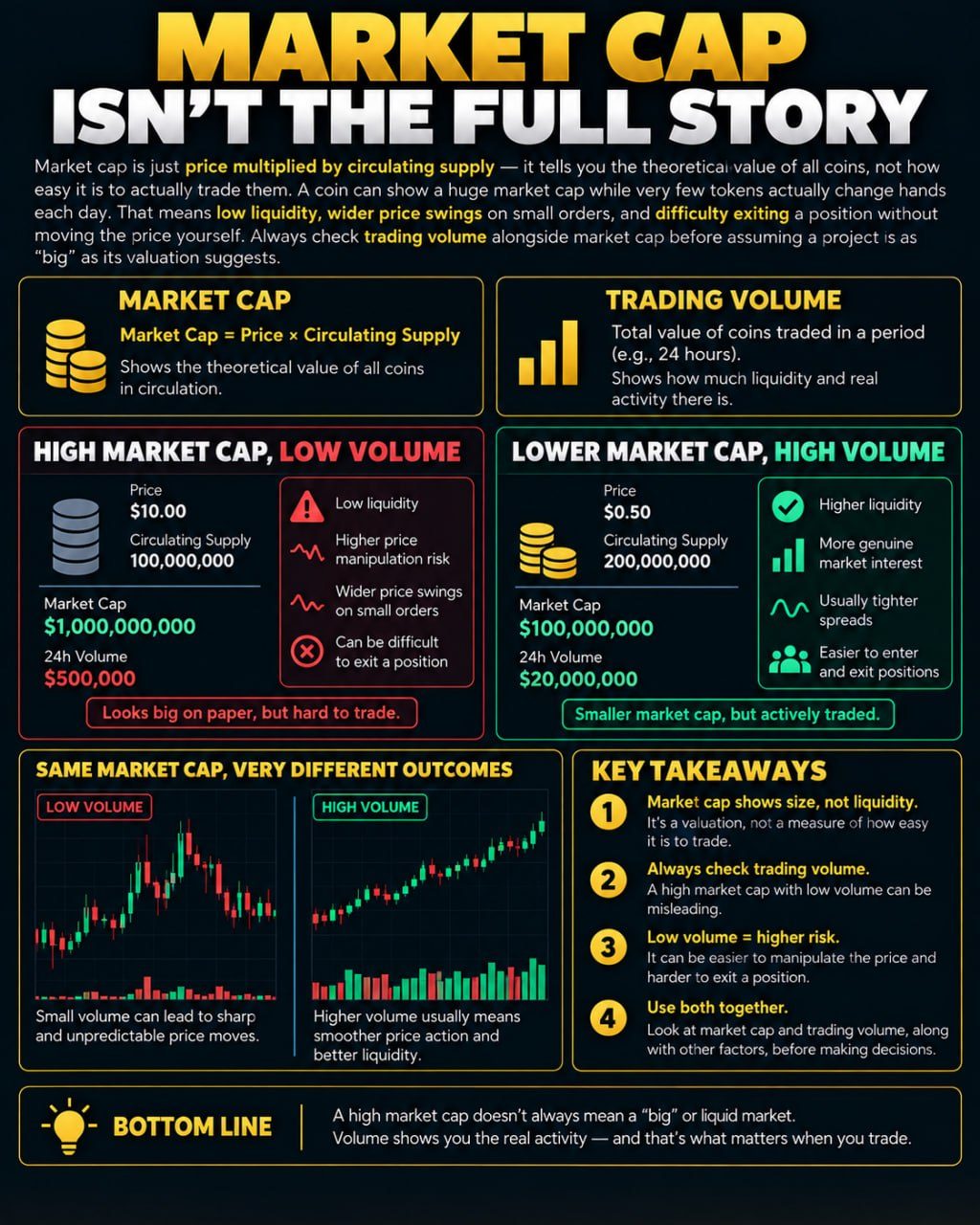
Market cap is just price multiplied by circulating supply — it tells you the theoretical value of all coins, not how easy it is to actually trade them. A coin can show a huge market cap while very few tokens actually change hands each day. That means low liquidity, wider price swings on small orders, and difficulty exiting a position without moving the price yourself. Always check trading volume alongside market cap before assuming a project is as "big" as its valuation suggests.
What Market Cap Actually Measures
Market capitalization, or "market cap," is calculated by multiplying a coin's current price by its circulating supply, which is the number of coins currently available and moving in the market, excluding any that are locked, reserved, or not yet released. The result is a single number meant to represent the total value of all coins in existence at that price. It is a useful starting point for comparing the rough size of different projects, similar to how market cap is used to compare companies in traditional markets.
However, this number is theoretical. It assumes every single coin could be sold at the current price, which is rarely true in practice. If even a small percentage of holders tried to sell at once, the price would likely drop significantly before all those coins found buyers. So market cap tells you a story about scale, not about how tradable or stable that value actually is.
Why Volume Tells a Different Story
Trading volume measures how many coins actually changed hands over a given period, usually 24 hours. This is a very different concept from market cap. A coin can have an enormous market cap because its price is high and its supply is large, while very few coins are actually being bought or sold on any given day. This mismatch is a sign of low liquidity, meaning there are not enough active buyers and sellers to absorb trades smoothly.
Low liquidity has real consequences. Even a modestly sized order can move the price noticeably, a phenomenon often called slippage, where the price you actually pay or receive differs from the price you saw before placing the trade. In illiquid markets, trying to exit a position can itself push the price down further, meaning a trader effectively works against their own order.
How Traders Commonly Use Both Metrics Together
Experienced traders rarely look at market cap alone. They compare it against volume to get a sense of how "active" a coin really is relative to its stated size. A coin with a high market cap and proportionally strong daily volume suggests broad participation and generally easier entry and exit. A coin with a high market cap but tiny volume suggests the opposite: a valuation that looks impressive on paper but is hard to act on in practice.
Some traders also look at how volume is spread across different price levels or order sizes, sometimes called market depth, to judge whether large trades could be absorbed without major price impact. This kind of check is especially important before placing sizable orders.
Common Mistakes and Limitations
A frequent mistake is assuming that a large market cap automatically means safety, stability, or ease of trading. It does not. Market cap can also be distorted by unusual supply structures, such as a small circulating supply with a much larger total supply waiting to be released later, which can affect future price behavior in ways the current market cap does not reflect.
Volume figures themselves are not perfect either. They can sometimes be inflated through artificial trading activity, so a healthy-looking volume number should still be interpreted with some caution rather than taken at face value.
Fitting This Into a Broader Risk Approach
Market cap and volume are just two data points among many, including price trends, order book depth, and overall market conditions. Neither metric, nor any combination of indicators, can guarantee future price behavior or eliminate risk. They are tools for building a more complete picture, not shortcuts to certainty.
Sensible risk management still applies regardless of how large or liquid a coin appears, including position sizing, understanding potential slippage, and never committing more than one is prepared to lose. Treating market cap as the full story, rather than one piece of a larger puzzle, is one of the easier mistakes to avoid once you know to look deeper.