
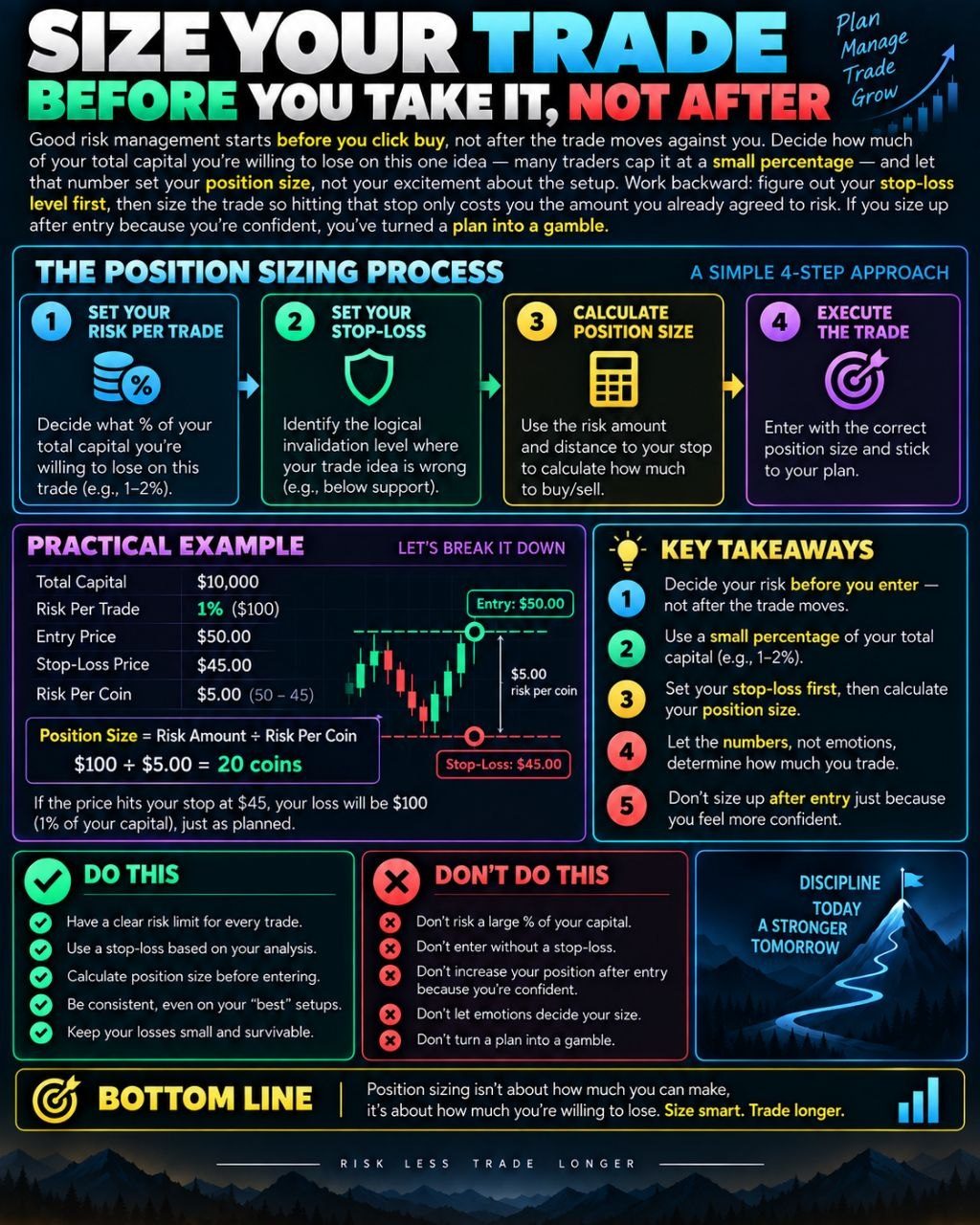
Good risk management starts before you click buy, not after the trade moves against you. Decide how much of your total capital you're willing to lose on this one idea — many traders cap it at a small percentage — and let that number set your position size, not your excitement about the setup. Work backward: figure out your stop-loss level first, then size the trade so hitting that stop only costs you the amount you already agreed to risk. If you size up after entry because you're confident, you've turned a plan into a gamble.
Why Sizing Comes First
Most new traders pick a coin, decide they like the setup, and then figure out how much to buy based on how much cash they have sitting around or how confident they feel. This backward approach means the trade's risk is essentially random. Position sizing done properly flips this order. Before you enter anything, you decide exactly how much money you are willing to lose if the trade goes wrong, and that number determines everything else about the trade, including how many coins or contracts you actually buy.
This matters because two trades that look identical on a chart can carry completely different levels of risk depending only on size. A setup is not risky or safe in isolation. It becomes risky or safe based on how much of your capital is exposed to it.
The Stop-Loss Comes Before the Size
A stop-loss is a predetermined price at which you exit a losing trade to prevent further loss. Rather than picking a trade size and then wondering where to place a stop, work in the opposite direction. First identify the price level where your original idea would be proven wrong, whatever that means for your strategy, whether it is a technical level, a percentage move, or a structural point on the chart. That level becomes your stop.
Once you know the distance between your entry and your stop, in percentage terms, you can calculate the position size that makes that distance equal your predetermined risk amount. For example, imagine you decide you are only willing to lose 1 percent of your total trading capital on a single idea. If your entry is 100 and your stop is 90, that is a 10 percent move. To make that 10 percent move cost only 1 percent of your capital, you would size the position so it represents roughly one tenth of your account, not your entire balance.
Picking a Risk Percentage
There is no single correct number, but many traders cap risk per trade somewhere in the low single digits, often between half a percent and two percent of total capital. The exact figure depends on your strategy, how many trades you take, and your own tolerance for drawdowns, meaning periods where your account value declines. The point of choosing a small, consistent percentage is that no single trade, even a string of several losing trades in a row, should be able to meaningfully damage your account.
Why Confidence Should Not Change Size
A common mistake is treating conviction as a reason to increase size after entering a trade, sometimes called adding to a winner impulsively or doubling down on a loser hoping for a reversal. Confidence feels informative in the moment, but markets do not care how sure you are. Increasing size because a trade "feels right" turns a planned, repeatable process into something closer to gambling, where outcomes depend on emotion rather than a consistent method.
Limitations to Keep in Mind
Position sizing based on a stop-loss assumes the stop will actually be hit at or near the price you expect. In fast-moving or illiquid markets, meaning ones with fewer buyers and sellers, prices can gap or slip past your intended stop, causing a larger loss than planned. This is called slippage. Sizing rules also do not account for correlated positions, where several trades you hold might lose money at the same time for related reasons, effectively multiplying your real risk beyond what any single calculation shows.
Fitting It Into a Broader Plan
Sizing trades this way works best alongside other habits, including diversifying across uncorrelated ideas, keeping a trading journal, and periodically reviewing whether your chosen risk percentage still fits your goals. No sizing method, stop-loss placement, or indicator can guarantee a profitable outcome. The goal is simply to make sure that when a trade does go wrong, and eventually one will, the loss is something you already planned for rather than something that surprises you.