
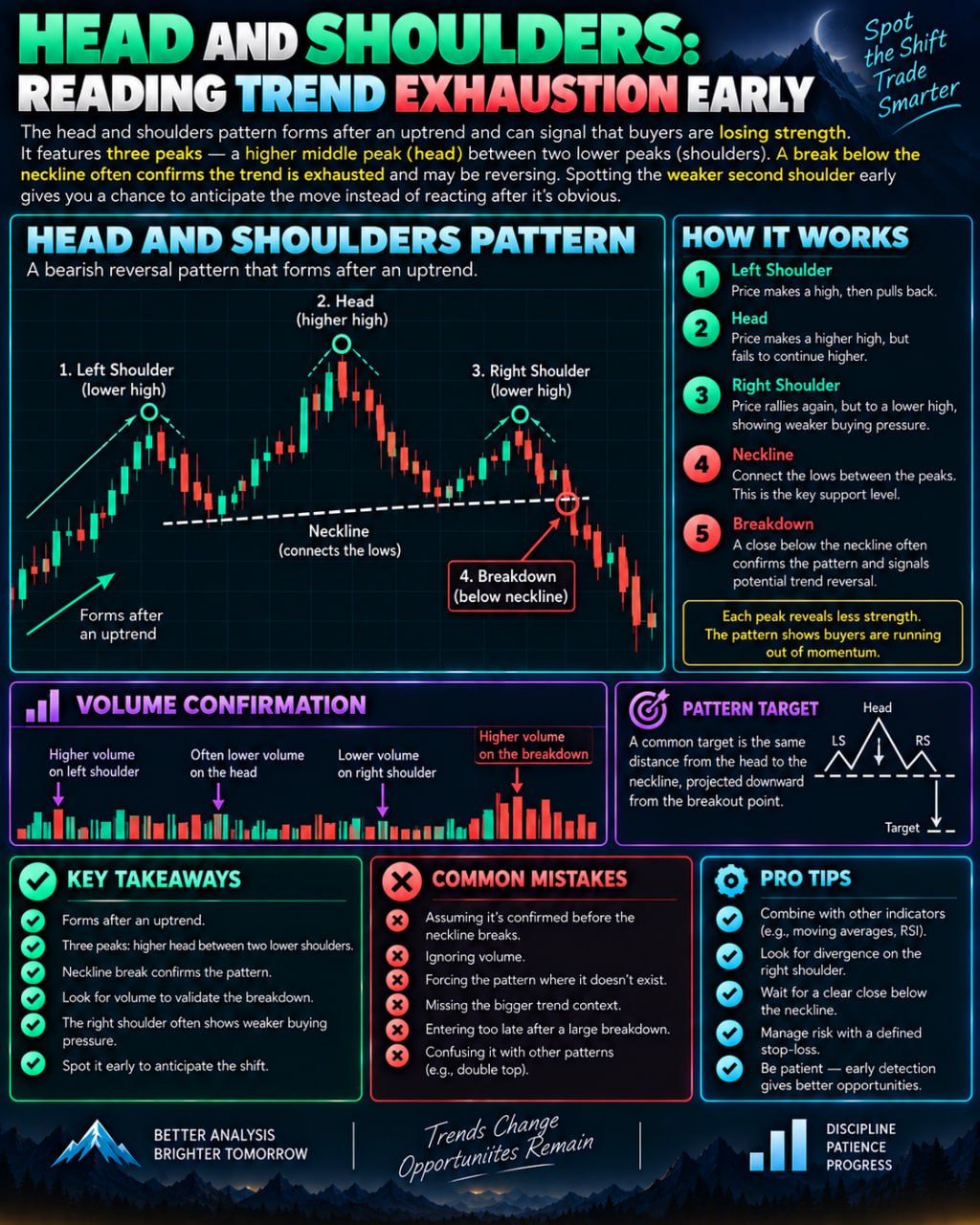
A head and shoulders pattern forms after an uptrend, with three peaks — a higher middle peak (head) flanked by two lower peaks (shoulders). Each peak fails to push much further, showing buyers are losing strength even as price makes a "higher high." The neckline connecting the lows between peaks is key — a break below it often confirms the trend is exhausted and reversing. Spotting the weakening second shoulder before the neckline breaks is what lets traders anticipate the shift rather than react after it's obvious.
What The Pattern Represents
A head and shoulders pattern is a way of visualizing a change in the balance between buyers and sellers after a sustained uptrend. Instead of price simply reversing in one sharp move, it forms three attempts to push higher. The first peak (the left shoulder) is followed by a pullback. Price then rallies again, forming a higher peak (the head), before pulling back once more. A final rally forms a third peak (the right shoulder) that fails to reach the height of the head, and then price pulls back again. The result, when you connect the two pullback lows, is a rough silhouette resembling a head with two shoulders on either side.
How It Forms Step By Step
The pattern reflects a gradual loss of momentum rather than a sudden event. During the left shoulder, buying is still strong and the higher high looks like a normal continuation of the uptrend. During the head, buyers push price to a new extreme, but often with less conviction, meaning volume or follow-through may be weaker even though the price itself is higher. By the right shoulder, buyers can no longer overcome sellers at the previous high, and the peak falls short. Each failed attempt to make a strong new high is a sign that demand is thinning out even while the overall trend still technically looks intact on the surface.
Reading The Neckline
The neckline is drawn by connecting the low points between the left shoulder and the head, and between the head and the right shoulder. This line acts as a rough support level throughout the pattern. Many traders treat a decisive close below the neckline as the point where the pattern is considered complete, since it suggests sellers have taken control of the level that previously held price up. Some traders also watch for the neckline to be retested from below after the break, treating that retest as another point of interest rather than a guarantee of continued decline.
Anticipating Versus Reacting
The real value some traders find in this pattern is not waiting for the neckline break, which is visible to everyone and already priced in for many participants, but noticing the weakening right shoulder as it forms. A right shoulder that struggles to approach the head's height, especially alongside declining participation or momentum readings, is an early clue that the uptrend may be running out of energy. Recognizing this earlier can change how a trader manages existing positions or thinks about risk, though it does not tell them what will happen next with certainty.
Common Mistakes And Limitations
A frequent error is spotting the pattern too early and assuming it will complete simply because two peaks resemble a shoulder and head. Patterns often fail partway through, with price making a new high instead of forming a proper right shoulder. Neckline breaks can also be false, with price dipping below and quickly recovering above it, trapping traders who acted the moment the line was touched. The pattern says nothing about how far a decline might go or how long it might take, and it works better as one piece of a broader read on market structure than as a standalone signal.
Fitting It Into A Trading Plan
Because no chart pattern guarantees an outcome, many traders combine head and shoulders analysis with volume trends, momentum indicators, or broader market context before drawing conclusions. Risk management matters more than the pattern itself, since even a textbook-looking formation can behave unpredictably. Treating this as one input among several, rather than a certainty, is generally considered a more realistic way to use it.