
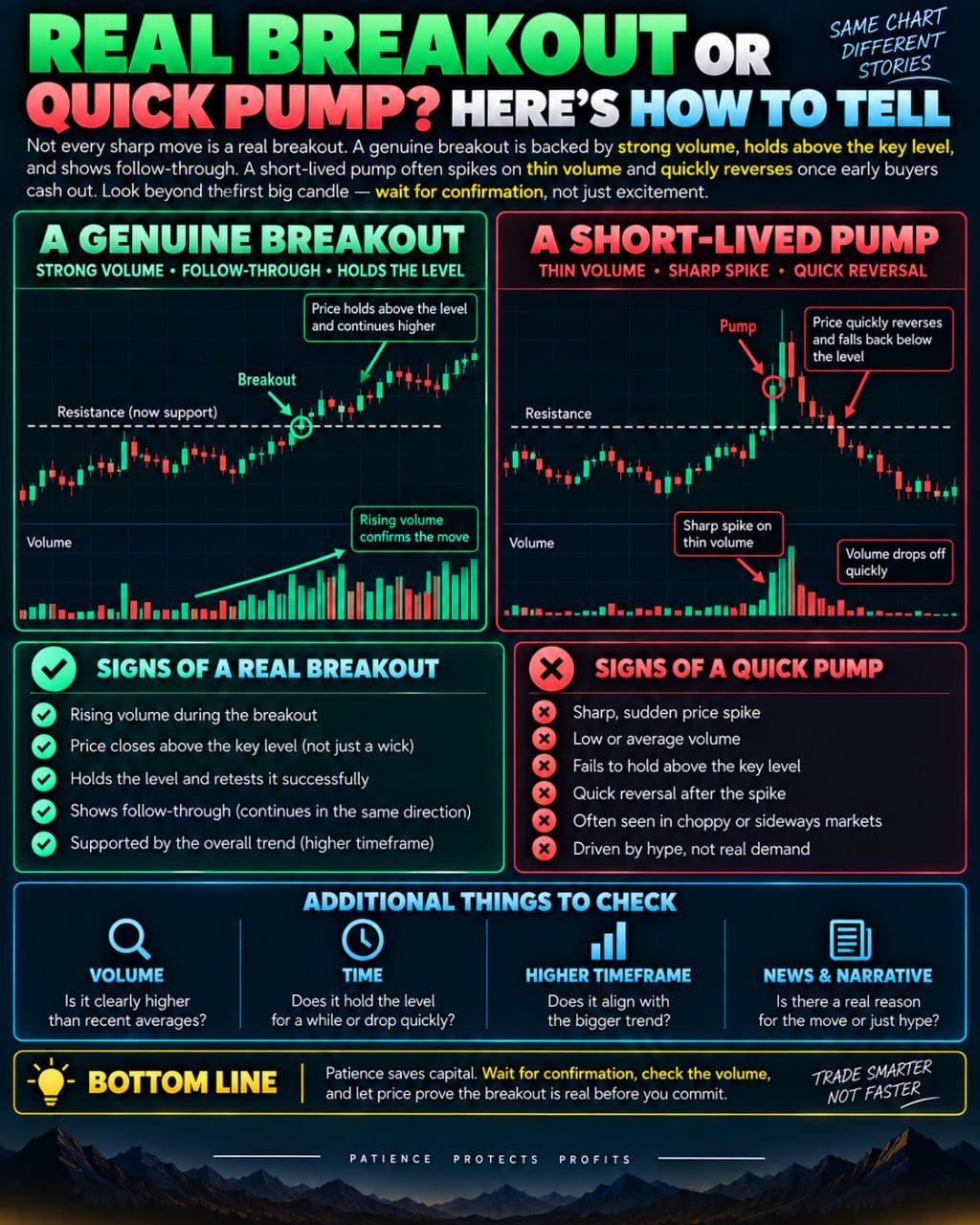
A genuine breakout usually comes with rising volume, as more traders confirm the move with real buying or selling. A short-lived pump often shows a sharp price spike on thin volume, followed by a fast reversal once early buyers cash out. Watch how price behaves after it clears a key level — holding above it for a while suggests strength, while an immediate snap-back signals a trap. Patience and waiting for confirmation beats chasing the first candle every time.
What a Breakout Actually Means
A breakout happens when the price of an asset moves beyond a level that had previously acted as a ceiling (resistance) or floor (support). These levels form because many traders place orders around the same price, either because it marks a prior high or low, or because it lines up with a chart pattern like a triangle or range. When price finally pushes through that level, it suggests that buyers or sellers have overwhelmed the orders that were holding the price back.
The key word is "suggests." A break of a level is just a price event. What happens in the minutes, hours, or days after the break is what tells you whether it reflects a genuine shift in supply and demand or just a brief imbalance that will not last.
Why Volume Matters So Much
Volume measures how much of the asset changed hands during a given period. It is often described as the fuel behind a price move. A breakout backed by rising volume means many participants are acting on the same idea at once, which makes the move more likely to be based on real conviction rather than a handful of large orders.
A pump on thin volume is different. Imagine a coin trading around 100 that suddenly spikes to 115 in a few minutes, but the total volume traded is small compared to its usual daily activity. That kind of move can be triggered by just one or two large orders, or by a wave of automated buying triggered by stop orders clustered above a resistance level. Because so few participants are actually involved, there is little real support for the new price, and it can unwind just as quickly as it appeared.
Reading Price Behavior After the Break
One of the most useful things to watch is not the breakout candle itself, but what price does afterward. If price clears a key level and then continues to trade above it, or pulls back toward that level and holds instead of falling through it, that is often read as a sign of strength. Traders sometimes call this a "retest," where the old resistance becomes new support.
If instead price pokes above the level for a moment and then immediately snaps back below it, this is often called a false breakout or a "trap," because it can catch traders who bought right at the break before reversing on them. No single retest or snap-back guarantees anything about the future, but the difference in behavior gives clues about how many participants are actually committed to the new price level.
Common Mistakes Traders Make
A frequent mistake is chasing the very first candle that breaks a level, out of fear of missing the move. This can mean buying right before a reversal, especially if the breakout occurred on low volume or during a period of low overall market activity. Another mistake is ignoring the broader context, such as whether the breakout lines up with news, overall market trend, or simply a quiet period where a small trade can move price disproportionately.
Relying on volume or price action alone also has limits. Volume data can be delayed or incomplete depending on the data source, and thin volume does not always mean a move will fail, just as high volume does not guarantee a move will hold.
Putting It Into a Wider Process
Waiting for confirmation, such as a retest or a period of holding above a level, generally means entering a position later and at a slightly worse price than chasing the initial move. Many traders view this trade-off as worthwhile because it reduces the chance of being caught in a false move.
None of this removes uncertainty. Breakouts, volume, and retests are tools for reading probability, not guarantees, and they work best alongside clear risk management, such as deciding in advance how much one is willing to lose on a trade.