
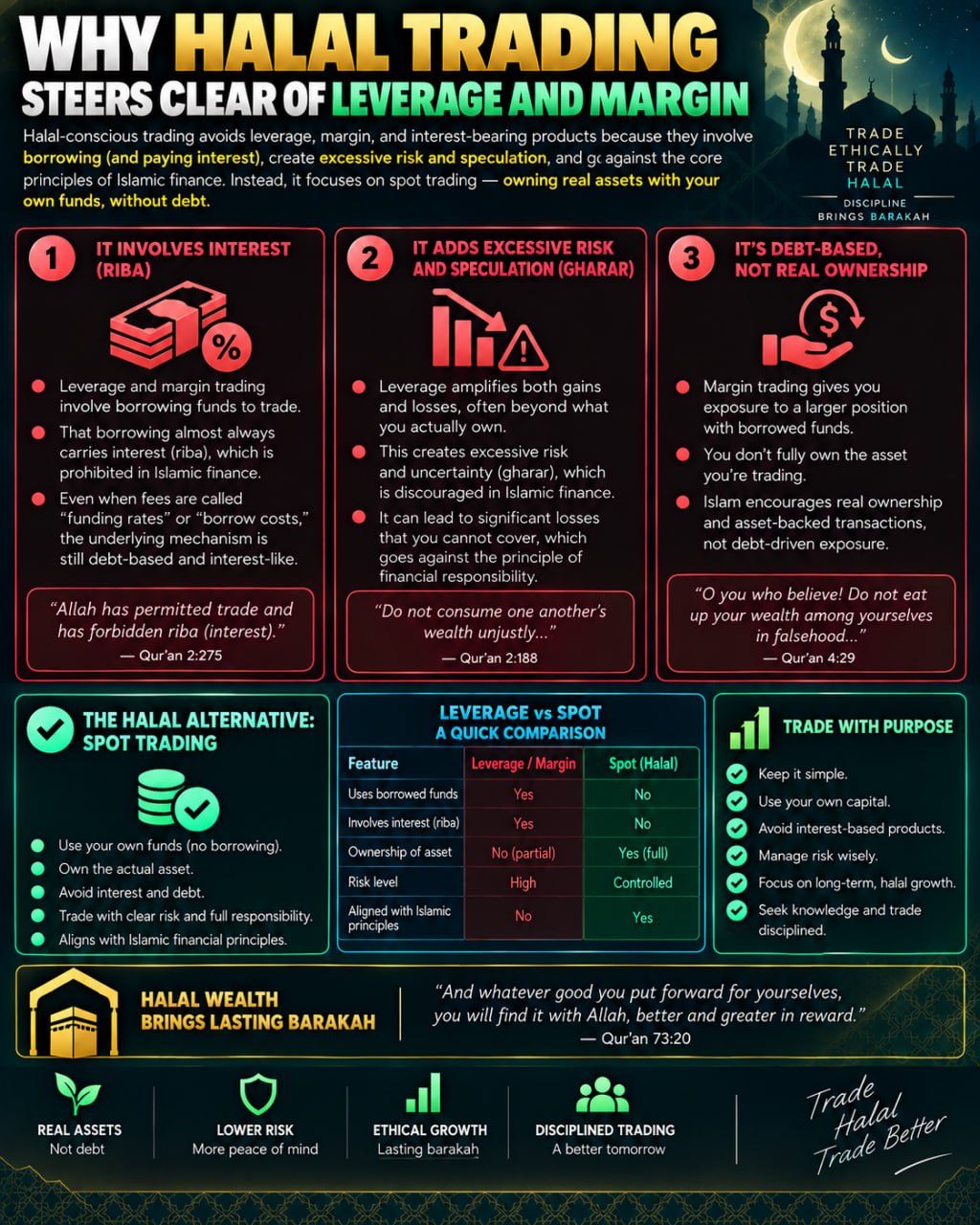
Leverage and margin trading involve borrowing funds to trade, and that borrowing almost always carries interest (riba), which is prohibited in Islamic finance. Even when fees are labeled as "funding rates" or "borrow costs" instead of interest, the underlying mechanism is still debt-based and interest-like. On top of that, leverage adds excessive risk and speculation (gharar), amplifying losses beyond what you actually own. Halal-conscious trading favors spot ownership of assets you fully pay for, avoiding both interest and debt-driven risk.
What Leverage And Margin Actually Are
Leverage means trading with more money than you actually have, by borrowing the difference from a broker or exchange. Margin is the collateral you put up to secure that loan. If you use 10x leverage with 100 units of your own money, you are effectively controlling 1,000 units of exposure, with the extra 900 borrowed. This can multiply gains, but it multiplies losses just as easily, and it introduces a lender into the trade who expects to be compensated for the risk of lending to you.
Where Interest Hides In These Products
That compensation almost always comes in the form of interest, even when the label sounds neutral. Perpetual futures contracts, a common leveraged product, use something called a funding rate, a periodic payment exchanged between long and short position holders to keep the contract price tied to the underlying asset. Margin trading platforms charge a borrow cost or overnight fee for the funds you have borrowed. These terms avoid the word interest, but the mechanism is the same, a charge tied to time and borrowed capital, which is functionally riba, the prohibited practice of earning or paying a premium simply for lending or borrowing money.
The Problem Of Gharar And Excess Risk
Beyond interest, Islamic finance is also cautious about gharar, meaning excessive uncertainty or speculation that resembles gambling more than genuine trade or investment. Leverage inherently amplifies this. A small price move that would be minor for a spot holder, someone who owns the asset outright, can wipe out an entire leveraged position and sometimes more, triggering forced liquidation, where the platform automatically closes your trade because your collateral can no longer cover potential losses. This kind of magnified, borrowed-money exposure is seen as introducing a level of speculative risk that goes beyond reasonable commercial risk-taking.
Why Spot Ownership Is The Preferred Alternative
Spot trading means buying an asset outright with money you already have, and owning it directly rather than through a borrowed or synthetic position. There is no lender, no interest charge, and no risk of liquidation beyond the value of what you put in. If a spot holding drops in value, the loss is limited to the amount invested, not amplified by debt. This aligns more naturally with the halal-conscious preference for real ownership and shared, proportionate risk rather than debt-driven speculation.
Common Mistakes And Practical Limitations
A frequent mistake is assuming that renaming a fee removes its underlying nature, for example treating a funding rate as automatically permissible because it is not called interest. Another is underestimating how leverage changes the emotional experience of trading, since larger swings in account value can push people toward impulsive decisions. It is also worth remembering that avoiding leverage does not eliminate risk entirely, spot assets can still lose significant value, and no approach removes the basic uncertainty of markets.
Putting It Into A Broader Risk Framework
Choosing spot over leveraged products is one piece of a wider risk management approach, not a complete strategy on its own. Position sizing, meaning how much of your capital you commit to any single trade, diversification, and a clear understanding of an asset before buying it all remain important regardless of whether leverage is involved. Avoiding interest-based and highly speculative structures addresses a specific religious and structural concern, but it works best alongside careful, patient, and well-researched decision-making rather than replacing it.