
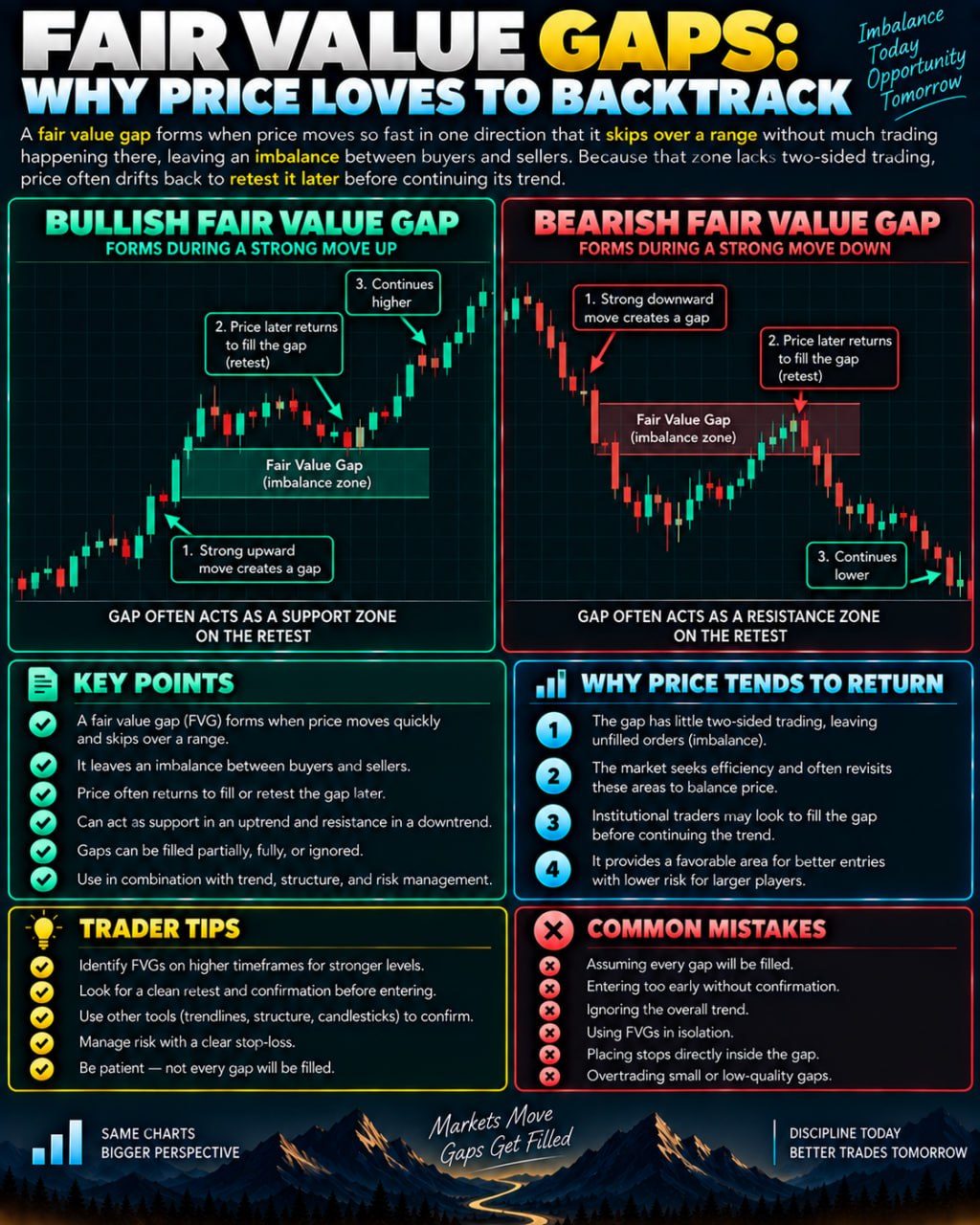
A fair value gap forms when price moves so fast in one direction that it skips over a range without much trading happening there, leaving an "imbalance" between buyers and sellers. Because that zone lacks two-sided trading, price often drifts back to retest it later before continuing its trend, as the market seeks efficiency. Traders watch these gaps as potential areas of interest, not guarantees — price can fill them partially, fully, or ignore them entirely. Always combine this concept with broader trend and risk management rather than trading it in isolation.
What Counts As A Fair Value Gap
A fair value gap, often shortened to FVG, shows up on a price chart when a market moves so sharply in one direction that it leaves behind a visible hole in trading activity. Picture three candles in a row on a chart. If the first candle's high and the third candle's low do not overlap, the space between them is the gap. That space represents an area where very few trades happened because price moved through it too quickly for buyers and sellers to properly meet.
Under normal conditions, price moves in a back-and-forth way, with buyers and sellers regularly trading at each level. That constant back-and-forth is what people mean by two-sided trading. When a fair value gap forms, that two-way exchange gets skipped over, leaving an imbalance, meaning one side, either buyers or sellers, was clearly in control for that stretch, and the other side barely got a chance to participate.
Why Price Tends To Revisit These Zones
The idea behind fair value gaps rests on a concept sometimes called market efficiency, the notion that markets tend to smooth out imbalances over time rather than leave them unresolved forever. Because the skipped zone lacks a fair two-sided auction, some traders believe price has an incentive to return there later, allowing orders on both sides to be filled at levels they missed the first time.
This is why gaps are often called areas of interest rather than certainties. Price may return to a gap hours later, days later, or not at all. When it does return, it might only dip into the edge of the zone, known as a partial fill, or it might travel all the way through it, known as a full fill, before resuming its original direction.
How Traders Commonly Use Them
Many traders mark fair value gaps on their charts as potential zones where price could pause, reverse briefly, or offer a more favorable entry point within an existing trend. For example, imagine a coin trending upward that suddenly jumps from 100 to 106 in one fast move, leaving a gap between 101 and 104. A trader watching that trend might view a pullback into that gap as a possible spot to reassess conditions, rather than assuming price must go there.
Some traders also use fair value gaps alongside other structural clues, such as recent swing highs and lows, or areas where a lot of past trading volume occurred, to build a fuller picture instead of relying on the gap alone.
Common Mistakes And Limitations
A frequent mistake is treating every gap as if it guarantees a return visit. In reality, many gaps get partially filled, some never get touched again, and others get filled so quickly that reacting after the fact leaves little room to act. Another mistake is trading gaps in isolation, ignoring the broader trend or overall market condition, which can lead to fighting against a much stronger move.
Fair value gaps are also somewhat subjective. Different traders may draw slightly different boundaries depending on which candles they use, and gaps on shorter timeframes appear constantly, so filtering out meaningful ones from noise takes practice and judgment.
Fitting Gaps Into A Broader Strategy
Because no chart pattern or gap works reliably on its own, most experienced traders treat fair value gaps as one piece of a larger framework rather than a standalone signal. Combining them with trend direction, key support and resistance areas, and sound risk management, such as position sizing and predefined exit points, tends to matter far more than the gap itself. No concept discussed here guarantees future price behavior, and markets can and do ignore these zones entirely.