
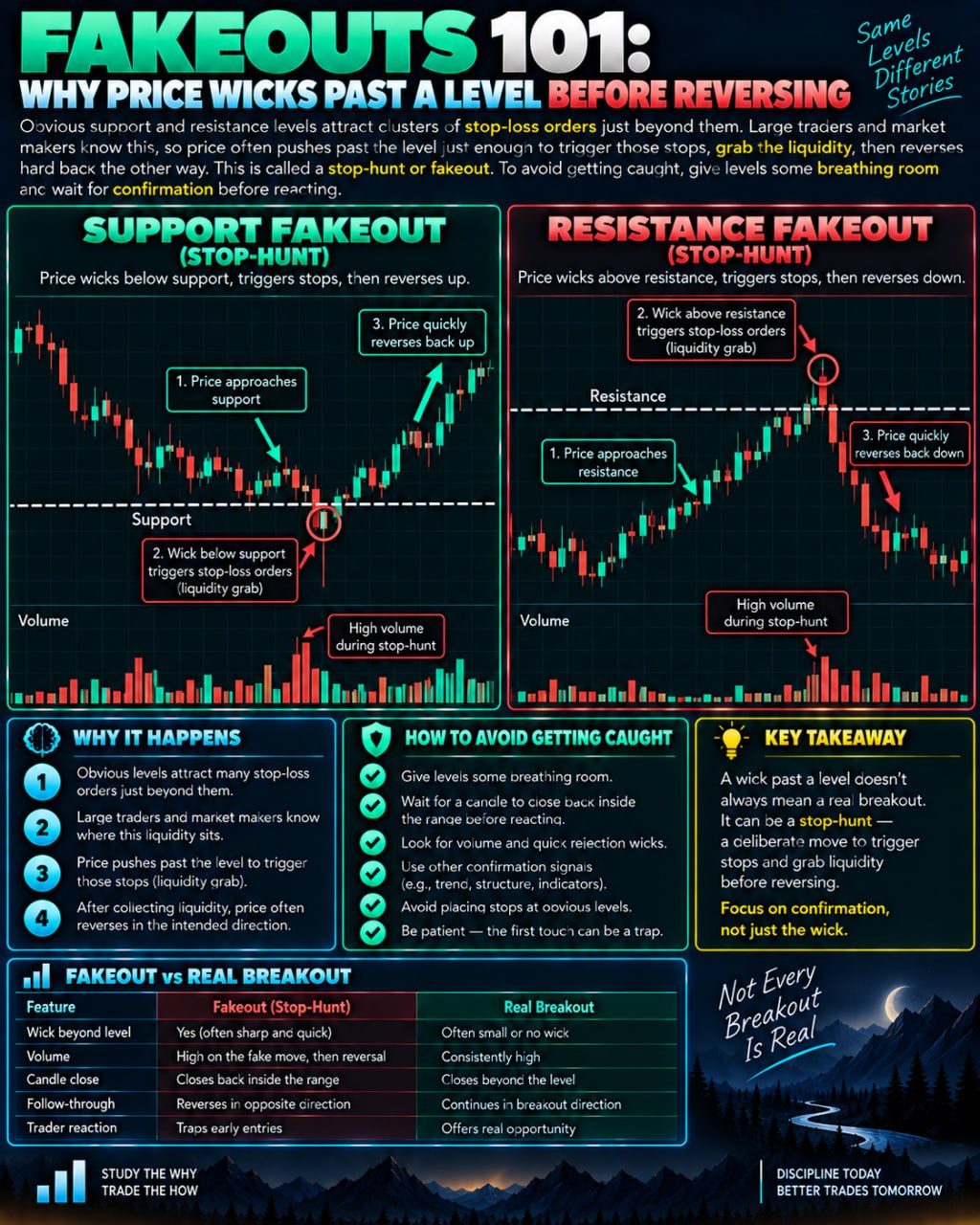
Obvious support and resistance levels attract clusters of stop-loss orders just beyond them. Large traders and market makers know this, so price often pushes past the level just enough to trigger those stops, grab the liquidity, then reverses hard back the other way. This is called a stop-hunt or fakeout. To avoid getting caught, give levels some breathing room, wait for a candle to close back inside the range before reacting, and treat the first touch of a "clean" level with caution rather than certainty.
What A Fakeout Actually Is
A fakeout happens when the price of an asset appears to break through a well-known support level (a price floor where buying has previously stepped in) or resistance level (a price ceiling where selling has previously capped gains), only to snap back in the opposite direction shortly after. Traders who acted on the apparent breakout, buying a resistance break or selling a support break, often end up trapped on the wrong side of the move. The term "stop-hunt" is sometimes used interchangeably, because the brief push beyond the level is thought to be aimed at triggering stop-loss orders clustered there rather than reflecting a genuine shift in supply and demand.
How These Setups Tend To Form
Obvious support and resistance levels are, by definition, watched by a large number of market participants. Traders who bought near a support level commonly place stop-loss orders just below it, so that if the level truly fails, their losses are limited. Traders who shorted near resistance do the same just above it. Over time this creates a cluster, or pool, of pending orders sitting just beyond the visible level.
Large traders and automated systems are aware these pools exist. Pushing price slightly past the level can trigger that cluster of stop orders, which itself adds volume and momentum in the breakout direction. Once those orders are absorbed, there may be little genuine buying or selling interest left to sustain the move, so price can reverse sharply back through the level. Imagine a coin trading in a range between 90 and 100. If it briefly touches 101, triggers a wave of stop-losses from short sellers, and then falls back to 95, that spike to 101 is a textbook fakeout.
How Traders Try To Read Them
Because fakeouts are common around obvious levels, some traders treat the first touch of a "clean," heavily-watched level with caution rather than treating a break as automatically meaningful. One common practice is waiting for a candle, a chart element showing the open, high, low, and close for a set time period, to fully close back inside the prior range before concluding the breakout failed. Another is giving the level some breathing room, treating a zone rather than an exact price as the meaningful area, since exact pinpoint levels rarely hold precisely.
Volume and momentum are often checked alongside price. A break accompanied by unusually thin volume or a quick, sharp wick with no follow-through is viewed with more suspicion than a break that holds and builds momentum over several candles.
Common Mistakes And Limitations
A frequent mistake is reacting instantly to any touch or brief close beyond a level, without waiting for confirmation. Another is assuming every break is a fakeout, which can cause traders to fade genuine breakouts and miss real trend moves. Fakeouts are a pattern observed after the fact more easily than in real time, and there is no reliable way to know in advance whether a given break will reverse or continue. No indicator or heuristic guarantees the outcome, and markets can and do produce genuine breakouts that never look back.
Fitting This Into A Broader Approach
Recognizing fakeout risk is one input among many, not a standalone system. It works best alongside broader context such as the overall trend, other support and resistance zones, and basic risk management, including position sizing and predetermined stop-loss placement that accounts for the level's normal noise. Treating any single pattern as certain, rather than as one probability-weighted clue, tends to increase risk rather than reduce it.