
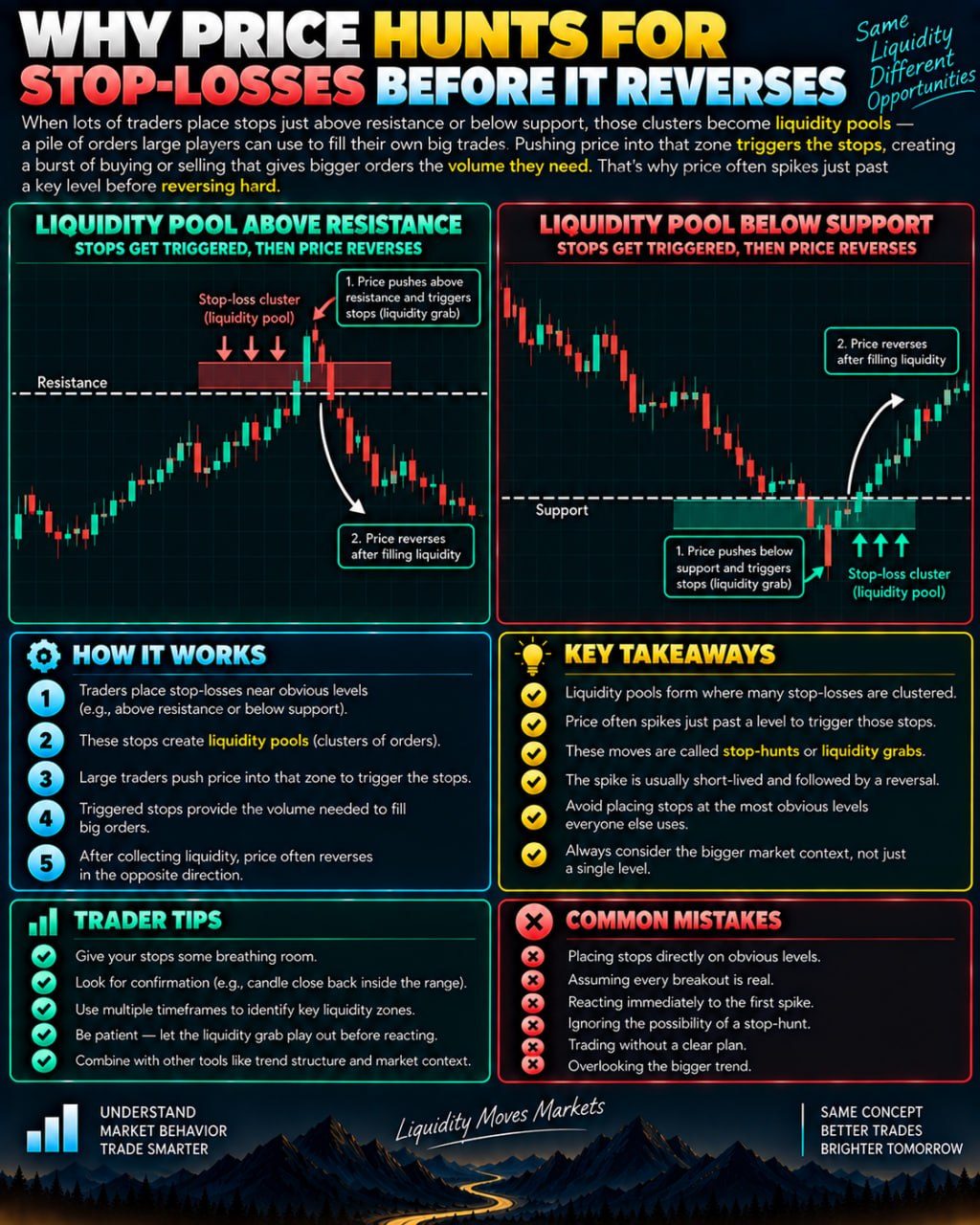
When lots of traders place stops just above resistance or below support, those clusters become "liquidity pools" — a pile of orders large players can use to fill their own big trades. Pushing price into that zone triggers the stops, creating a burst of buying or selling that gives bigger orders the volume they need. That's why price often spikes just past an obvious level before reversing hard. Understanding this helps you avoid placing stops at the most "obvious" spot everyone else uses.
What A Liquidity Pool Actually Is
A liquidity pool, in this context, has nothing to do with decentralized finance token pairs. It simply means a cluster of pending orders sitting at a similar price level. When a trader buys and sets a stop-loss, that stop-loss becomes a resting sell order sitting in the market until it is triggered. If hundreds or thousands of traders all place their stop-losses just above an obvious resistance level or just below an obvious support level, that creates a large pile of orders waiting to be executed at roughly the same price.
For someone who needs to fill a very large trade, this pile of orders is useful. A big buyer, for example, cannot always buy a huge amount at once without pushing the price up against themselves. But if price moves into a zone full of resting sell-stops, those stops convert into market sell orders, which the large buyer can absorb to fill their own position without needing every counterparty to want to sell voluntarily.
How The Hunt Typically Unfolds
Picture a coin trading in a range, with support sitting at a round number like 100. Many traders who bought above 100 place their stop-loss just under it, say at 98, because that is the "obvious" place everyone is taught to use. Price may drift down toward 100, hold for a while, then suddenly spike down to 97 or 96, triggering all those stops in a rush of selling, before snapping back above 100 within minutes or hours.
That sharp poke below the level and quick reversal is often described as a stop hunt or a liquidity grab. It is not necessarily a deliberate conspiracy every single time; it can also emerge naturally from the mechanics of thin order books, where a modest amount of aggressive selling is enough to sweep a crowded area and then run out of fuel, allowing price to reverse once the forced selling is exhausted.
How Traders Try To Read It
Some traders watch for a fast, sharp wick through a well-known level followed by an equally fast move back inside the prior range as a sign that the move was driven by stop triggering rather than genuine sustained conviction. They may wait for price to close back above or below the level, rather than reacting to the wick itself, treating the sweep as a shakeout instead of a real breakout.
Others use this idea to think differently about placing their own stops, avoiding the single most obvious round number or exact swing point, and instead giving the trade a little extra room, or basing the stop on volatility or account risk rather than mimicking the crowd exactly.
Limitations And Common Mistakes
None of this is guaranteed or provable in real time. A sharp move past a level can just as easily be the start of a genuine breakout that keeps going, not a hunt that reverses. Traders who assume every wick is a fakeout can end up holding losing positions far longer than planned, waiting for a reversal that never comes.
It is also a mistake to treat this concept as a trading signal on its own. It describes a possible mechanism behind price behavior, not a repeatable setup with defined entries and exits.
Fitting It Into A Wider Approach
This idea works best alongside broader context such as trend direction, volume, and overall market structure, rather than in isolation. Risk management still matters most: position sizing, acceptable loss per trade, and not moving stops emotionally after entering a position. Understanding why price sometimes overshoots a level before reversing can make a trader more patient and less surprised, but it does not remove uncertainty, and no single concept can predict what price will do next with certainty.