
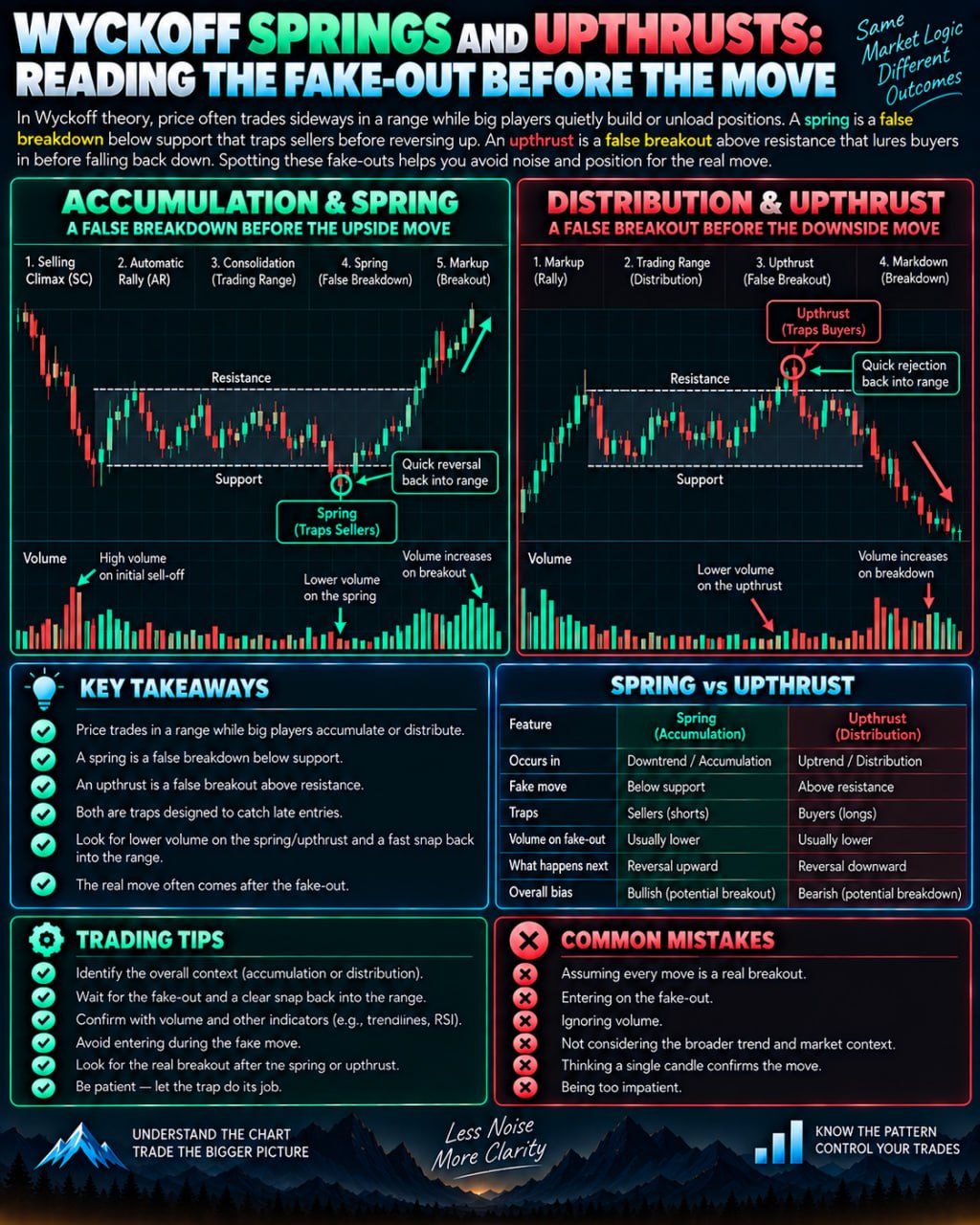
In Wyckoff theory, price often trades sideways in a range while big players quietly build or unload positions. A "spring" is a brief dip below the range's support that traps sellers before price reverses upward — a false breakdown. An "upthrust" is the mirror image: a quick push above resistance that lures buyers in before price falls back down. Spotting these fake-outs, ideally with lower volume on the move and a fast snap back into the range, helps traders avoid reacting to noise and instead watch for the real breakout that follows.
What A Trading Range Represents
Before springs and upthrusts can make sense, you need to understand the environment they occur in. Wyckoff theory, named after early twentieth century trader Richard Wyckoff, suggests that markets move through phases of accumulation and distribution. Accumulation is when a coin trades sideways in a range while larger participants (sometimes called "smart money" or "composite operators" in Wyckoff language) quietly buy up supply without pushing price too far in either direction. Distribution is the mirror process, where those same larger participants sell into demand while price still looks range-bound to casual observers.
During these ranges, price bounces between a rough floor called support and a rough ceiling called resistance. Most retail traders watch these levels closely, which is exactly why they become useful for a specific kind of test.
The Spring: A Trap Below Support
A spring happens when price dips briefly below the established support of a range, then quickly reverses back above it. On a chart it looks like a fake breakdown. The logic behind it, according to Wyckoff thinking, is that this dip triggers stop-loss orders (automatic sell orders placed just under support) and lures in short sellers betting on further decline. Once that supply is absorbed, there is less selling pressure left, and price can turn upward more freely.
A spring is considered more convincing when it happens on relatively lower volume compared to earlier moves in the range, and when price snaps back inside the range quickly rather than lingering below it. A slow, heavy-volume break below support that stays there is not a spring, it may simply be a genuine breakdown.
The Upthrust: A Trap Above Resistance
An upthrust is the mirror image. Price pushes briefly above resistance, drawing in breakout buyers who assume a new upward trend is starting, then reverses back down into the range. This can flush out late buyers and provide supply for larger sellers to distribute into. As with springs, upthrusts are read as more meaningful when volume on the push is unremarkable and the reversal back into the range happens quickly.
How Traders Try To Use These Patterns
Traders who follow Wyckoff style analysis often treat springs and upthrusts as clues rather than signals to act on immediately. The idea is to wait for confirmation, such as price reclaiming the range with conviction, before considering the fake-out complete. Some also watch for a follow-up test, a smaller retest of the same level that holds, before expecting the real breakout or breakdown to follow.
It is worth repeating that this is pattern reading based on historical analogy, not a mechanical rule. Two ranges that look identical can resolve in opposite directions.
Common Mistakes And Limitations
A frequent error is labeling every brief poke outside a range as a spring or upthrust after the fact, when in real time it was genuinely ambiguous. Hindsight makes these patterns look cleaner than they were live. Volume data, especially in crypto markets, can also be fragmented across venues, making the "lower volume" confirmation less reliable than in traditional markets with centralized reporting.
These patterns also do not tell you how far a subsequent move will go, only that a trap may have occurred. They should be combined with other context, like overall trend, broader market conditions, and sound position sizing, rather than used alone.
Fitting Into A Wider Risk Framework
No chart pattern, including a Wyckoff spring or upthrust, guarantees an outcome. Traders who use this framework generally pair it with predefined risk limits, such as deciding in advance how much they are willing to lose if the pattern fails, and avoiding oversized positions based on a single observation. Treating these ideas as one input among many, rather than a certainty, is central to using them responsibly.