
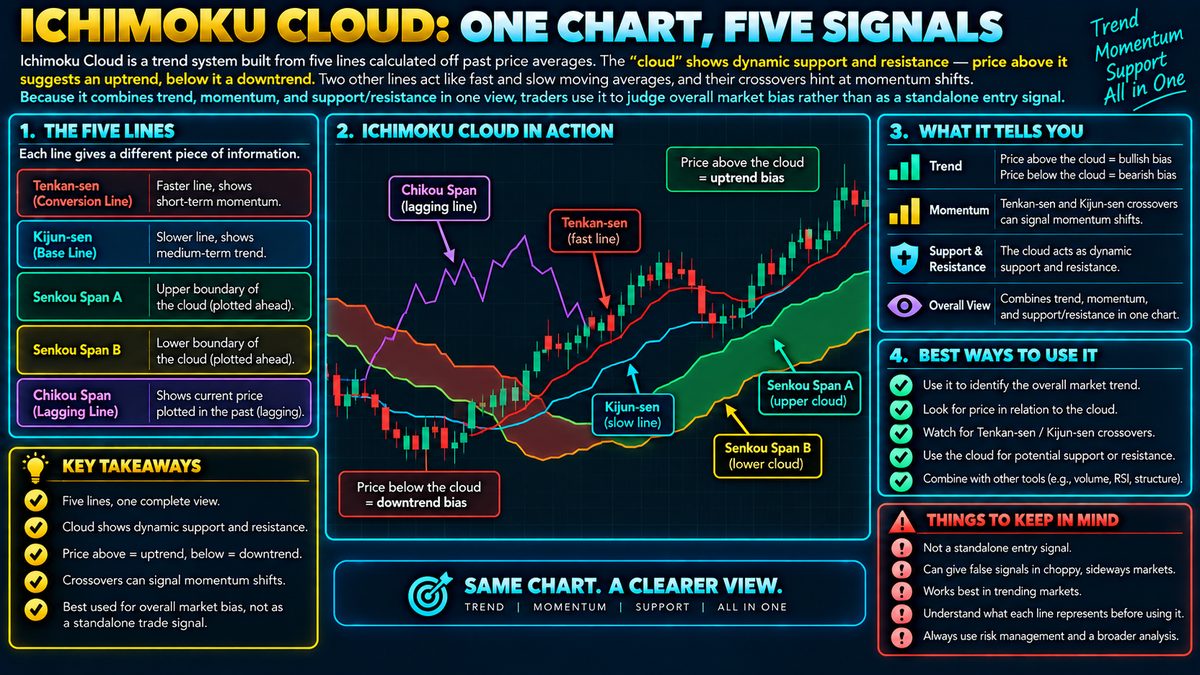
Ichimoku Cloud is a trend system built from five lines calculated off past price averages. The "cloud" (a shaded area between two of those lines) shows dynamic support and resistance — price above it suggests an uptrend, below it a downtrend. Two other lines act like fast and slow moving averages, and their crossovers hint at momentum shifts. Because it combines trend, momentum, and support/resistance in one view, traders use it to judge overall market bias rather than as a standalone entry signal.
What The Five Lines Actually Are
Ichimoku Cloud, short for Ichimoku Kinko Hyo, is a charting system that plots several lines derived from simple price averages over different lookback periods. The conversion line (sometimes called Tenkan-sen) averages the highest and lowest price over a short period, reacting quickly to recent moves. The base line (Kijun-sen) does the same over a longer period, so it moves more slowly and reflects the medium-term trend. Two further lines, projected forward in time, form the edges of the cloud, and a fifth line, the lagging span, plots the current closing price shifted backward so you can compare it against past price action. Together these five components try to summarize trend direction, momentum, and support or resistance in a single glance.
How The Cloud Forms
The cloud itself is the shaded area between the two projected lines. Because those lines are calculated from past price averages and then pushed forward in time, the cloud you see on the right side of the chart is effectively a forecast of where support or resistance might sit, based on historical price behavior. When price trades above the cloud, traders often read that as a sign the broader trend is up, and the cloud below acts like a floor of potential support. When price sits below the cloud, the same logic flips: the cloud can act as a ceiling of resistance, and the bias is read as bearish. When price moves inside the cloud, it is often interpreted as a period of indecision or transition, where trend direction is unclear.
Reading The Crossovers
The conversion line and base line behave similarly to a fast and a slow moving average. When the faster conversion line crosses above the slower base line, some traders view it as an early hint of upward momentum building, and the reverse crossover is read as a hint of downward momentum. These crossovers are typically weighed alongside the cloud's position, since a bullish crossover happening below a bearish cloud carries a very different meaning than the same crossover happening above a bullish cloud. The lagging span adds another layer, letting traders compare the current price against price from several periods earlier to see whether momentum is confirming or contradicting the other signals.
Using It As A Bias Tool, Not A Trigger
Because Ichimoku combines several moving pieces, many traders use it to establish an overall market bias, such as leaning toward looking for upside setups only while price holds above the cloud, rather than treating any single line touch or crossover as a standalone reason to enter or exit a trade. The idea is that when trend, momentum, and support or resistance all point the same direction, the overall picture is considered more coherent, though never certain.
Limitations And How It Fits With Other Tools
Ichimoku is a lagging system since every line is built from past prices, so it can be slow to reflect sudden reversals, and its signals can appear cluttered or contradictory during choppy, sideways markets. It also was designed with certain default time periods in mind, which may not suit every asset or timeframe without adjustment. No combination of these lines guarantees future price direction, and clouds can be broken through quickly in volatile conditions. Many traders pair Ichimoku with volume analysis, other trend or momentum indicators, or basic chart structure to cross-check its signals, and they combine it with clear risk management such as predefined position sizing and stop levels, since any single tool, however comprehensive it looks, can still be wrong.