
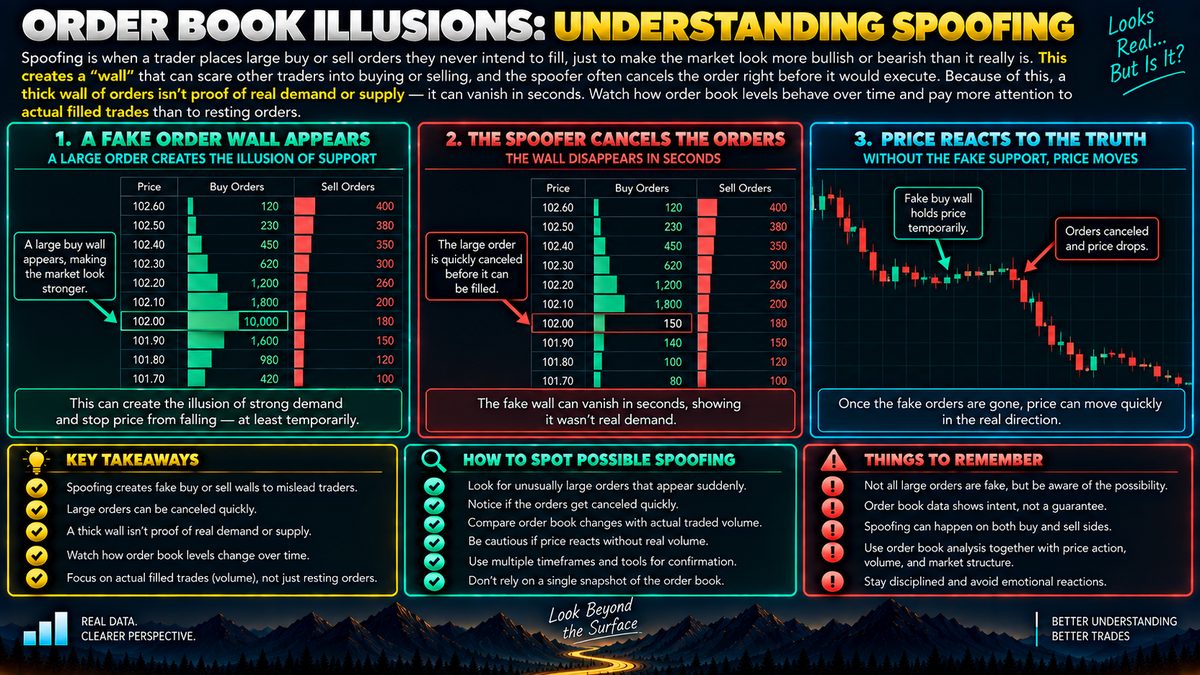
Spoofing is when a trader places large buy or sell orders they never intend to fill, just to make the market look more bullish or bearish than it really is. This creates a "wall" that can scare other traders into buying or selling, and the spoofer often cancels the order right before it would execute. Because of this, a thick wall of orders isn't proof of real demand or supply — it can vanish in seconds. Watch how order book levels behave over time rather than reacting to a single snapshot, and pay more attention to actual filled trades than to resting orders.
What an Order Book Actually Shows
An order book is a live list of buy orders and sell orders waiting to be matched at a given exchange or trading venue. Buy orders are called bids, and sell orders are called asks. Each entry shows a price and the amount someone wants to trade at that price. When you look at an order book, you are looking at intentions, not completed transactions. Nothing there has actually happened yet, it is simply a queue of offers waiting for a counterparty.
This distinction matters because a resting order can be placed and cancelled in an instant, with no cost beyond a few seconds of screen time. That flexibility is normal and healthy for markets most of the time, but it also means the order book can be used to create impressions rather than to genuinely trade.
How Spoofing Works
Spoofing happens when someone places a very large buy or sell order with no real intention of letting it fill. The goal is to make the market look heavier on one side than it actually is. If a large sell wall suddenly appears just above the current price, other traders may assume there is strong resistance and decide to sell or avoid buying, pushing the price down on their own. Once the spoofer sees the reaction they wanted, or once the price gets close enough that the order might actually execute, they cancel it and may do the opposite trade they were hoping the crowd would set up for them.
The size of the order is doing the persuading, not any real supply or demand. Because cancelling an order is instant and largely free, this kind of behavior can be repeated many times, and it can appear and disappear within seconds, long before most manual traders even notice it.
Why a Thick Wall Is Not Proof of Anything
A large order sitting in the book tells you what someone is willing to do right now, not what they will actually do when the price gets there. Genuine large orders do exist, from institutions or funds managing real positions, so not every big order is spoofing. The problem is that from the outside, a real wall and a fake wall look identical at a single glance.
This is why relying on one snapshot of the order book is risky. A trader who sees a large sell order and assumes the price cannot rise past it may be reacting to something that will vanish the moment it is tested. Treating a resting order as a guarantee of future price behavior confuses intention with commitment.
Reading the Order Book Over Time
A more useful approach is to watch how order book levels behave across many moments rather than react to what is visible right now. If a large order stays in place as the price approaches it, gets partially filled, and shrinks accordingly, that is more consistent with a genuine order. If it repeatedly appears, then disappears the instant price nears it, that pattern looks more like spoofing.
Actual filled trades, sometimes shown as a time and sales feed or tape, carry more weight than resting orders because a completed trade means money has genuinely changed hands. Volume that shows up in real trades cannot simply be cancelled.
Fitting This Into a Trading Process
Order book behavior is only one input among many, and it should never be the sole basis for a decision. It works best alongside broader tools like trend analysis, volume over time, and a clear plan for position size and risk. No pattern in the order book, spoofed or genuine, can reliably predict where price will go next, and treating it as certainty is a common and costly mistake. Staying aware that walls can be illusions is less about spotting a trick and more about building healthy skepticism into how you read any market data.