
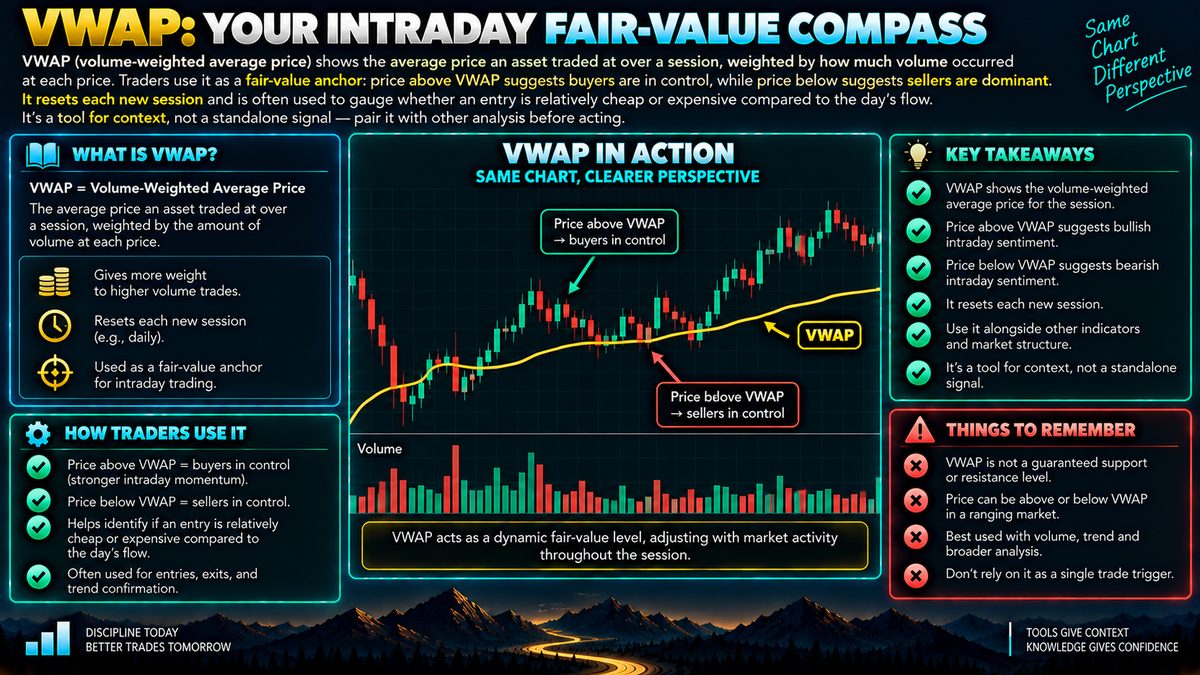
VWAP (volume-weighted average price) shows the average price an asset traded at over a session, weighted by how much volume occurred at each price. Traders use it as a fair-value anchor: price above VWAP suggests buyers are in control that session, while price below suggests sellers are dominant. It resets each new session and is often used to gauge whether an entry is relatively cheap or expensive compared to the day's flow. It's a tool for context, not a standalone signal — pair it with other analysis before acting.
What VWAP Actually Measures
VWAP stands for volume-weighted average price. Unlike a simple moving average, which just averages the closing prices over a set number of candles, VWAP factors in how much volume traded at each price level during a session. This means a price level where a huge amount of coins changed hands will pull the VWAP line toward it much more than a price level where only a trickle of volume occurred. In plain terms, VWAP tells you the "true" average price paid by everyone participating that session, weighted by actual activity rather than just the raw sequence of prices.
Because it incorporates volume, VWAP is often seen as a more honest reflection of where the market has actually been transacting, compared to price-only tools. A session, in this context, usually means a defined trading day, though some platforms let you view it over other timeframes. The key detail is that VWAP resets at the start of each new session, so it is not a long-term indicator like a 50-day or 200-day moving average. It is built specifically for intraday context.
How the Line Is Built
As a session progresses, the VWAP calculation continuously updates by multiplying each traded price by its volume, summing those values, and dividing by total volume traded so far. Early in the session, VWAP can move around quite a bit since there is less data feeding into it. As the day matures and volume accumulates, the line tends to smooth out and become more stable, reflecting a more complete picture of that day's trading.
This is why VWAP is sometimes described as a "moving anchor." It is not a fixed price target; it shifts throughout the day based on where and how much volume is occurring, only fully finalizing once the session closes.
Reading Price Relative to VWAP
Many traders use VWAP as a simple reference point for control. If price is trading above VWAP, it can suggest that, on average, buyers during this session have been willing to pay higher prices, hinting at some buying pressure. If price is below VWAP, it can suggest sellers have been more dominant, with average trades occurring at lower levels. Some traders watch for price returning to test VWAP after moving away from it, treating the line as a potential area of interest, similar to how others use support or resistance zones.
It is also common for institutional-style trading approaches to use VWAP as a benchmark for execution quality, judging whether a large order was filled at a "good" average price relative to the rest of the session's flow.
Common Mistakes and Limitations
A frequent error is treating VWAP as a guaranteed bounce or reversal zone rather than a statistical reference. Price can cross VWAP repeatedly during choppy sessions, generating misleading signals if used in isolation. VWAP also carries no predictive power on its own; it only describes what has already happened, not what will happen next.
Another limitation is that VWAP resets each session, so comparing today's VWAP to yesterday's has little meaning. It is also less useful in very low-volume markets, where a handful of trades can distort the weighting.
Fitting VWAP Into a Broader Approach
VWAP works best combined with other tools such as trend analysis, support and resistance zones, or momentum indicators, rather than as a standalone trigger. Since it is descriptive rather than predictive, it should inform context, not replace a full trading plan. Position sizing, stop-loss placement, and overall risk management remain essential regardless of where price sits relative to VWAP. No indicator, including VWAP, can guarantee outcomes, and all trading involves risk of loss.