
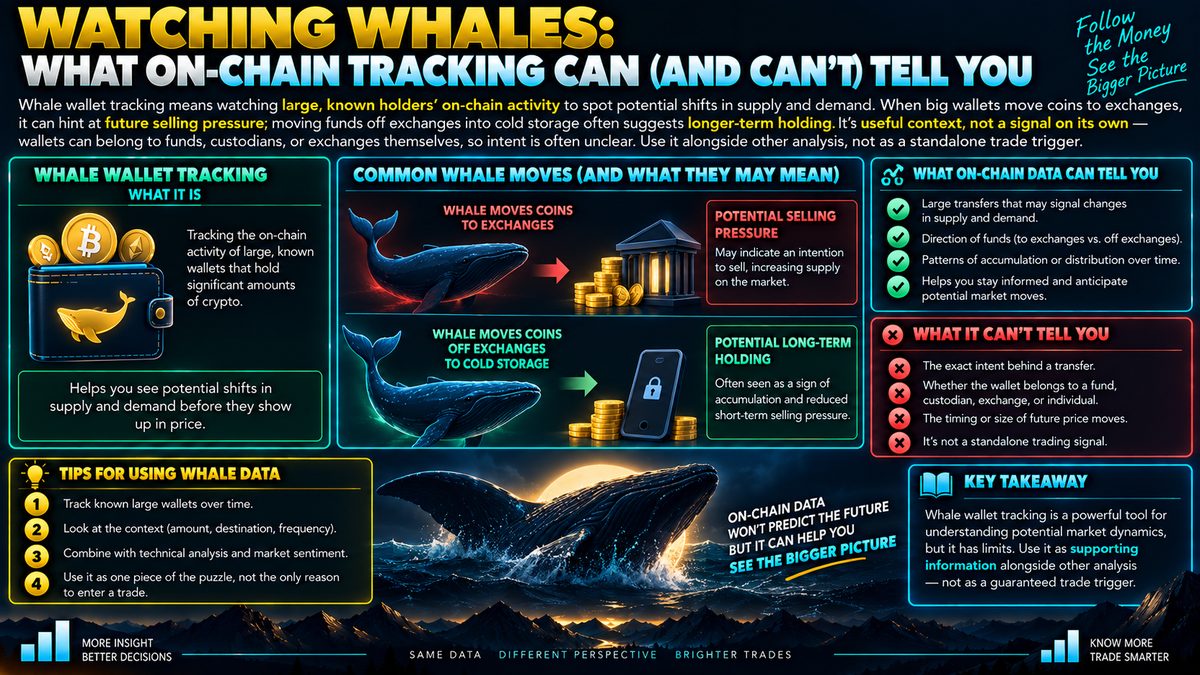
Whale wallet tracking means watching large, known holders' on-chain activity to spot potential shifts in supply and demand. When big wallets move coins to exchanges, it can hint at future selling pressure; moving funds off exchanges into cold storage often suggests longer-term holding. It's useful context, not a signal on its own—wallets can belong to funds, custodians, or exchanges themselves, so intent is often unclear. Use it alongside other analysis, not as a standalone trade trigger.
What Whale Tracking Actually Is
A blockchain is a public ledger, meaning anyone can see every transaction ever made, including the wallet addresses involved and how much was moved. Whale tracking is the practice of watching wallets that hold unusually large amounts of a coin and observing what they do with it. The word whale simply refers to a holder big enough that their transactions could theoretically influence supply available on the market.
Because blockchains are transparent but not necessarily tied to real names, trackers usually work from patterns rather than certainty. A wallet holding a very large balance gets labeled a whale, and its transfers get logged and sometimes broadcast publicly through alert services or research dashboards. None of this requires special access, just the willingness to read raw blockchain data or tools that summarize it.
How the Signal Is Supposed to Work
The basic logic is about where coins sit. When a large wallet moves coins onto an exchange, some traders interpret that as a possible precursor to selling, since coins generally need to be on an exchange to be sold for another asset. Conversely, when coins move off an exchange into a private or cold storage wallet, meaning one not connected to the internet, it is often read as a sign of intent to hold for the longer term, since it becomes less convenient to sell quickly.
Imagine a hypothetical wallet moves 10,000 units of a coin from cold storage onto an exchange. Observers might treat this as a hint that supply available for sale has increased, which in theory could pressure price if demand does not also increase. This is the entire logic in its simplest form: watching where supply appears to be positioning itself.
Why Intent Is Often Unclear
The core weakness of this approach is that a wallet's balance tells you nothing about who controls it or why they are moving funds. Many of the largest wallets belong to exchanges themselves, custodians holding assets on behalf of many clients, or institutional funds rebalancing between cold storage and hot wallets for routine security reasons. A transfer that looks dramatic on a dashboard might simply be an exchange shuffling its own reserves.
Even when a wallet plausibly belongs to an individual or fund, moving coins to an exchange does not confirm a sale is coming. It could be collateral for a loan, a transfer between the holder's own accounts, or preparation for a transaction unrelated to selling. Reading motive into a single movement is guesswork dressed up as analysis.
Common Mistakes Traders Make
A frequent error is treating any single large transfer as an actionable trigger, entering or exiting a position purely because a whale wallet moved funds. Another is ignoring the base rate, meaning large wallets move coins constantly for mundane reasons, so isolated alerts without broader context are close to noise. Traders also sometimes confuse correlation with causation, assuming a price move that followed a transfer was caused by it, when many other factors were likely at play simultaneously.
Fitting It Into a Broader Approach
On-chain data is best treated as one input among many, alongside broader market structure, volume trends, and general risk management practices such as position sizing and predefined exit plans. It can add context, for example noticing sustained trends in exchange inflows or outflows over weeks rather than reacting to one transaction. No on-chain metric, indicator, or pattern guarantees future price behavior, and whale tracking is no exception. Used cautiously and combined with other analysis, it can sharpen awareness of supply dynamics, but it should never stand alone as a reason to enter or exit a trade.