
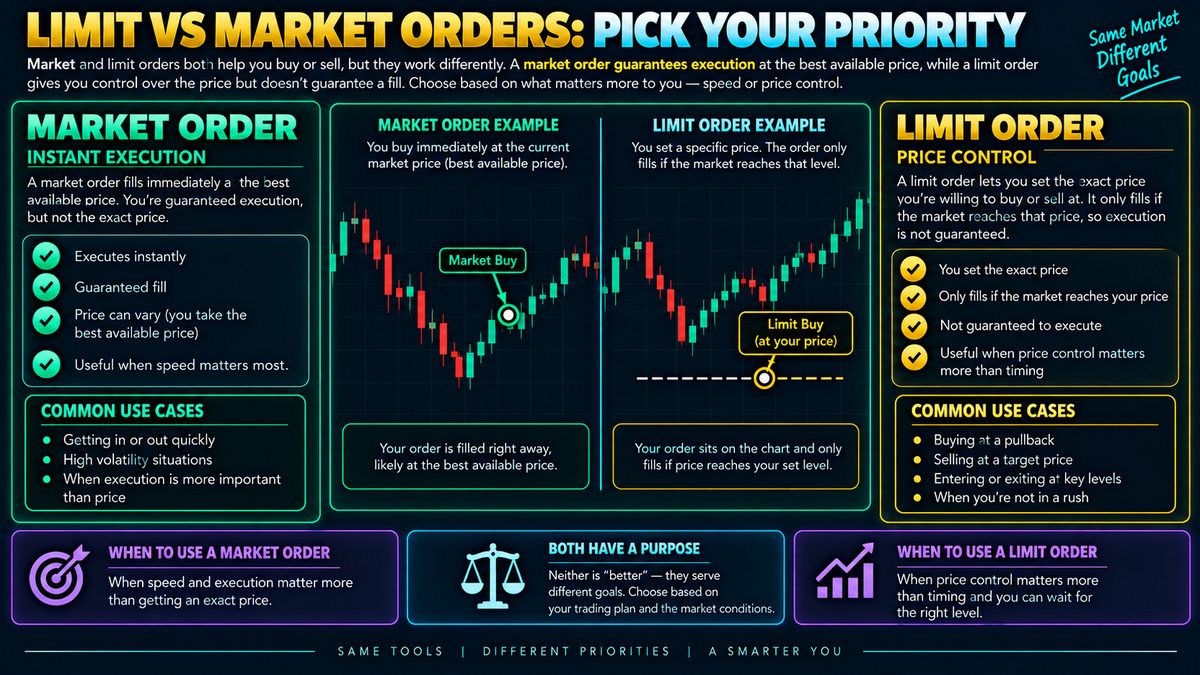
A market order fills instantly at whatever price is available — you're guaranteed execution but not the price. A limit order lets you set the exact price you're willing to buy or sell at, but it only fills if the market reaches that level, so speed isn't guaranteed. Use market orders when getting in or out fast matters most; use limit orders when price control matters more than timing. Neither is "better" — they just serve different goals.
What Each Order Type Actually Does
A market order tells the system to fill your trade immediately using whatever prices are currently offered by other traders. Because it prioritizes speed, you accept the best available price at that moment, which can shift slightly between when you click and when the trade completes, especially in a fast-moving market. This gap between the price you expected and the price you actually got is often called slippage.
A limit order works differently. Instead of accepting whatever price is available, you set a specific price you're willing to buy or sell at. The order sits and waits, and it only executes if the market actually trades at your chosen price or better. This gives you control over price, but no guarantee that the trade happens at all, since the market might never reach your level.
How Order Books Make This Work
Behind both order types is something called an order book, which is essentially a running list of buy and sell orders at different price levels. Limit orders sit in this book, waiting to be matched. A market order, by contrast, skips the waiting line and matches immediately against whatever limit orders are already sitting there, working through them until the order is filled.
This is why a market order can experience slippage during periods of low liquidity, meaning there simply aren't enough resting limit orders nearby to fill your trade at one clean price. In calm, high-volume conditions the difference is usually tiny; in volatile or thin markets it can be noticeable.
When Traders Lean on Market Orders
Traders often reach for market orders when timing feels more important than getting an exact price. This might be during a fast-moving news event, when trying to exit a position quickly to limit further loss, or when the asset trades in high enough volume that price differences are expected to be small anyway. The tradeoff is accepting some uncertainty about the final execution price in exchange for certainty that the trade happens now.
When Traders Lean on Limit Orders
Limit orders are typically used when a trader has a specific price in mind and is comfortable waiting for the market to come to them. This is common for entering a position at a level considered attractive, or exiting at a target level without needing to watch the screen constantly. Because the order won't fill unless the price is reached, it also acts as a simple form of discipline, preventing impulsive trades at prices the trader didn't actually want.
The cost of this control is that the market may move away without ever triggering the order, meaning the opportunity is missed entirely. There's no universal answer for which outcome is worse; it depends on the trader's goals for that specific trade.
Common Mistakes and Limitations
A frequent mistake is using a market order in a thin or volatile market and being surprised by how far the fill price drifted from the last quoted price. Another is setting limit orders unrealistically far from current price and forgetting about them, or conversely setting them so close that they trigger prematurely on normal price noise.
Neither order type solves the harder problem of deciding what to trade or when, and neither guarantees a good outcome. They're just tools for expressing a preference between speed and price control. Sound risk management, such as position sizing and having a plan for both directions the trade could go, matters far more than which order type is chosen, and no order type can substitute for that broader plan.