
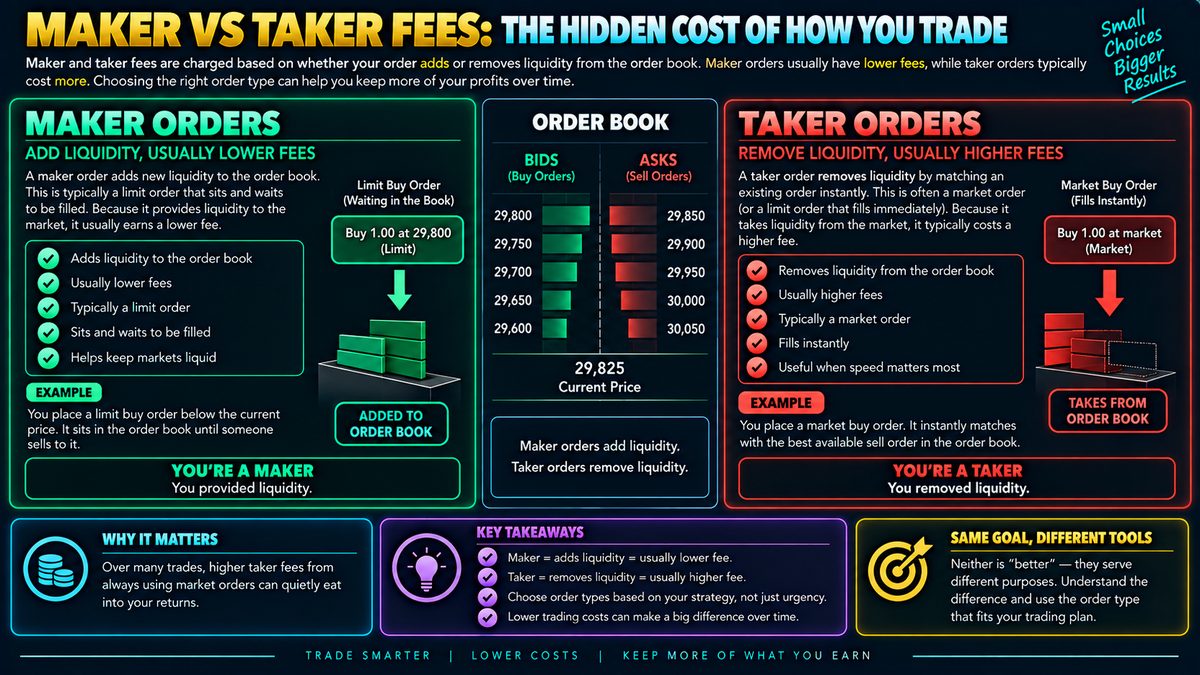
A maker order adds new liquidity to the order book — like placing a limit order that sits and waits to be filled — and usually earns a lower fee. A taker order removes liquidity by matching an existing order instantly, such as a market order, and typically costs more. Over many trades, defaulting to market orders out of impatience can quietly eat into returns. Understanding this difference helps you choose order types that fit your strategy, not just your urgency.
What Maker And Taker Actually Mean
Every trading venue keeps a running list of buy and sell orders waiting to be matched, often called the order book. When you place an order that does not match immediately and instead sits on that book waiting for someone else to trade against it, you are adding liquidity. This is a maker order, most commonly a limit order, where you specify the exact price you are willing to buy or sell at, and it only fills once the market reaches that price.
A taker order does the opposite. It matches against an order already sitting on the book, filling instantly at the best available price. A market order, where you simply say "buy now" or "sell now" without specifying a price, is the classic example. Because taker orders consume existing liquidity rather than contributing new liquidity, venues usually charge them a higher fee than maker orders, and sometimes charge makers close to nothing or even pay them a small rebate.
Why The Fee Difference Exists
Liquidity, meaning the depth and availability of buy and sell orders at various prices, is what makes a market function smoothly. Venues want more of it because it means trades execute with less slippage, which is the gap between the price you expected and the price you actually got. By pricing maker orders cheaper, venues encourage traders to leave resting orders on the book instead of constantly demanding instant fills. Taker orders are convenient but they remove that available liquidity, so the higher fee is essentially a cost for immediacy.
How Traders Use This Distinction
Traders who are patient and not chasing a fast-moving price often default to limit orders, accepting the small risk of not being filled in exchange for a lower fee and, sometimes, more control over their entry or exit price. Traders who prioritize certainty of execution, for example someone reacting to sudden news or trying to exit a position quickly, tend to accept the taker fee as the price of speed. Some active traders build strategies specifically around capturing the maker rebate on high volume, though this usually only matters at a scale most retail traders will not reach.
Frequency matters more than any single fee. A single trade's fee difference looks trivial, but someone trading many times a day or week compounds those extra costs, and over months it can meaningfully erode profits even if each individual trade seems fine.
Common Mistakes And Limitations
A frequent mistake is using market orders purely out of impatience or habit, without asking whether a limit order would achieve the same goal at a better cost. Another is ignoring that limit orders carry their own risk, namely that the price may simply never reach your specified level, causing a missed opportunity while you wait to save a small fee. Fee structures also vary by trading volume tiers and by asset, so assuming a flat rate across all situations can lead to miscalculating actual trading costs.
It is also worth remembering that fees are only one part of total trading cost. Spread, slippage, and the psychological cost of waiting or chasing a trade all matter too, and none of these guarantee better outcomes on their own.
Fitting Fees Into A Broader Strategy
Order type choice should follow your trading plan, not the reverse. If your strategy depends on precise entries, limit orders and their lower fees often align naturally. If your strategy depends on reacting quickly to conditions, the taker fee may simply be a necessary cost. Treating fee awareness as one small piece of a broader risk management approach, alongside position sizing and clear entry and exit rules, tends to serve traders better than treating any single order type as inherently superior.