
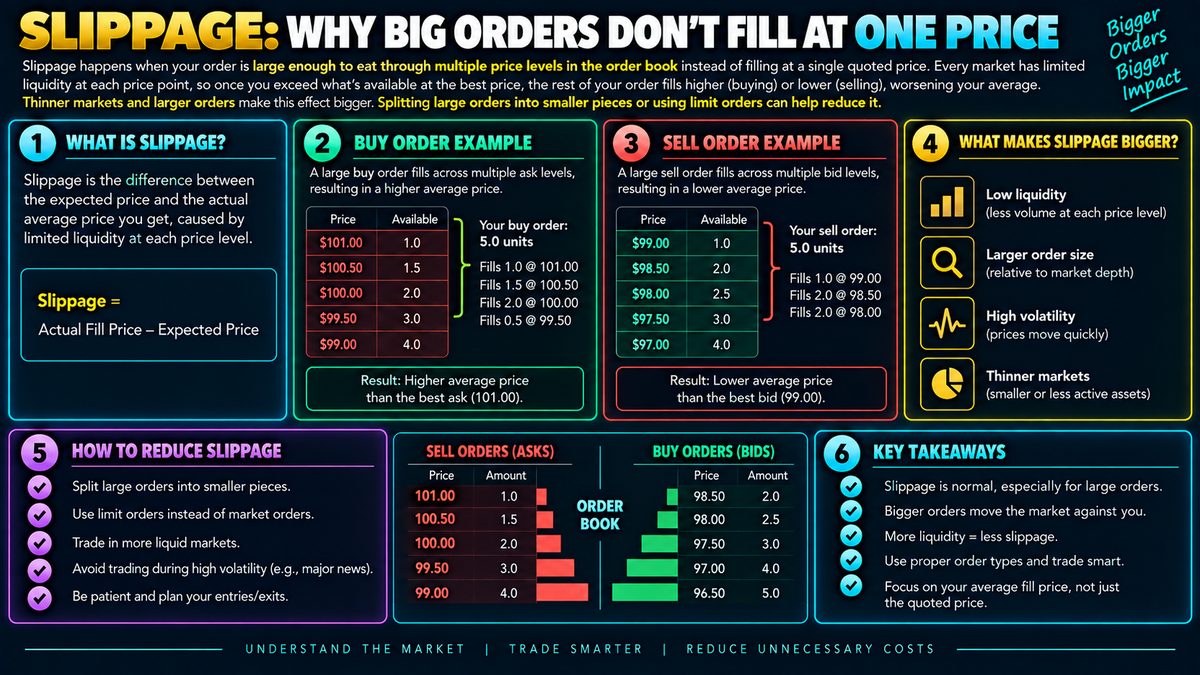
Slippage happens when your order is large enough to eat through multiple price levels in the order book instead of filling at a single quoted price. Every market has limited liquidity sitting at each price point, so once you exceed what's available at the best price, the rest of your order fills higher (buying) or lower (selling), worsening your average. Thinner markets and larger orders make this effect bigger. Splitting large orders into smaller pieces or using limit orders can help reduce it.
What Slippage Actually Is
Slippage is the difference between the price you expected to get and the price you actually got when your order filled. It happens because markets do not have unlimited amounts of a coin sitting available at any single price. Instead, there is a limited quantity of buy and sell orders stacked at different price levels, and when your order is big enough, it has to reach past the first level to find more supply or demand, changing your average fill price along the way.
How the Order Book Creates This Effect
Imagine a coin where the best available sell price is 100, but only 10 units are offered there. If you want to buy 50 units, the first 10 fill at 100, but the remaining 40 have to be filled by the next cheapest sellers, who might be asking 101, then 102, and so on. Your order eats through each of these price levels in sequence, called the order book, until it is fully filled. The result is that your average price ends up higher than the 100 you originally saw quoted, even though no single mistake was made. The same thing happens in reverse when selling into a thin market, pushing your average fill price lower than the top quoted bid.
Why Thin Markets Make It Worse
The size of the slippage depends heavily on liquidity, meaning how much buy and sell interest sits near the current price. In a market with deep liquidity, there may be large quantities available at each price step, so even a sizable order barely moves the average price. In a thin or illiquid market, there might be very little sitting at each level, so even a modest order can jump through several price steps and produce a much worse average fill. This is why the same order size can behave completely differently depending on which market or which time of day it is placed in, since liquidity is not constant.
How Traders Read and Anticipate It
Experienced traders often glance at the order book depth before placing a large order, checking how much volume sits within a few price levels of the current price. This gives a rough sense of how much room there is before an order will start causing noticeable slippage. Some traders also watch overall trading volume and volatility as rough proxies for liquidity, since quiet, low volume periods tend to have thinner books and larger price gaps between levels. None of this eliminates slippage, but it helps set realistic expectations before submitting an order.
Common Mistakes and Limitations
A common mistake is assuming the quoted price is the price you will actually pay or receive, especially with larger orders or in smaller markets. Another is placing large market orders, which are designed to fill immediately regardless of price, without first checking how thin the book is. It is also easy to forget that slippage can compound with other costs like trading fees, making the real cost of a trade higher than it first appears. Slippage estimates based on a snapshot of the order book are never guaranteed either, since the book can change in the instant before an order arrives.
Managing Slippage Within Risk Management
Traders often reduce slippage by splitting a large order into smaller pieces spread out over time, giving the market a chance to refill at each level between trades. Using limit orders, which specify the worst price you are willing to accept, is another common approach, though it carries the tradeoff that the order might not fill at all if the price moves away. Ultimately, slippage is just one more variable to account for alongside fees, volatility, and position sizing, and no technique removes it entirely, only manages its impact.