
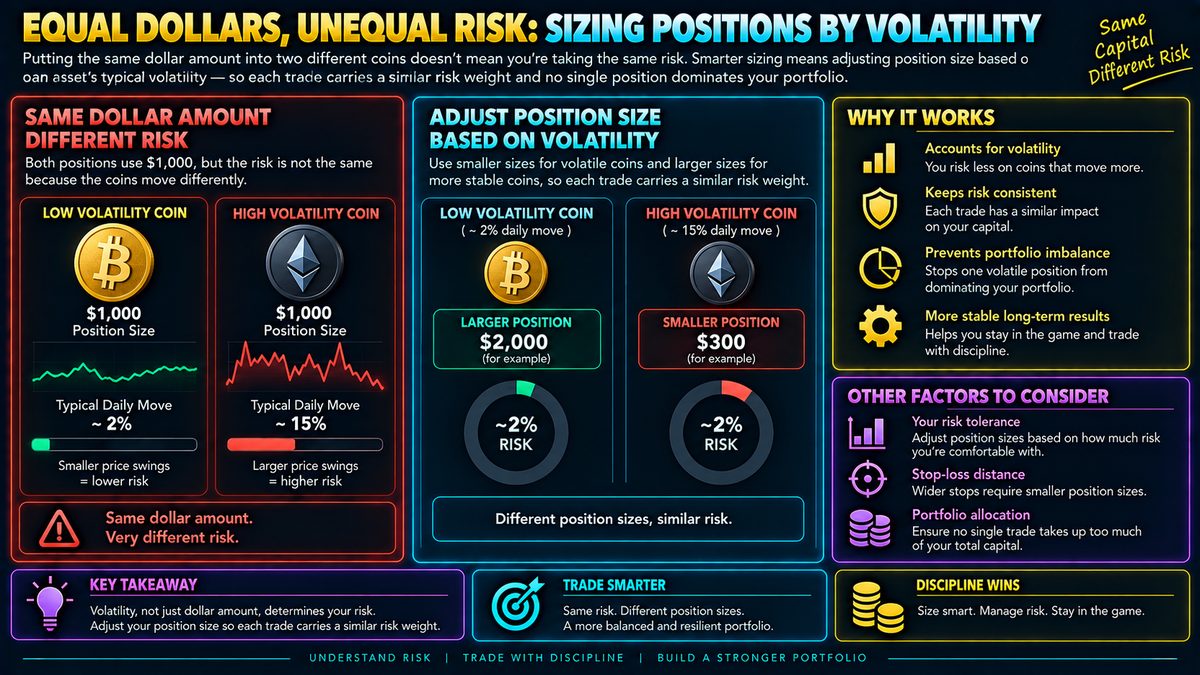
Putting the same dollar amount into two different coins doesn't mean you're taking the same risk. A coin that swings 15% in a day can wipe out far more of your capital than one that moves 2%, even at identical position sizes. Smarter sizing means adjusting position size based on an asset's typical volatility — putting less into wilder coins and more into calmer ones — so each trade carries a similar risk weight. This keeps one volatile position from dominating your overall portfolio risk.
Why Equal Dollars Don't Mean Equal Risk
Imagine putting 1,000 into a coin that typically moves 2% in a day, and another 1,000 into a coin that typically moves 15% in a day. On paper your capital allocation looks balanced, but the second position can generate seven or eight times the daily profit or loss swing of the first. Volatility, which simply means how much and how fast a price tends to move up and down, is what actually determines how much risk a dollar of exposure carries. Treating every coin as equally risky just because you put the same dollar amount into it is a common blind spot for newer traders.
What Volatility Actually Measures
Volatility is usually estimated by looking at how much an asset's price has moved over some recent period, often expressed as a percentage swing per day or as a statistical measure called standard deviation, which describes how spread out price changes tend to be around their average. A coin with high volatility can move a large percentage in either direction within hours. A coin with low volatility tends to drift more slowly. Neither is inherently better or worse, but they behave very differently inside a portfolio, and a strategy built for one can fail badly when applied to the other without adjustment.
The Idea Behind Volatility-Based Sizing
Volatility-based position sizing means adjusting how much capital you commit to a trade based on how wildly that asset tends to move, rather than assigning a flat dollar amount to everything. The goal is for each position to carry a similar amount of risk, sometimes called risk parity, even though the dollar amounts differ. In practice this usually means putting a smaller dollar amount into a historically wilder coin and a larger dollar amount into a calmer one, so that a typical daily move in either position produces a roughly similar dollar impact on your account.
One simple approach traders use is to size positions inversely to a volatility measure, meaning if one asset is roughly three times as volatile as another, the position in that asset might be roughly a third the size. This is not a precise science and there is no single correct formula, but the underlying logic is consistent: let expected price swings, not just conviction or excitement about a coin, help determine how much is at stake.
How Traders Use This in Practice
Many traders combine volatility sizing with a stop loss, which is a predetermined price level at which a losing trade is closed to limit further loss. By estimating volatility first, a trader can decide both how far away a stop should sit and how large the position should be, so that if the stop is hit, the dollar loss stays within a comfortable range. This keeps a single volatile trade from dominating the portfolio's overall risk just because it was exciting or heavily promoted.
Limitations and Common Mistakes
Volatility measured from the past is only an estimate of the future, and market conditions can shift quickly, meaning a calm coin can suddenly become turbulent with little warning. Relying on a single volatility number can also create false confidence, since sharp news events or sudden shifts in trading activity can produce moves far outside recent norms. Another mistake is assuming that smaller position size alone makes a trade safe, when poor entry timing or lack of a plan can still cause outsized losses regardless of sizing.
Fitting This Into a Broader Risk Framework
Volatility-based sizing works best as one part of a broader risk management approach that also includes diversification across uncorrelated assets, clear stop losses, and limits on total exposure per trade and per portfolio. No sizing method, indicator, or pattern can guarantee a particular outcome, and volatility itself can change without warning. Thinking in terms of risk weight rather than dollar amount is simply a more honest way to see what a portfolio is actually exposed to.