
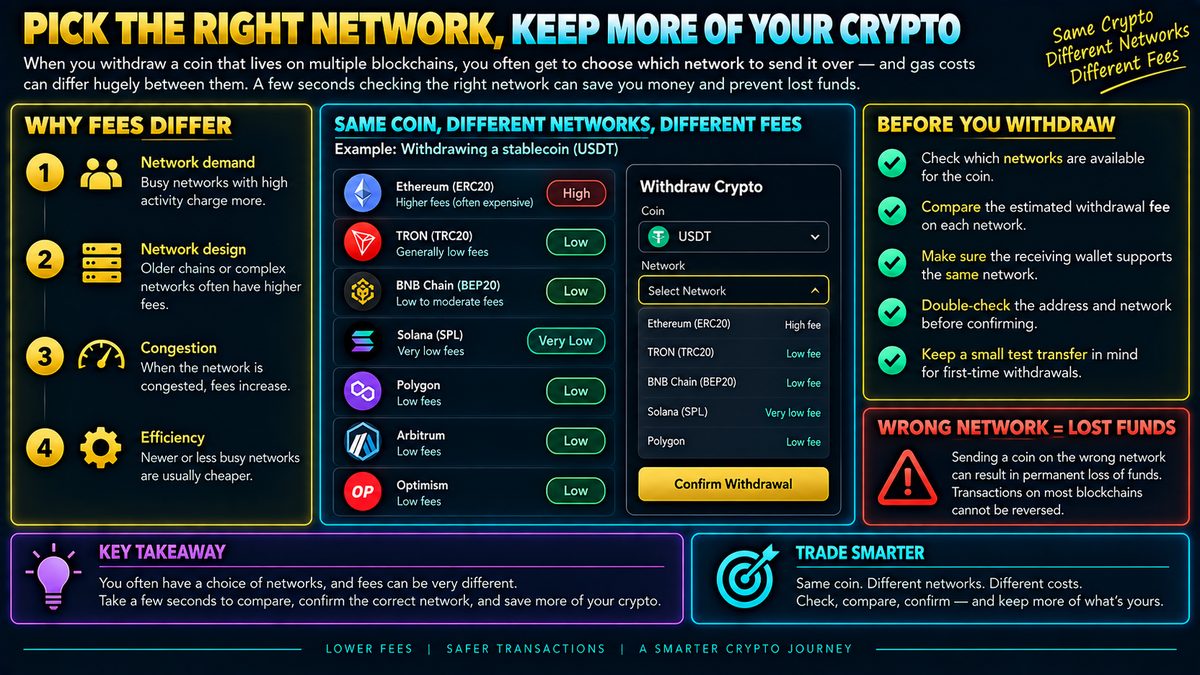
When you withdraw a coin that lives on multiple blockchains, you often get to choose which network to send it over — and gas costs can differ hugely between them. Older or more congested chains tend to charge more per transaction, while newer or less busy networks are usually cheaper. Always match the network you select with the network the receiving wallet or address actually supports, since sending on the wrong chain can mean lost funds. A few seconds checking this before confirming can save real money over time.
What "Choosing a Network" Actually Means
Many well-known coins are not tied to a single blockchain. A token like a stablecoin, for example, can exist as a version built on one blockchain, and a separate version built on another blockchain, and yet another version on a third. These are sometimes called different "networks" or "chains," and they each have their own rules, validators, and fee structures, even though the token itself might carry the same name and represent the same underlying value.
When you go to withdraw or send that coin, you are often shown a dropdown menu asking which network you want to use. This is not a cosmetic choice. It determines which set of computers processes your transaction, how long it takes to confirm, and how much you pay in gas, which is the fee charged to have your transaction included and processed on that blockchain.
Why Fees Differ So Much Between Chains
Gas costs are basically a reflection of supply and demand for space on a blockchain. Older, heavily used networks tend to have more people competing to get their transactions processed at any given moment, which pushes fees higher. Newer or less congested networks usually have more spare capacity, so transactions can be cheaper and sometimes confirm faster too.
This does not mean the newer network is always "better." Older, busier chains are often that way because they have a long track record, wide adoption, and deep security from having many participants. Cheaper is not automatically safer, and network choice involves tradeoffs beyond just the fee you pay today.
Matching the Network to the Destination
The single most important rule here is that the network you send on must match the network the receiving address actually supports. A wallet address is not universal across all chains just because it looks like a valid string of characters. If you send a coin over a network that the receiving wallet does not recognize or support, the funds can become permanently inaccessible, with no customer service or blockchain mechanism able to reverse it.
A practical habit is to check the receiving side first, whether that is a wallet app or another party's deposit address, and confirm exactly which networks it accepts before you touch the withdrawal screen. If you are not sure, sending a small test amount first, even though it costs a little extra in fees, can save far more if something is misconfigured.
How Traders Use This to Save Money
Someone who withdraws or moves funds frequently can end up paying meaningfully more over time by always defaulting to the same network out of habit, especially if that network happens to be one of the pricier ones. Comparing the fee estimates shown for each available network option, when there is a real choice, is a small step that compounds into real savings across many transactions.
This becomes more noticeable with smaller transaction sizes, where a fixed gas fee eats up a larger percentage of the amount being moved. For larger transfers, the fee difference matters less in relative terms, though it is still worth checking.
Common Mistakes and Limitations
The most common mistake is rushing through the network selection screen without reading it, assuming all options are interchangeable. Another is assuming a low fee always signals the smarter choice without first verifying the destination supports that same network. Fee levels also fluctuate over time based on network congestion, so what was cheap yesterday is not guaranteed to stay cheap.
None of this is a guarantee of anything, and no single choice of network protects against every risk. Treat this as one part of a broader habit of double-checking addresses, amounts, and destinations before confirming any transfer.