
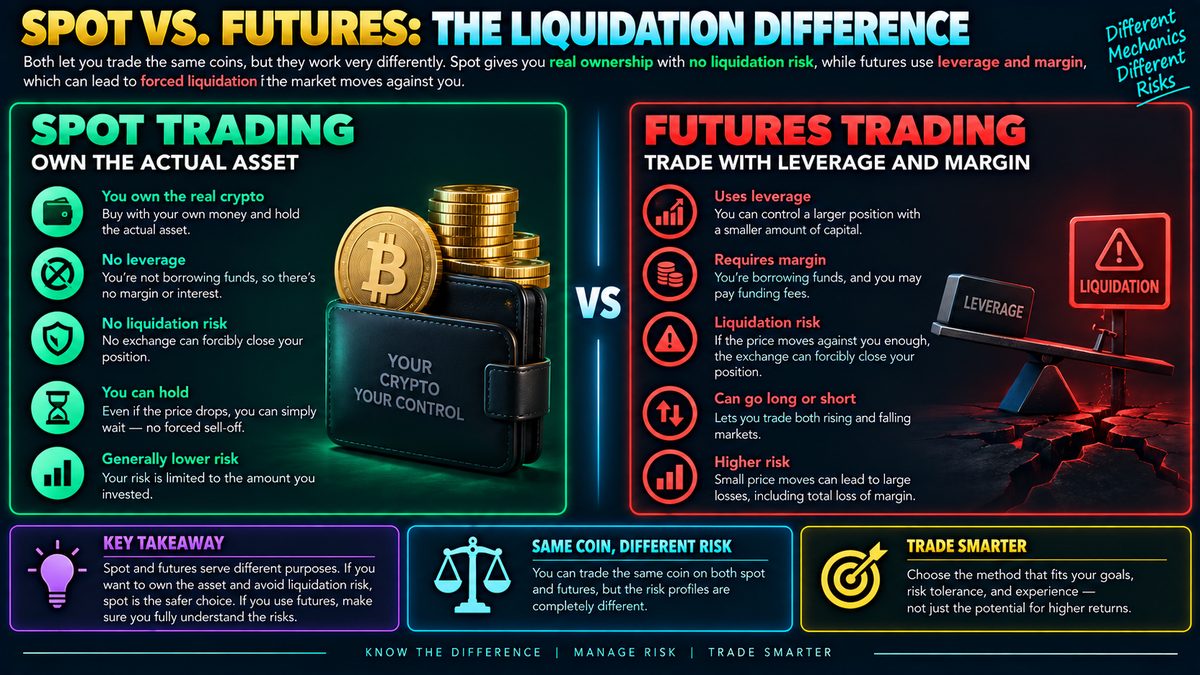
When you buy crypto on spot, you own the actual asset outright with your own money — there's no borrowed leverage and no exchange that can forcibly close your position. Futures trading uses leverage and margin, meaning if the price moves against you enough, the exchange liquidates your position to cover the loan. Spot can still lose value if the market drops, but you can simply hold — there's no forced sell-off wiping you out overnight. That structural difference is why spot is generally considered lower-risk than leveraged futures trading.
What Ownership Actually Means
When you buy an asset on the spot market, you are exchanging your own money for the actual coin or token, right now, at the current price. Once the trade settles, that asset is yours. Nobody has lent you anything, and there is no loan sitting behind the position. If you buy one unit of a hypothetical coin at 100 using your own funds, you now hold that coin outright, the same way you'd hold a stock certificate or a bar of gold. Its value can rise or fall with the market, but the coin itself cannot be taken from you because of a price move.
Futures trading works differently. A futures contract lets you take a position that is larger than the cash you put up, using something called leverage. Leverage is essentially borrowed exposure: you post a smaller amount of your own money, called margin, and the exchange or broker effectively fronts the rest so your position size is bigger than your actual balance. This magnifies both gains and losses relative to your own capital.
How Liquidation Happens
Because a leveraged position is partly financed by borrowed exposure, the exchange needs a way to protect itself if the trade goes badly. That mechanism is liquidation. If the market moves against your position enough that your margin can no longer cover the potential loss, the exchange automatically closes the position, often at a loss that consumes most or all of your posted margin. This can happen quickly, sometimes within minutes, during sharp price swings.
Liquidation is not a punishment or a glitch; it is a built-in risk control for a system that runs on borrowed exposure. The exchange calculates a liquidation price in advance based on your leverage and margin, and once the market touches that level, the closure is typically automatic and not something you can negotiate or pause.
Why Spot Losses Feel Different
On spot, if the market drops, the value of your holding drops too, and that can be uncomfortable to watch. But nothing forces you to sell. You can choose to hold through the decline, wait, or average your entry over time, because there is no loan and no liquidation price hanging over the position. The loss only becomes final if you decide to sell.
With leveraged futures, a large enough adverse move can close the position for you, regardless of what you would have preferred to do. The position can be gone before the market has a chance to recover, which removes the option of simply waiting it out.
Common Mistakes and Limitations
A frequent mistake beginners make is treating leverage as a way to make small amounts of capital grow faster without appreciating that it also shrinks the room for error. Higher leverage means a smaller price move is needed to trigger liquidation. Another mistake is ignoring margin requirements or adding to a losing leveraged position hoping for a reversal, which can accelerate liquidation risk rather than reduce it.
It is also worth remembering that spot is not risk-free. Prices can still fall substantially, and holding through a downturn is a choice with its own consequences, not a guaranteed path to recovery.
Fitting This Into Risk Management
Understanding this structural difference helps explain why many traders treat spot and leveraged futures as very different risk categories, not just different products. Position sizing, only risking money you can afford to lose, and understanding leverage and liquidation mechanics before using them are basic parts of managing risk. None of this guarantees an outcome, and no strategy removes the possibility of loss, but knowing how liquidation works is a foundational step before considering leveraged trading at all.