
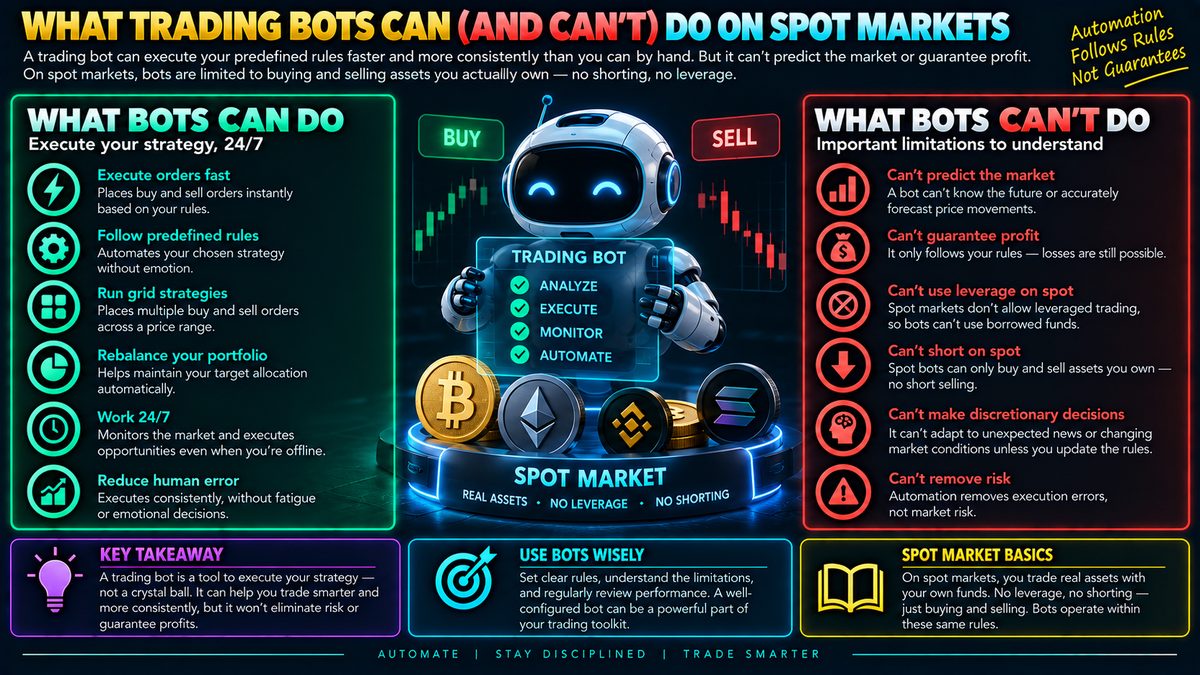
A trading bot can execute your predefined rules faster and more consistently than you can by hand — placing orders, managing grids, or rebalancing without emotion or fatigue. What it can't do is predict the market or guarantee profit; it only follows the logic you (or its strategy) give it. On spot markets specifically, bots can't short or use leverage, so they're limited to buying and selling assets you actually own. Good automation removes execution errors, not risk.
How Trading Bots Actually Work
A trading bot is a piece of software that automates the buying and selling of assets according to a set of predefined rules, often called a strategy. Instead of a person watching charts and manually clicking buy or sell, the bot monitors market data continuously and reacts based on the logic it was given. That logic might be as simple as "buy when price drops by a certain percentage, sell when it rises by another percentage," or as complex as a multi-condition system involving several indicators.
The important thing to understand is that a bot does not think. It does not analyze news, sense sentiment, or adapt on its own unless it was specifically programmed to do so. It executes instructions with speed and consistency, but the quality of those instructions is entirely up to whoever designed the strategy. A well-built bot running a poor strategy will still lose money, just very efficiently.
What Spot Markets Allow and Restrict
Spot trading means buying or selling an asset for immediate delivery and settlement, using funds you actually hold. If you buy a coin on the spot market, you own that coin outright. This is different from derivatives markets, where you can trade contracts based on an asset's price without owning the asset itself.
Because of this, bots operating purely on spot markets face a structural limit: they cannot short an asset, meaning they cannot profit from a price decline by selling something they do not own. They also cannot use leverage, which is borrowed capital that amplifies both gains and losses. A spot bot can only buy, hold, or sell what is actually in the account. This makes spot bots inherently less risky in one sense, since there is no borrowed money to lose beyond your own funds, but it also means their toolkit is narrower than leveraged trading systems.
Common Bot Strategies on Spot Markets
Many spot bots are built around repetitive, rules-based tasks that are tedious for humans but simple for software. Grid strategies, for example, place a series of buy and sell orders at set price intervals, aiming to capture small moves as price oscillates within a range. Rebalancing bots periodically adjust a portfolio back to target allocations, selling what has grown and buying what has shrunk. Dollar-cost averaging bots buy a fixed amount at regular intervals regardless of price, removing the temptation to time the market.
These approaches share a common thread: they replace emotional, inconsistent human decision-making with mechanical consistency. The bot does not hesitate, panic, or get tired. This can reduce certain execution errors, like fat-finger mistakes or missed orders during volatile moments.
What Bots Cannot Do
No bot can predict where a market is headed. Any claim that a bot "knows" future price movement should be treated with skepticism. Bots follow rules based on past and present data, and markets can behave in ways that break historical patterns entirely. A strategy that performed well in one type of market, such as a sideways range, may perform poorly in a strongly trending or highly volatile one.
Automation also cannot eliminate risk. It only removes certain types of human error from execution. The underlying exposure to market movement, liquidity conditions, and strategy design flaws remains fully intact. A poorly parameterized grid bot, for instance, can accumulate losses just as easily as a human making the same mistakes repeatedly.
Fitting Bots Into a Broader Risk Framework
Because bots do not manage risk on their own, the trader is still responsible for position sizing, setting reasonable limits, and understanding what a strategy does in different market conditions before deploying it. Backtesting, or testing a strategy against historical data, can offer some insight, but past performance never guarantees future results.
Treat a bot as a tool for consistent execution, not a substitute for judgment, research, or risk management. The rules you give it define its behavior entirely, and no amount of automation changes the fact that spot market outcomes remain uncertain.