
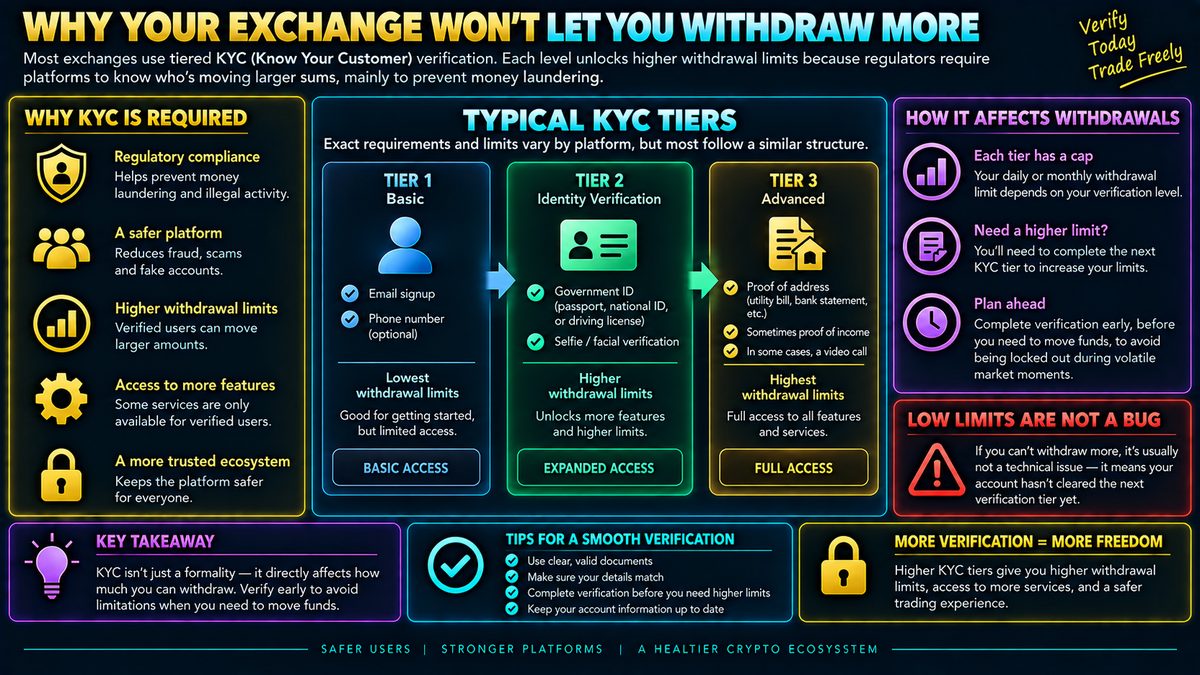
Most exchanges use tiered KYC (Know Your Customer) verification — basic email signup, then ID checks, then proof of address or income, sometimes even a video call. Each tier unlocks higher daily or monthly withdrawal limits because regulators require platforms to know who's moving larger sums, mainly to prevent money laundering. If you're stuck at a low withdrawal cap, it's usually not a bug — it just means your account hasn't cleared the next verification tier yet. Completing verification early, before you need to move funds, avoids being locked out during volatile moments.
What KYC Tiers Actually Mean
KYC stands for Know Your Customer, a process regulated financial platforms use to confirm who their users are. Most crypto exchanges structure this as a series of tiers rather than a single one-time check. The first tier is often just an email address and a password, which lets you browse the platform or maybe deposit a small amount. Each tier after that asks for more proof about who you are, and in exchange unlocks higher withdrawal limits. This structure exists because regulators require financial platforms to apply more scrutiny as the amount of money moving through an account grows.
The logic is not about trusting or distrusting any individual trader. It is a blanket policy applied to every user, because the platform itself is legally required to have systems in place that make large-scale money laundering, fraud, or sanctions evasion harder to hide behind anonymous accounts.
Why the Checks Get Stricter
The first verification step usually involves submitting a government-issued ID, sometimes matched against a selfie or short video to confirm the document belongs to the person holding it. This tier typically raises your daily or monthly withdrawal cap from a very small amount to something more workable for regular trading.
Higher tiers can ask for proof of address, such as a utility bill, or proof of income or source of funds, especially if you want to move very large sums. Some platforms add a live video call for their highest tier. Each additional document exists because regulators expect exchanges to apply more scrutiny in proportion to the size and risk of the transactions being processed. It is not personal, and it is not evidence of suspicion against you specifically.
Why the Cap Feels Frustrating
When a withdrawal fails or gets capped, it is easy to assume something is broken. In most cases the platform is working exactly as designed. The system checks your verification tier before releasing funds, and if your tier's limit is below the amount you are trying to withdraw, the transaction will not go through no matter how many times you retry it.
This becomes especially frustrating during volatile market moments, when traders want to move funds quickly. Verification review times are usually similar regardless of market conditions, so a sudden price swing does not speed up an ID check that might otherwise take a day or more to clear.
Practical Habits Around Verification
Completing higher verification tiers before you actually need the higher limit is generally the simplest way to avoid being stuck. Waiting until you are in the middle of trying to move a large sum means you are relying on a review process to finish quickly, which is not something you control.
It also helps to keep documents current, since expired IDs or mismatched addresses are common reasons a verification submission gets rejected or delayed. Checking what each tier requires in advance, and confirming your account already meets the limit you expect to need, is a small piece of preparation that has nothing to do with predicting markets and everything to do with basic account housekeeping.
Where This Fits With Risk Management
Withdrawal limits are one of many operational details, separate from trading strategy, that can affect your ability to act when you want to. No indicator, chart pattern, or strategy can help if funds are stuck behind a verification tier you have not cleared. Treating account setup, including KYC tiers, as part of your overall risk management is a reasonable habit, since it removes one avoidable source of delay from situations that are already often stressful and unpredictable.