
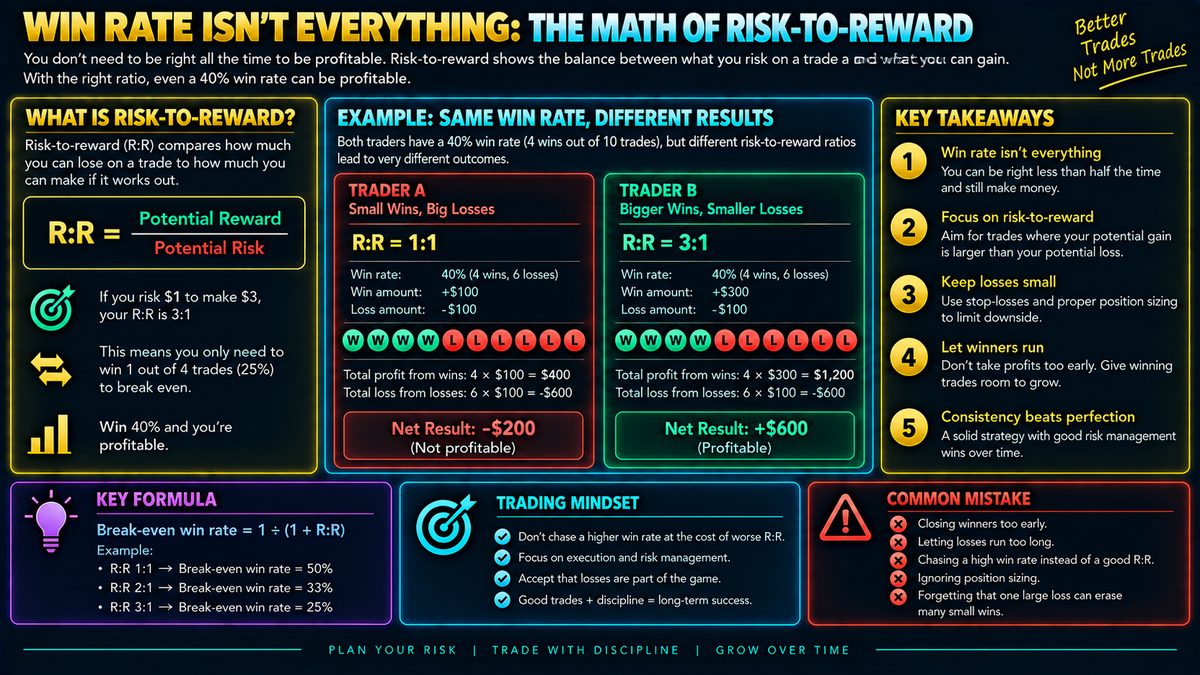
Risk-to-reward compares what you're risking on a trade to what you stand to gain if it works out. If you risk $1 to make $3, you only need to win about 1 in 4 trades to break even — win 40% and you're solidly profitable. That's why chasing a "high win rate" can be misleading if your losses are big and your wins are small. Focus on sizing losses tightly and letting winners run further than what you risk.
What Risk-to-Reward Actually Means
Risk-to-reward is a simple ratio that compares how much you could lose on a trade to how much you could gain if the trade plays out the way you hoped. If you place a stop-loss (a predetermined price where you exit to limit damage) $1 away from your entry, and your target is $3 away, your risk-to-reward ratio is 1:3. You are risking one unit to potentially gain three.
This ratio is separate from win rate, which is simply the percentage of trades that end profitably. Many new traders obsess over win rate alone, assuming a strategy that wins 70% of the time must be good. But win rate means very little without knowing the size of the wins and losses attached to it.
Why Win Rate Alone Can Mislead
Imagine a hypothetical trader who wins 8 out of 10 trades, each earning 50 dollars, but the 2 losing trades each cost 300 dollars. That is an 80% win rate, yet the trader loses money overall: 8 times 50 is 400, while 2 times 300 is 600, for a net loss of 200. A high win rate with poor risk-to-reward can quietly drain an account.
Now imagine the opposite: a trader who wins only 3 out of 10 trades but risks 100 dollars to make 300 on each winner. That is a 30% win rate, yet the trader nets a profit: 3 times 300 is 900, minus 7 times 100 is 700, leaving 200 in profit. This is why traders often say "you don't need to be right often, you need to be right big when you're right."
The Break-Even Math
Every risk-to-reward ratio has a matching break-even win rate, the minimum percentage of wins needed just to avoid losing money over many trades, ignoring fees. With a 1:3 ratio, the math works out to needing roughly 25% winners to break even, because each loss costs one unit while each win returns three. Win above that threshold and the approach is, in theory, profitable over time; win below it and losses compound even if the wins feel satisfying in the moment.
This is only a mathematical framework, not a guarantee. Markets do not care about your ratio, and a string of losses or wins can happen in any order. Real trading also involves fees, slippage (the difference between an expected and actual execution price), and the emotional difficulty of sitting through drawdowns, all of which can erode even a favorable ratio.
Common Mistakes Traders Make
One frequent error is setting a wide stop-loss "just in case" while keeping a tight profit target, which quietly turns a decent setup into a poor risk-to-reward trade. Another is moving stops further away mid-trade to avoid taking a loss, which increases risk without increasing potential reward. Traders also sometimes cut winners short out of fear, converting what could have been a 1:3 trade into something closer to 1:1, undermining the whole math even if the win rate looks fine on paper.
Fitting This Into a Broader Approach
Risk-to-reward should not be viewed in isolation. It works alongside position sizing, deciding how much capital to risk per trade, and overall risk management, such as capping the percentage of an account risked on any single idea. It also pairs with technical or fundamental analysis to decide where entries, stops, and targets make sense in the first place.
No ratio, indicator, or pattern can predict outcomes with certainty. Thinking in terms of risk versus reward simply gives traders a clearer, more honest way to evaluate whether a strategy has a reasonable mathematical foundation before ever placing a trade.