
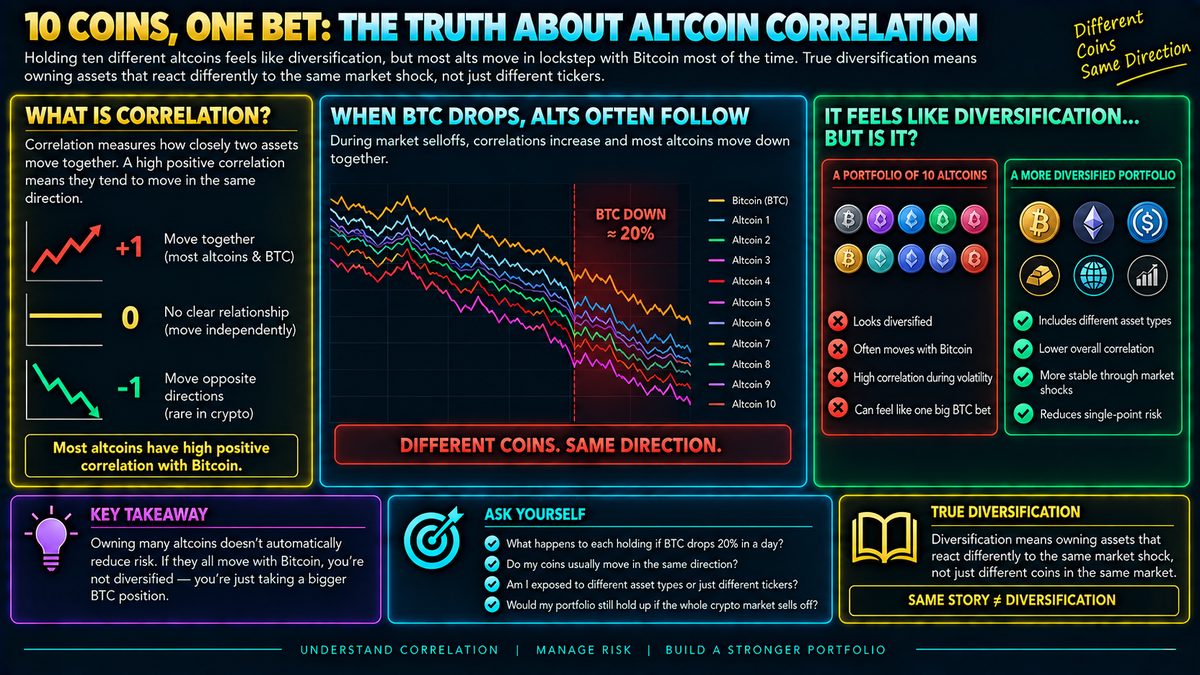
Holding ten different altcoins feels like diversification, but most alts move in lockstep with Bitcoin most of the time — when BTC drops hard, correlations spike and everything red-candles together. True diversification means owning assets that react differently to the same market shock, not just different tickers. Before assuming you're spread out, ask what happens to each holding if BTC drops 20% in a day — if the answer is "the same thing," you're really just running one leveraged BTC position with extra steps.
Why More Coins Doesn't Mean More Safety
Owning ten altcoins can feel like a well-built portfolio simply because there are ten different names, ten different logos, ten different stories. But the number of tickers you hold says nothing about how independently those assets actually behave. Diversification is not about counting positions, it is about how those positions respond when something in the market changes. If all ten respond the same way to the same event, you do not have ten bets, you have one bet wearing ten costumes.
This matters because most altcoins are priced, traded, and psychologically anchored around Bitcoin. Bitcoin is the largest, most liquid, and most widely tracked asset in the space, and it functions as a kind of gravitational center. When it moves sharply, attention, liquidity, and sentiment tend to move with it, pulling smaller coins along for the ride.
What Correlation Actually Means
Correlation is a way of describing how closely two things move together. If two assets are highly correlated, they tend to rise and fall at similar times and often by similar magnitudes. If they are uncorrelated, one can rise while the other falls, or one can stay flat while the other swings wildly. Correlation is not fixed, it changes over time depending on market conditions, and it is usually described as ranging from a strong positive relationship to a strong negative one, with plenty of room for weak or shifting relationships in between.
In calmer periods, altcoins can drift with some independence, driven by their own news, project updates, or niche communities. But this independence tends to be shallow. It exists mainly when nothing major is happening. As soon as a significant shock hits the wider market, that independence often evaporates.
Why Correlations Spike During Stress
Imagine a hypothetical scenario where Bitcoin drops 20% in a single day. In moments like this, traders across the market often reduce risk broadly rather than selectively. Liquidity can thin out, panic selling can spread, and automated systems reacting to volatility can amplify the move. Under this kind of stress, the specific reasons someone originally bought an altcoin, whether a new feature, a partnership, or a community narrative, tend to matter far less than the simple fact that the entire market is repricing risk at once.
This is why altcoins often fall harder than Bitcoin during sharp downturns, even though they may have felt calm or independent just days before. The underlying correlation was there the whole time, it was simply dormant until a shock exposed it.
A Simple Way to Test Your Own Portfolio
A useful mental exercise is to ask, for each coin you hold, what would likely happen to it if Bitcoin fell sharply in a short period. If your honest answer for every single holding is some version of it would probably drop too, then you are not really spread across ten independent ideas. You are holding one leveraged view on Bitcoin's direction, expressed through multiple tickers, often with less liquidity and more volatility than Bitcoin itself.
True diversification would mean having at least some holdings that respond differently to that same shock, whether by falling less, staying flat, or being driven by a completely separate set of factors.
Limits of This Framework and Sensible Risk Management
No correlation measurement is permanent or guaranteed, relationships between assets can shift, weaken, or strengthen unexpectedly. Past co-movement is not proof of future behavior. This is simply a lens for thinking more honestly about concentration risk, not a predictive tool or a signal for action.
Sound risk management still applies regardless of how many coins you hold, including position sizing, understanding your own risk tolerance, and never allocating money you cannot afford to lose to any single narrative, including the narrative of being diversified.