
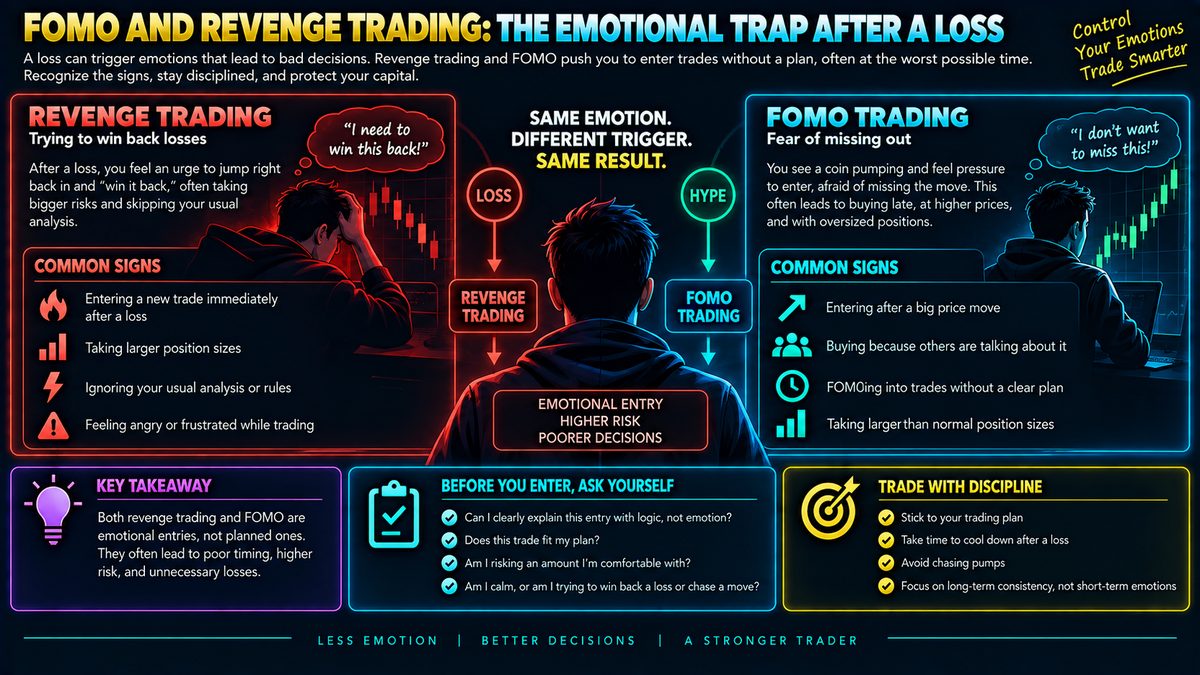
Revenge trading happens when a loss triggers an urge to jump right back in and "win it back," often skipping your usual analysis. FOMO is similar but driven by fear of missing a move, pushing you to enter late and oversized. Both are emotional entries, not planned ones. A simple check: if you can't explain your entry with a clear reason beyond "I need this to work," step back and wait.
What Revenge Trading Actually Is
Revenge trading is the urge to place a new trade immediately after a loss, driven by the desire to "make the money back" rather than by any fresh signal in the market. The loss feels personal, and the mind treats the next trade as a way to undo it, as if the market owes something back. In reality, each trade is independent. A coin that just cost you money has no memory of that loss and no obligation to reward you next.
This pattern often shows up as sizing up. If a trader normally risks a small, fixed amount per trade, a revenge trade might use double or triple that size, because the goal has shifted from following a plan to erasing a feeling. That shift is the core danger: the trade is now driven by emotion management, not market analysis.
What FOMO Looks Like
FOMO, short for fear of missing out, is a different emotional trigger but leads to similarly impulsive entries. It happens when a trader watches a price move sharply, imagine a coin trading at 100 that quickly climbs to 130, and feels an urgent need to get in before it moves further. The entry is reactive, based on watching other people seemingly profit, rather than on a setup that was identified in advance.
FOMO entries tend to happen late, near the end of a move, and often oversized because the trader is trying to catch up rather than following a predetermined position size. The irony is that FOMO and revenge trading often feed each other in a cycle. A missed move triggers FOMO, a bad FOMO entry causes a loss, and the loss triggers revenge trading, which risks compounding the damage.
Why These Patterns Form
Both patterns come from the same underlying source, an emotional reaction overriding a rational process. Losses trigger frustration or a sense of unfairness. Missed opportunities trigger anxiety about being left behind. Markets are especially good at provoking both feelings because prices move continuously and publicly, and every uninvested moment can feel like a missed chance or an unresolved failure.
There is also a psychological pull toward feeling in control again. After a loss, sitting still can feel worse than acting, even if acting is not backed by any real analysis. Taking a new position, even a poorly reasoned one, creates an illusion of regaining control over an outcome that was never fully controllable in the first place.
A Simple Check Before Entering
One practical habit is to ask, before clicking anything, whether the entry can be explained using a reason that existed before the current emotional moment. That might be a specific setup, a level, a plan made earlier when calmer. If the only honest answer is something like "I need this to work" or "I can't miss this," that is a signal to pause rather than act.
Stepping back does not mean the opportunity or the loss disappears. Markets tend to offer many opportunities over time, and no single trade defines a trading record. Waiting a few minutes, writing down the reasoning, or simply closing the screen for a while can interrupt the emotional loop before it turns into an oversized or poorly timed position.
Fitting This Into a Broader Plan
Managing FOMO and revenge trading works best alongside basic risk management, such as deciding position size and stop levels before entering a trade, not after a loss or during a rally. Keeping a simple trading journal that records the reason for each entry can make emotional trades easier to spot in hindsight, which helps reduce them over time.
None of this guarantees better outcomes, since markets remain unpredictable and no habit removes risk entirely. But recognizing these emotional triggers as patterns, rather than isolated moments of weakness, is often the first step toward trading with more consistency and less regret.