
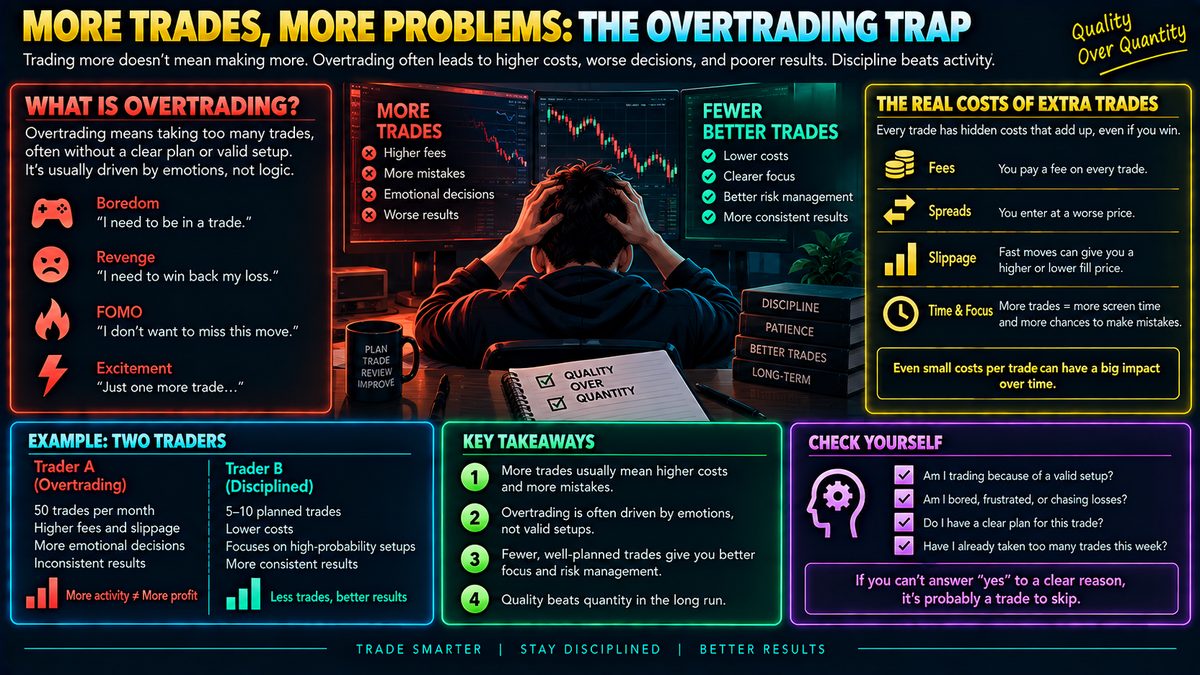
Overtrading happens when you take trades out of boredom, revenge, or fear of missing out rather than a real setup. Every extra trade adds fees, spreads, and slippage, which quietly eat into profits even if you're "right" often. It also spreads your focus thin, making it harder to manage risk properly on any single position. Fewer, well-planned trades based on a clear strategy usually beat a high volume of impulsive ones.
What Overtrading Actually Looks Like
Overtrading is not about a specific number of trades per day. It is about the reason behind each trade. A trader following a clear plan might take several trades in a session because several valid setups appeared. That is not overtrading. Overtrading is when trades are entered because of boredom, because a previous loss stings and you want to "win it back" (often called revenge trading), or because you see a coin moving fast and fear missing out (FOMO) on the move. The common thread is that the decision comes from emotion or restlessness rather than from a predefined strategy or checklist.
This pattern often sneaks in quietly. A trader might start the day with discipline, then after a loss or a slow market, begin clicking into trades just to feel active or to feel in control again. The market itself did not change; the trader's decision-making process did.
How the Costs Quietly Add Up
Every trade carries some cost, even a winning one. There are trading fees charged per transaction, the spread (the small gap between the buy and sell price), and slippage, which is the difference between the price you expected and the price you actually got, especially in fast or thin markets. On a single trade these costs might look tiny. Multiply them across dozens of unnecessary trades and they can quietly consume a meaningful share of profits, sometimes turning an otherwise profitable strategy into a break-even or losing one.
This is a purely mathematical problem, separate from whether your trade ideas were good or bad. A trader can be "right" about market direction more often than not and still lose money overall simply because the frequency of trading generates more costs than the edge can cover.
Why Frequency Weakens Risk Management
Good risk management, such as setting a stop-loss (a predetermined exit point to limit losses) or sizing a position appropriately relative to your account, requires attention and discipline for each individual trade. When a trader is juggling many impulsive positions at once, that attention gets divided. It becomes easier to forget a stop-loss, misjudge position size, or hold a losing trade too long simply because there is no mental bandwidth left to track it properly.
Fewer trades, chosen carefully, allow a trader to actually follow through on the risk plan for each one, rather than treating risk management as an afterthought squeezed in between rapid-fire decisions.
Common Triggers and Self-Checks
Boredom during slow markets, frustration after a loss, and FOMO during sudden price spikes are the three triggers that most commonly lead to overtrading. Recognizing these feelings as they arise is more useful than trying to count trades after the fact. A simple habit some traders use is pausing before every entry to ask whether the trade matches a written rule in their plan, or whether it is being taken purely because of a feeling in the moment.
Keeping a trading journal that records the reason for each trade can also make overtrading visible over time, since patterns of impulsive entries tend to stand out once written down.
Where This Fits Into a Broader Strategy
Avoiding overtrading is not a standalone fix; it works alongside having a clear strategy with defined entry and exit criteria, a consistent position-sizing rule, and realistic expectations about win rates. No strategy or indicator guarantees profit, and reducing trade frequency does not by itself make a trader profitable. It simply removes one common source of unnecessary cost and error, leaving more room for the underlying strategy, whatever it is, to actually be tested fairly.