
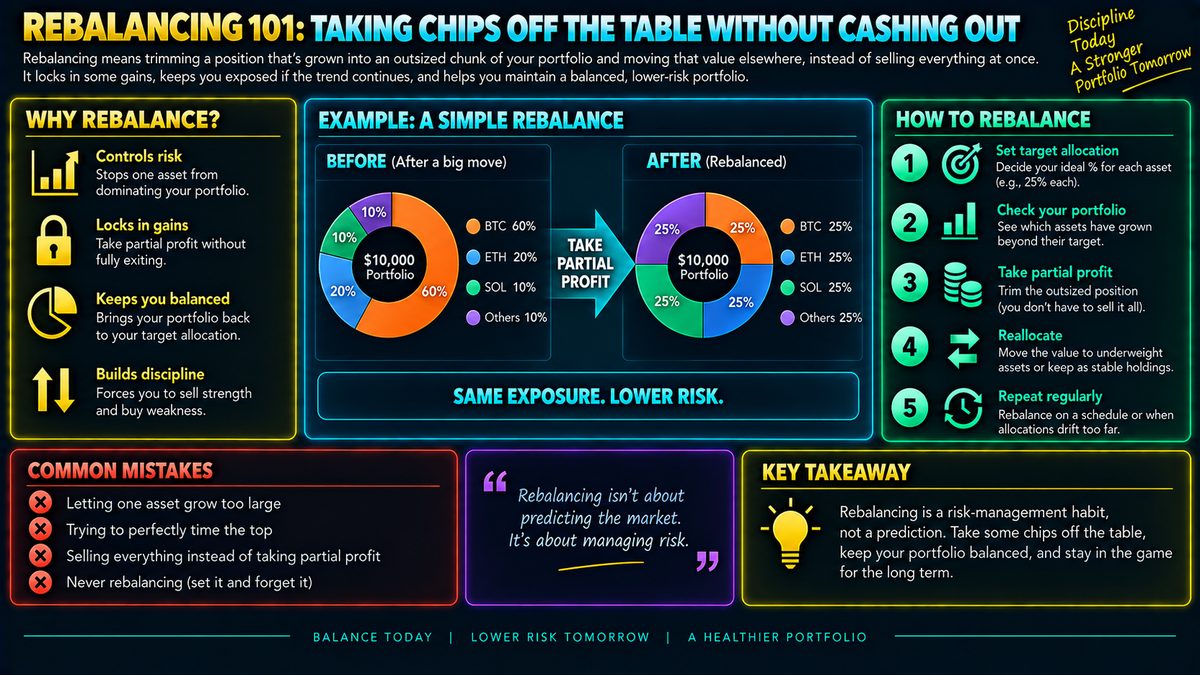
Rebalancing means trimming a position that's grown into an outsized chunk of your portfolio and moving that value elsewhere, instead of selling everything at once. If one asset runs up hard, it can end up dominating your risk without you realizing it — taking partial profit brings it back in line with your original targets. This locks in some gains, keeps you exposed if the trend continues, and forces the classic discipline of selling strength and buying weakness. It's a risk-management habit, not a prediction about where price goes next.
What Rebalancing Actually Means
Rebalancing is the process of adjusting your portfolio back toward a set of target weights after prices move and throw those weights out of alignment. Imagine you started with a portfolio where one coin was meant to be 20 percent of your holdings. If that coin doubles in price while everything else stays flat, it might now represent 35 percent of your total portfolio value. Rebalancing means trimming some of that position and redistributing the proceeds so the coin returns closer to its original 20 percent target, rather than letting it silently become the dominant driver of your results.
This is different from panic selling or from an all-or-nothing exit. You are not declaring the asset is bad or that its run is over. You are simply acknowledging that your risk exposure has drifted away from what you originally intended, and you are nudging it back.
How Positions Drift Without You Noticing
Portfolios drift because prices move at different speeds. A position that performs well grows faster than the rest of your holdings, and compounding gains can make that drift accelerate quietly over weeks or months. You might check your holdings one day and realize a single asset now represents far more of your total risk than you ever consciously chose.
This matters because concentration risk is not always obvious in percentage terms. A coin that grew from 20 percent to 35 percent of your portfolio has not just grown in value, it has grown in influence over your overall outcome. If that asset were to fall sharply, the damage to your total portfolio would now be proportionally larger than you originally planned for.
The Mechanics of Trimming
Rebalancing typically means selling a portion, not all, of an oversized position and reallocating that value elsewhere, whether into cash, into other assets that have lagged behind, or into a stablecoin as dry powder. The goal is to bring the position back toward its original target weight, not to zero it out.
Some traders rebalance on a fixed schedule, such as monthly or quarterly. Others rebalance based on thresholds, only acting once a position drifts a certain number of percentage points away from its target. Both approaches share the same underlying discipline: they force you to sell into strength and, when redistributing funds, potentially add to weakness, which is the opposite of what emotion usually tells people to do.
What Rebalancing Locks In and What It Doesn't
Trimming a winning position locks in a portion of the paper gains as realized value, which reduces your exposure if the trend reverses. At the same time, you remain invested in the asset, so you still participate if the uptrend continues. This is the core trade-off: you give up some potential upside in exchange for reduced downside concentration.
Rebalancing says nothing about where price is headed next. It is not a signal that a top is in or that a reversal is coming. It is a mechanical risk-management habit, applied regardless of your view on future price direction.
Common Mistakes and Limitations
A common mistake is rebalancing too frequently, which can rack up transaction costs and taxable events for very small adjustments. Another is abandoning the discipline exactly when it matters most, holding on through a large runup because it feels wrong to sell something that keeps going up, then having no plan when it eventually turns.
Rebalancing also assumes your original target weights were reasonable in the first place. It cannot fix a portfolio that was poorly constructed or overly concentrated from the start. It works best as one part of a broader risk framework, alongside position sizing, diversification, and clear thinking about how much loss you can tolerate, rather than as a standalone strategy.