
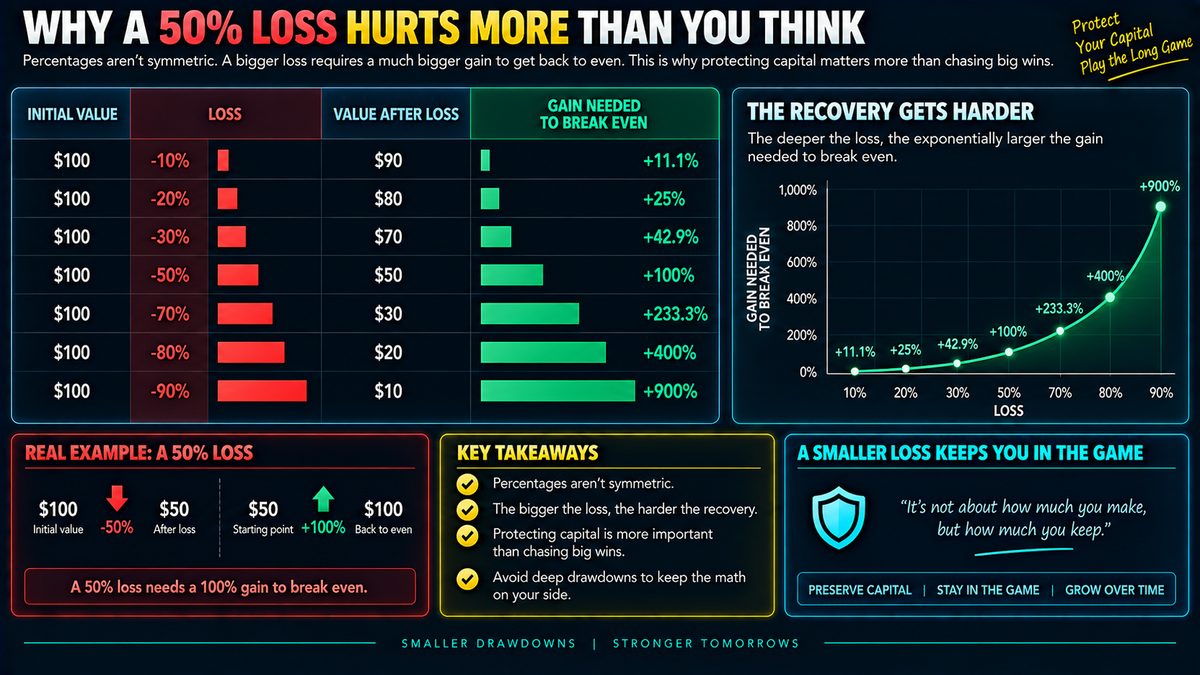
Percentages aren't symmetric. If your portfolio drops 50%, you don't need a 50% gain to recover — you need 100%, because you're now growing from a much smaller base. Lose 80% and you need a 400% gain just to get back to even. This is why protecting capital matters more than chasing big wins: avoiding deep drawdowns keeps the math on your side. The bigger the loss, the exponentially harder the comeback.
The Math Behind the Pain
Imagine a portfolio worth 100. If it falls 50 percent, it is now worth 50. To get back to 100, that 50 has to grow by 100 percent, not 50 percent. This is because percentage losses and percentage gains are measured against different bases. The loss is measured against the original, larger amount, while the recovery gain is measured against the new, smaller amount. That mismatch is what makes losses so much harder to undo than they first appear.
The effect gets worse as losses get bigger, and not in a straight line. A 20 percent loss needs a 25 percent gain to recover. A 50 percent loss needs a 100 percent gain. An 80 percent loss needs a 400 percent gain. A 90 percent loss needs a 900 percent gain. Each extra bit of drawdown demands a disproportionately larger comeback, which is why this relationship is often described as exponential rather than linear.
Why Traders Underestimate This
Most people intuitively think of losses and gains as mirror images, so a 50 percent drop feels like it should be undone by a 50 percent rise. This is one of the more common blind spots in trading psychology. It matters because it can lead someone to hold a losing position far longer than planned, telling themselves the recovery is just one good move away, when in reality the math has quietly stacked the odds against them.
This is also why drawdown, meaning the decline from a portfolio's peak value to its lowest point before a new peak, is watched so closely by experienced traders and fund managers. A strategy that avoids large drawdowns, even if its average returns look modest, can outperform a flashier strategy that occasionally suffers deep losses, simply because deep losses are so costly to reverse.
How This Shapes Risk Management
Because the math punishes large losses so severely, many trading approaches focus on limiting how much of a portfolio is risked on any single trade or position. Common tools include position sizing, where only a small fraction of total capital is committed to any one trade, and stop losses, which are predetermined exit points designed to cap how far a loss can run before it is closed out.
Diversification, meaning spreading capital across different assets rather than concentrating it in one, can also help reduce the odds of a single event causing a catastrophic drawdown. None of these tools guarantee protection, and losses are a normal part of trading, but the goal is to keep any individual loss small enough that recovery remains realistic rather than requiring an outsized rebound.
Common Mistakes to Avoid
A frequent mistake is chasing large, infrequent wins to compensate for earlier losses, sometimes by increasing position size after a drawdown in hopes of recovering faster. This can amplify the damage if the market moves the wrong way again. Another mistake is ignoring drawdown entirely and focusing only on potential upside, which overlooks how much harder recovery becomes once losses grow large.
It is also worth remembering that no risk management technique, position size, or stop loss can eliminate the possibility of loss altogether. Markets are unpredictable, and every method has limitations. Understanding the asymmetry between losses and the gains needed to recover is simply one way to think more clearly about risk, not a guarantee of any particular outcome.