
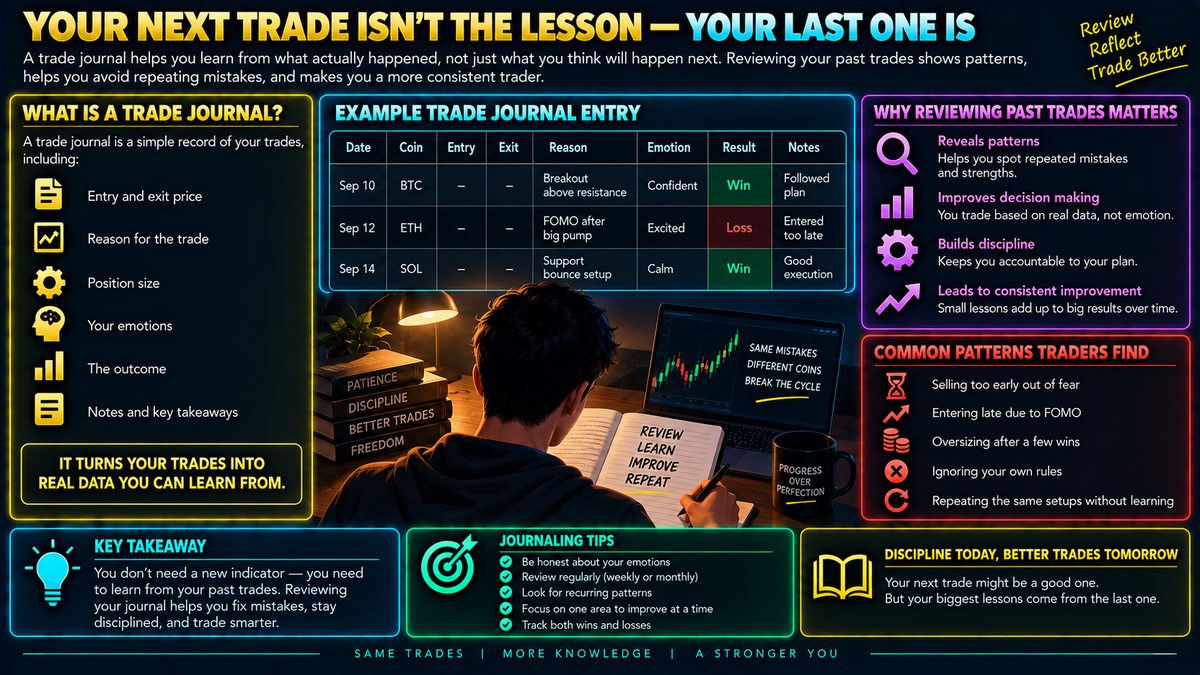
A trade journal is a simple log of what you entered, why, and what happened after — price, reasoning, emotion, outcome. Most traders chase the next setup instead of studying the last one, which means they repeat the same mistakes with different coins. Reviewing past entries shows you patterns: maybe you always sell too early out of fear, or oversize when you're on a winning streak. Fix those patterns and your results improve without needing a single new indicator.
What A Trade Journal Actually Is
A trade journal is nothing more than a written record of your trading decisions. For every trade you take, you note the basics: what you bought or sold, the price you entered at, roughly why you entered (what setup, signal, or reasoning triggered the trade), how big the position was relative to your account, and what happened afterward. Some traders also jot down how they felt before, during, and after the trade — calm, anxious, greedy, bored. That emotional note often turns out to be the most valuable line in the entry.
None of this requires special software. A simple spreadsheet or even a notebook works. The point isn't the format, it's the habit of writing things down before memory gets rewritten by hindsight. Once a trade is closed, it is very easy to convince yourself you "knew" it would work out, or that a loss was just bad luck. A journal written in the moment removes that fog.
How Patterns Emerge From The Log
A single trade tells you almost nothing. Ten trades start to hint at something. Fifty or a hundred trades, reviewed honestly, tend to reveal repeating behavior that you would never notice trade by trade. Maybe you consistently exit winning positions within minutes out of fear they'll reverse, leaving profit on the table. Maybe after two or three wins in a row you increase position size sharply, right before a losing streak begins. Maybe you keep entering trades based on excitement about a coin's story rather than any actual plan.
These patterns are invisible in the moment because each trade feels like its own unique situation with its own justification. It's only when you lay them side by side that the repetition becomes obvious. This is the core value of journaling: it turns a blur of individual decisions into a dataset you can actually study.
Reading Your Own History Honestly
The review process matters as much as the logging. Set aside time, weekly or monthly, to read back through recent entries without judging yourself too harshly or too leniently. Look for repeated triggers: certain market conditions, certain emotional states, certain types of setups that keep leading to the same outcome, good or bad.
It helps to separate process from result. A trade can be well-reasoned and still lose money, and a poorly-reasoned trade can still win by chance. Journaling lets you judge your decision-making quality over time rather than getting fooled by the outcome of any single trade, which is largely noise.
Common Mistakes When Journaling
Many traders start a journal, log a handful of entries, then stop once the excitement fades or once they hit a losing stretch they don't want to look at. Others only log the trades they're proud of, which defeats the purpose. A useful journal has to include the boring trades and the embarrassing ones.
Another mistake is recording only numbers and skipping the reasoning and emotion. Price and outcome alone can't tell you why you made a decision. Without that context, the review months later has nothing to learn from.
Fitting It Into A Bigger Trading Practice
A journal isn't a strategy, an indicator, or a signal generator, and it won't tell you what to trade next. Its role is self-awareness, which sits alongside risk management, position sizing rules, and whatever technical or fundamental approach you use to find trades. No log can guarantee better results, and past patterns in your own behavior don't promise future ones will match. Markets change, and so do you. But consistently reviewing what you actually did, rather than what you meant to do, is one of the few genuinely free tools available to any trader willing to be honest with themselves.