
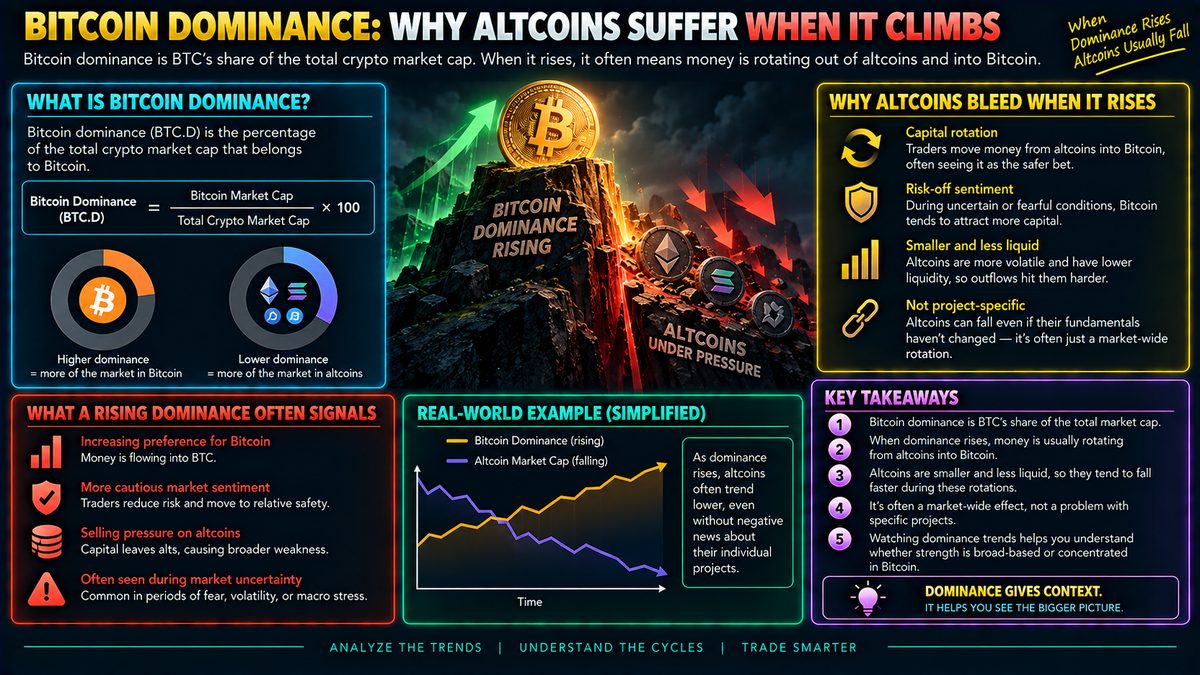
Bitcoin dominance is simply BTC's share of the total crypto market cap. When it rises, it usually means money is rotating out of altcoins and into Bitcoin, often because traders see it as the safer bet during uncertain or fearful conditions. Altcoins are smaller and less liquid, so when capital flows out of them into BTC, their prices can fall even if nothing bad is happening with those specific projects. Watching dominance trends helps you understand whether market strength is broad-based or concentrated in Bitcoin alone.
What Bitcoin Dominance Actually Measures
Bitcoin dominance is a percentage that shows how much of the entire crypto market's total value, or market capitalization, is made up of Bitcoin alone. Market capitalization, often shortened to market cap, is calculated by multiplying a coin's price by the total number of coins in circulation. If you add up the market caps of every cryptocurrency and then work out what share of that total belongs to Bitcoin, you get the dominance figure.
This number moves for two reasons. Either Bitcoin's price is rising or falling faster than the rest of the market, or new coins are being created and gaining value, which dilutes the total pool. Because thousands of altcoins, meaning any cryptocurrency that is not Bitcoin, exist alongside Bitcoin, dominance is really a snapshot of relative strength rather than an absolute measure of health.
How Rising Dominance Affects Altcoins
When dominance climbs, it usually means capital is rotating toward Bitcoin and away from altcoins. Many traders treat Bitcoin as the relatively safer or more established asset within crypto, so during periods of uncertainty, fear, or reduced risk appetite, money tends to concentrate there first. This is sometimes described informally as a flight to quality within the crypto space, borrowing a phrase from traditional markets.
Altcoins are generally smaller and less liquid, meaning there are fewer buyers and sellers actively trading them compared to Bitcoin. When even a modest amount of capital exits altcoins simultaneously, their prices can drop noticeably, even though nothing has actually changed about the underlying project, its technology, or its team. This disconnect between price action and fundamentals is a key reason dominance is worth understanding.
Reading Dominance Trends in Context
A rising dominance line does not automatically mean altcoins are doing something wrong. It might simply mean Bitcoin is attracting more attention or capital at that moment. Conversely, falling dominance often coincides with periods traders informally call altcoin seasons, where capital spreads out into smaller projects, sometimes chasing higher potential returns once confidence in the broader market improves.
Traders often use dominance alongside overall market cap trends. If total market cap is rising while dominance is also rising, it can suggest new money is entering the market broadly but concentrating in Bitcoin. If total market cap is falling while dominance rises, it may suggest a defensive shift within existing capital rather than new capital entering at all. Neither scenario guarantees what happens next.
Common Mistakes and Limitations
A frequent mistake is treating dominance as a precise timing tool, as if crossing some specific level guarantees an imminent rotation into or out of altcoins. Dominance is a lagging, aggregate measure built from thousands of assets with wildly different liquidity and behavior, so it smooths over a lot of nuance and can shift due to a handful of very large coins rather than the market as a whole.
Another limitation is that dominance calculations can be affected by how data providers classify or include certain assets, which means figures can vary slightly between sources. It also says nothing about why capital is moving, only that it appears to be.
Using Dominance With Other Tools
Dominance works best as one input among several, not a standalone signal. Pairing it with volume data, volatility measures, and basic risk management such as position sizing and predefined stop levels gives a more balanced picture than watching dominance alone. No single metric, including this one, can reliably predict future price movements, and treating it as a guarantee rather than a contextual clue is a common way traders overestimate its usefulness.