
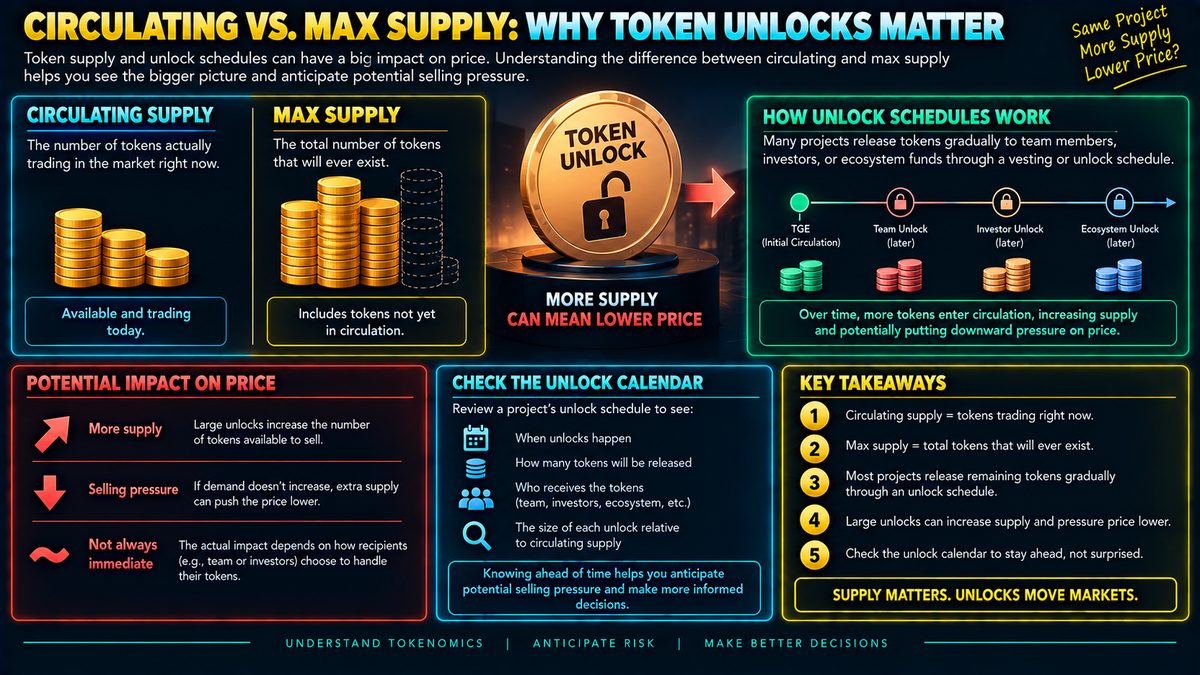
Circulating supply is the number of tokens actually trading right now, while max supply is the total that will ever exist. Many projects release the rest gradually to team members, investors, or ecosystem funds through a vesting or "unlock" schedule. When a large unlock hits, those newly available tokens can be sold, increasing supply against existing demand and pressuring price lower. Checking a project's unlock calendar helps you anticipate potential selling pressure before it happens, rather than being surprised by it.
Supply Basics: Circulating, Total, and Max
Every token generally has a few different supply figures worth knowing. Circulating supply is the number of tokens currently accessible and tradable in the open market. Total supply usually includes circulating tokens plus any that exist but are locked, reserved, or not yet distributed. Max supply is the hard cap on how many tokens will ever be created, if one exists at all, since some projects have no fixed ceiling and can mint more indefinitely.
The gap between circulating supply and max supply matters because it represents tokens that could eventually enter the market. Imagine a hypothetical coin with 100 million tokens circulating out of a max supply of 500 million. That means 400 million tokens are still waiting to be released somewhere down the line, and how and when that happens can meaningfully affect the token's future supply picture.
Where the Rest of the Supply Comes From
Tokens that are not yet circulating typically sit with specific groups. Founding teams and early employees often receive allocations as compensation. Venture investors or early backers frequently buy in at discounted prices before public trading begins. Ecosystem or treasury funds may be set aside for future development, grants, or partnerships. Instead of releasing all these tokens immediately, projects commonly use a vesting schedule, which gradually unlocks tokens over months or years.
Vesting exists partly to align incentives, since team members and investors are encouraged to stay committed rather than sell everything right away. It also theoretically smooths out supply increases over time rather than dumping everything on day one.
What Happens When Tokens Unlock
An unlock is the moment when previously restricted tokens become available to move, transfer, or sell. When a large unlock occurs, the holders receiving those tokens are not required to sell, but many choose to, especially early investors looking to realize gains or team members diversifying their holdings. If a meaningful chunk of new supply enters the market without a matching increase in buying demand, basic supply and demand dynamics suggest downward price pressure is more likely, though it is never guaranteed.
This does not mean every unlock leads to a price decline. Demand conditions, overall market sentiment, and the size of the unlock relative to daily trading volume all play a role. A small unlock in a highly liquid market may barely register, while a large unlock in a thinly traded token could have a more noticeable effect.
Reading an Unlock Calendar
Many projects publish or disclose their vesting and unlock schedules publicly, and third-party trackers often compile this information into calendars. Reviewing these schedules can help traders understand when large releases are expected, who is receiving the tokens, and what percentage of circulating supply the unlock represents. Comparing the unlock size to average daily trading volume gives a rough sense of how significant the event might be.
This is a research habit, not a predictive tool. Knowing an unlock is coming does not tell you what will happen to price, since markets can price in expectations ahead of time, react less than anticipated, or respond to unrelated news instead.
Limitations and Putting It in Context
Unlock schedules are just one piece of a broader picture. They should be considered alongside overall market conditions, project fundamentals, trading volume, and other technical or on-chain factors. Relying on any single data point, including unlocks, can lead to overconfidence.
Sensible risk management still applies regardless of what a calendar shows. That includes position sizing, avoiding overexposure to any single token, and accepting that supply data is informative context, not a signal that removes uncertainty from a decision.