
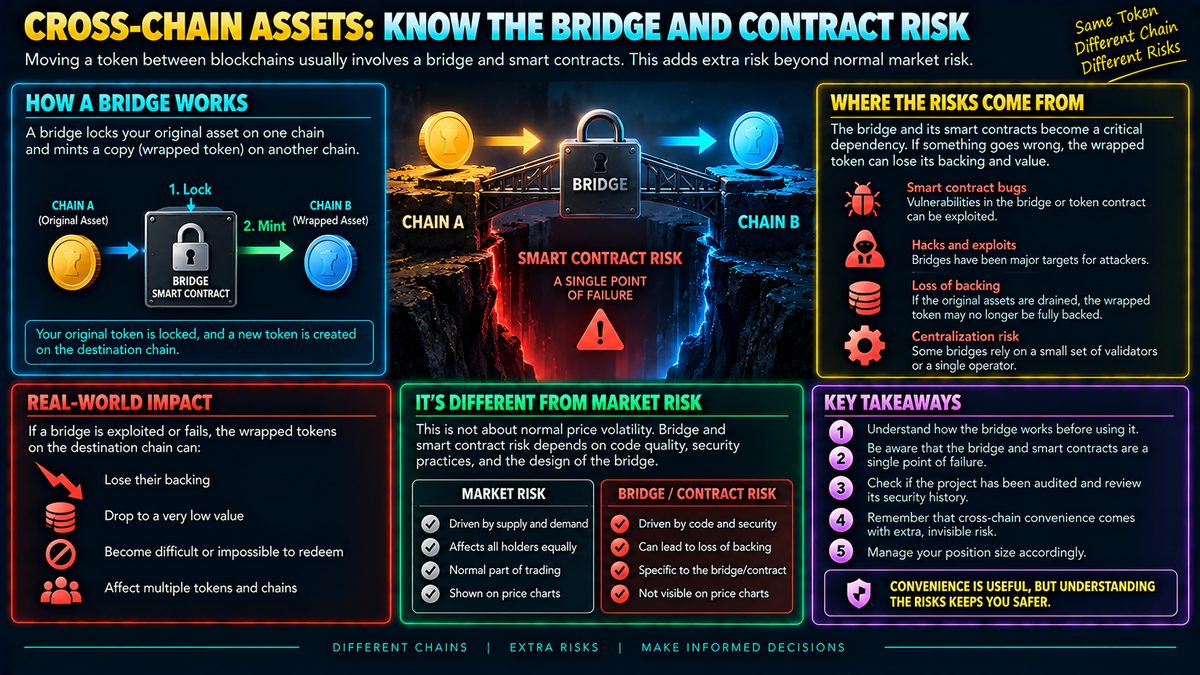
When you move a token from one blockchain to another, you're usually using a "bridge" — a smart contract that locks your original asset and mints a copy on the new chain. That contract, and the code behind the bridge itself, becomes a single point of failure: if it has a bug or gets exploited, the wrapped asset you're holding can lose its backing and its value. This is separate from normal market risk, since it depends on code quality and audits, not price action. Before using any bridge, understand that convenience often comes with extra, invisible risk layered on top of the asset itself.
What A Bridge Actually Does
Blockchains are mostly separate systems that do not talk to each other natively. A bridge is the piece of software that lets a token "move" from one chain to another. In most designs, your original token gets locked in a smart contract, which is a program that runs automatically on the blockchain, on the chain you started from. In exchange, a new token is minted on the destination chain that is meant to represent the same value. This new token is often called a wrapped asset, because it wraps a claim on the original locked coin rather than being that coin itself.
This setup is convenient. It lets you use one chain's ecosystem while technically holding value that originated somewhere else. But it also means you are no longer holding the original asset directly. You are holding a promise, backed by code, that the wrapped token can eventually be redeemed for the real thing.
Where The Risk Actually Lives
The core risk is that the wrapped token is only as good as the contract and system backing it. If the bridge's code has a flaw, or if the people running it make a mistake in how funds are secured, an attacker may be able to drain the locked assets without burning the corresponding wrapped tokens. When that happens, the wrapped tokens still exist and still trade, but the backing behind them is gone or reduced. Holders can be left with a token that has lost some or all of its value, even though nothing happened to the price of the original asset on its home chain.
This is fundamentally different from normal market risk. Market risk comes from supply and demand, sentiment, and macro conditions. Bridge risk comes from software design, key management, and how much trust is placed in a small group of validators or operators. A token can be doing nothing unusual in terms of price and still become worthless overnight if the bridge behind it fails.
Reading The Warning Signs
There is no perfect way to judge a bridge from the outside, but a few habits help. Check whether the bridge's contracts have been reviewed by independent security firms, commonly called audits, and understand that even audited code can still contain missed issues. Look at how long the bridge has been operating and whether it has handled meaningful volume without incident, though past stability is not a guarantee of future safety. Consider how much control rests with a small number of parties versus being spread across many independent validators, since concentrated control is generally a larger single point of failure.
Common Mistakes To Avoid
A frequent mistake is treating a wrapped token as fully interchangeable with the original asset, when in practice its value depends entirely on the bridge staying solvent and secure. Another mistake is moving large amounts through a bridge simply because it is fast or cheap, without checking how established or tested it is. Some traders also assume that because a bridge is popular, it must be safe, but popularity reflects usage, not security.
Fitting This Into Risk Management
Because bridge risk sits outside normal price analysis, it needs its own place in your thinking. Diversifying where you hold wrapped assets, avoiding leaving large amounts parked in a bridge longer than necessary, and treating any bridged token as carrying extra risk on top of the underlying asset are reasonable habits. None of this removes risk entirely, and no audit or track record guarantees safety. Understanding that convenience often hides an additional layer of code risk is simply part of using cross-chain assets responsibly.