
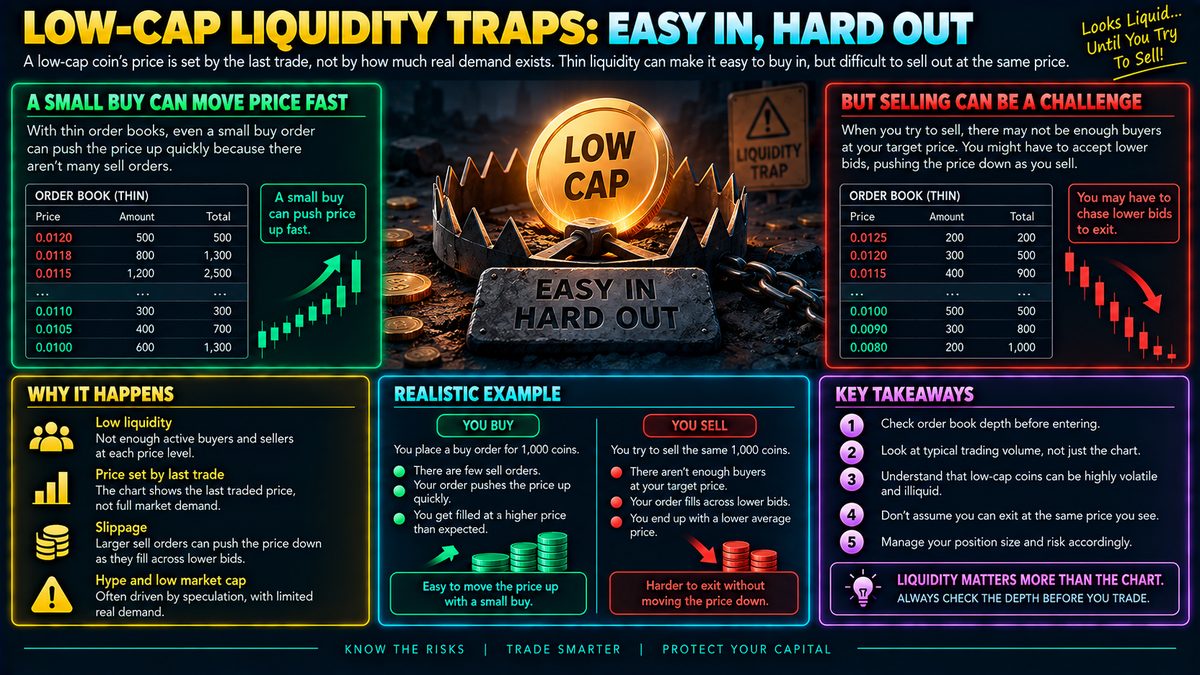
A low-cap coin's price is set by the last trade, not by how much real demand exists behind it. With thin order books, even a small buy order can push price up fast, but when you try to sell, there may not be enough buyers waiting to absorb your size at that level. So you end up chasing lower bids down just to exit. Always check order book depth and typical trading volume, not just price charts, before assuming you can exit at the price you see.
Why Price Alone Can Be Misleading
When you look at a chart, you see one number: the price of the most recent trade. That number tells you nothing about how much buying or selling interest exists around it. A coin can show a price of, say, 100 units even if the next real buyer is only willing to pay 60. Low-cap coins, meaning cryptocurrencies with a small total market value and relatively few holders, are especially prone to this because so few trades are needed to move the price a lot. The last trade might have been for a tiny amount, yet it sets the reference point everyone sees.
What an Order Book Actually Shows
An order book is a live list of buy orders (bids) and sell orders (asks) waiting to be filled at various prices. Liquidity refers to how much size sits close to the current price on both sides. In a liquid market, there are many orders stacked at small price increments, so a trade of reasonable size barely moves the price. In a thin, or illiquid, order book, there might be only a handful of orders, spread far apart. This means a modest buy can leap through several price levels because there is nothing there to absorb it, and the same is true in reverse when you try to sell.
How the Trap Forms
Imagine a coin with very few active traders. Someone places a modest buy order, and because there are barely any sell orders stacked above the current price, that single order pushes the price up sharply. Other traders see the price jump and assume strong demand, so more buyers pile in, pushing it higher still. But this apparent strength can be an illusion built on very little actual trading activity. When you decide to sell, you discover the bids waiting to buy from you are thin and far below the price you saw. To exit, you may need to accept progressively lower prices, selling into weaker and weaker bids just to get filled, which can turn a paper gain into a real loss.
Volume as a Reality Check
Trading volume, the total amount of the asset bought and sold over a period, helps reveal whether a price move reflects broad participation or just a few trades. A price that has risen sharply on very low volume is more fragile than the same move backed by consistent, higher volume over time. Before assuming you can exit near the price you see, it helps to look at both the order book depth and recent volume patterns, not just the chart. If the size you intend to trade is large relative to typical volume or the visible depth, your own order could be the thing that moves the market against you.
Managing the Risk
There is no indicator or setup that guarantees you can exit at a favorable price, especially in thinly traded markets. Reasonable habits include checking depth on both sides of the order book before entering, sizing positions relative to typical volume rather than account size alone, and accepting that a full exit may require multiple smaller trades over time rather than one clean sale. Combining this awareness with broader risk management, such as not concentrating too much capital in a single low-liquidity asset, helps limit the damage when getting out proves harder than getting in. This is general market awareness, not a signal about what to buy or sell.