
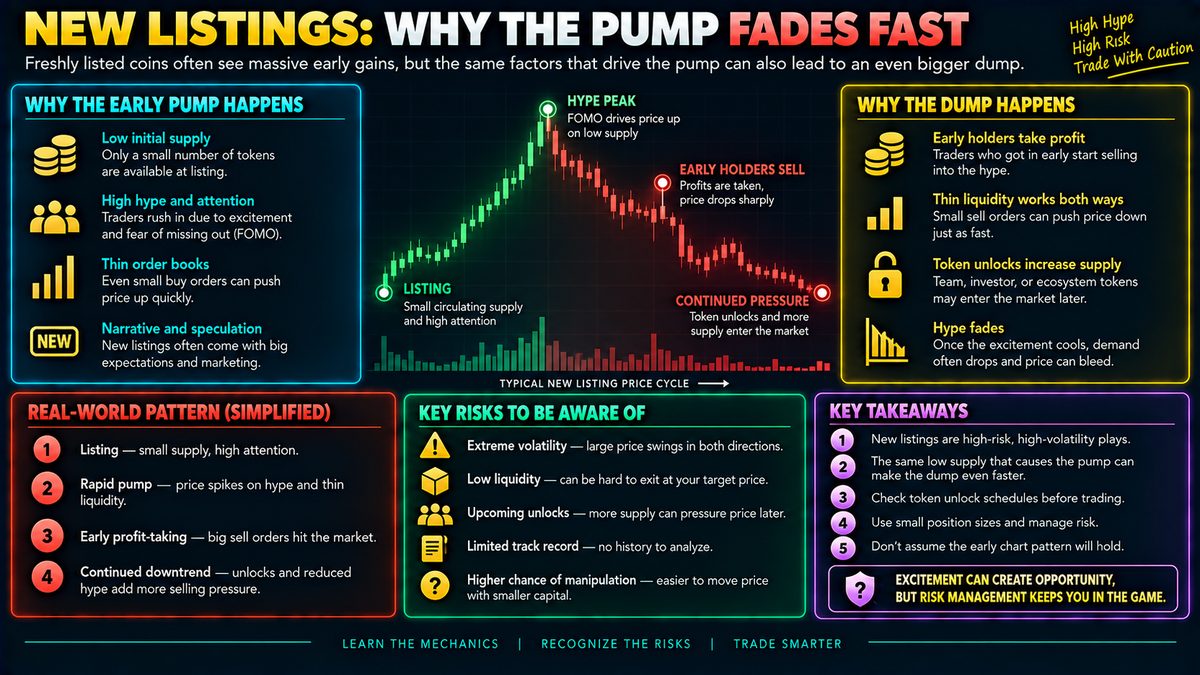
When a coin first lists, supply is tiny and early buyers are often driven by hype or fear of missing out, so price can spike quickly on thin order books. That same thin liquidity means small sell orders can crash price just as fast once early holders take profit. Add in unlocked team/investor tokens hitting the market later, and the initial pump often turns into a slow bleed. Treat new listings as high-risk, high-volatility plays — size positions small and never assume the early chart pattern will hold.
Why New Listings Move So Fast
When a coin first becomes available to trade, only a small portion of its total supply is usually in public hands. Early investors, the project team, and sometimes a small pool of retail buyers hold most of the coins, while the actual amount changing hands on the open market is tiny. This is often called thin liquidity, meaning there are not many buy and sell orders sitting on the order book at any given price.
Because the order book is thin, it does not take much buying pressure to push the price up sharply. A handful of eager traders placing market orders can move the price far more than the same amount of money would move a coin with deep, established liquidity. This is why new listings often show dramatic green candles in their first hours or days, giving the impression of unstoppable momentum.
The Same Thinness Works in Reverse
Thin liquidity is a double-edged sword. Just as small buy orders can send price soaring, small sell orders can send it crashing. Once early buyers who got in near the very start decide to lock in gains, their selling can overwhelm the order book just as easily as the initial buying did. A handful of large holders exiting at once can erase a large percentage of the price in minutes.
This is compounded by the psychology of new listings. Much of the early buying is driven by hype, social media attention, or fear of missing out rather than any assessment of the project's fundamentals. When that emotional energy fades, or when a bigger opportunity distracts traders elsewhere, buying interest can dry up almost as fast as it appeared, leaving the price with little support.
Unlocks and Slow Bleeds
Many new coins have token allocations set aside for the founding team, early investors, or advisors. These allocations are frequently locked for a period and released gradually over time, a process often called vesting or unlocking. When these unlocks occur, holders who bought in at very low prices before the public listing may sell to realize profits, adding steady new supply to the market.
This can create a pattern where an initial pump gives way not to a single crash but to a prolonged, grinding decline as unlock events continue to introduce new sellers over weeks or months. A chart that looked exciting in its first days can quietly bleed lower for a long stretch afterward, catching traders who assumed the early trend would continue.
Reading the Pattern Without Overtrusting It
Recognizing this pump-then-fade tendency can help traders set realistic expectations, but it is not a rule that always plays out the same way, and no chart pattern or indicator guarantees a particular outcome. Some listings never pump at all, others hold gains for a long time, and some fade quickly only to recover later. Treating any single pattern as certain is a common mistake.
Traders who choose to participate in new listings often try to manage the risk rather than predict the outcome. This can include using very small position sizes relative to their overall portfolio, setting predefined exit plans before entering, and remaining aware of upcoming unlock schedules if that information is publicly available.
Putting It in a Broader Risk Context
New listings are best understood as one of the higher-risk, higher-volatility corners of the market. They can be combined with other analysis tools such as volume trends or broader market conditions, but none of these remove the underlying uncertainty. Sound risk management, including limiting exposure and avoiding money one cannot afford to lose, matters more here than in almost any other trading scenario, since both the speed of gains and the speed of losses can be extreme.