
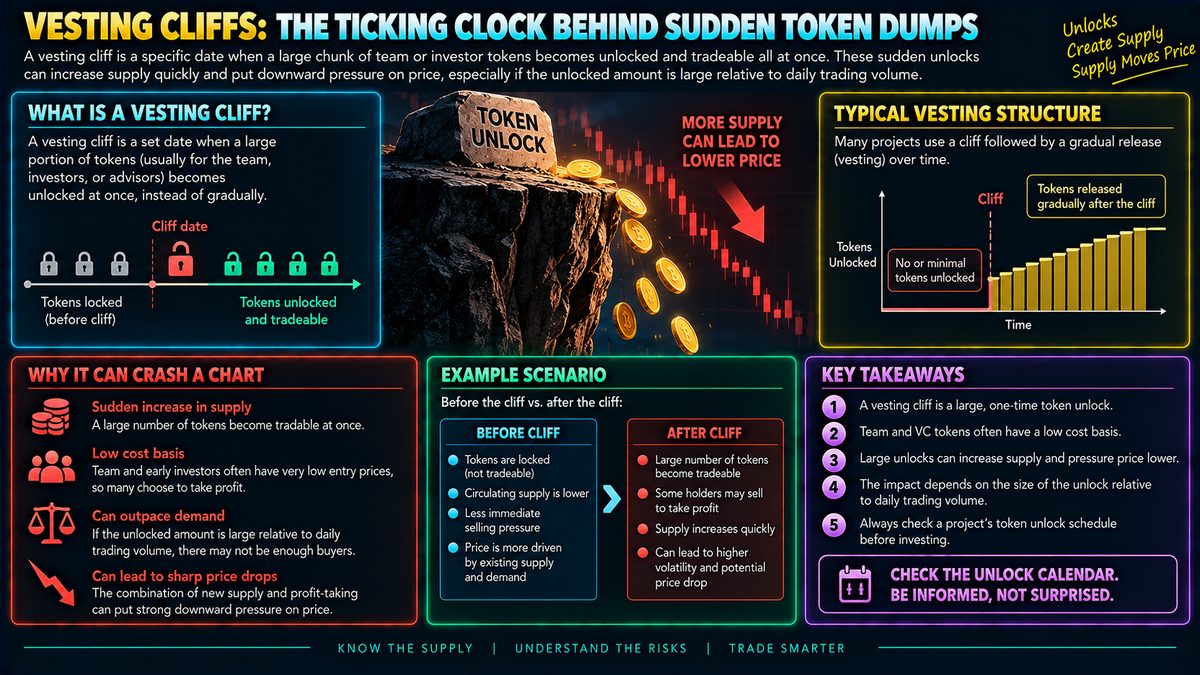
A vesting cliff is a set date when a big chunk of team or investor tokens becomes unlocked and tradeable all at once, instead of trickling in gradually. Before the cliff, those tokens are just numbers on a chart; after it, holders can sell freely, and many take profit fast since their cost basis is often near zero. If the unlocked amount is large relative to daily trading volume, that sudden supply increase can outpace demand and pressure price sharply. Always check a project's token unlock schedule so you're not blindsided by a cliff date.
What A Vesting Cliff Actually Is
When a crypto project launches, it usually promises a chunk of its total token supply to early investors, founders, advisors, and team members. Rather than handing over all those tokens immediately, projects often use a vesting schedule, a plan that spreads out when tokens become usable. A cliff is a specific point in that schedule where nothing unlocks for a long stretch, and then a large batch unlocks all at once on a single date. Before that date, the tokens exist only as an entry in a smart contract or spreadsheet. They cannot be sold, transferred, or moved to a wallet, so they have no direct effect on the tradeable supply, meaning the number of coins actually available to buy and sell in the market.
Why Projects Structure Tokens This Way
Cliffs and vesting exist mainly to align incentives. If team members or early backers could sell their entire allocation on day one, they might dump tokens the moment a project lists on the market, regardless of whether the project actually succeeds. By locking tokens for months or years, projects try to keep insiders motivated to keep building. The tradeoff is that this creates a predictable future event, a known date when a large supply increase will hit the market, which anyone can look up in advance if they know where to check.
How Traders Read And React To Cliffs
Because a cliff date is public information, some traders track token unlock calendars the way others track earnings dates for stocks. The key number they look at is not just how many tokens unlock, but how that amount compares to average daily trading volume, meaning the typical amount of the token bought and sold each day. If the unlock is small relative to volume, the market can often absorb it without much visible impact. If the unlock is large relative to volume, there is a higher chance that new sellers outnumber willing buyers, which can pressure price downward, especially since many recipients have a cost basis, meaning what they originally paid, near zero and are eager to lock in any profit.
Some traders watch price action in the days leading up to a cliff, reasoning that anticipation alone can move markets. Others wait to see actual on-chain movement, meaning tokens visibly moving from vesting contracts into wallets or exchanges, before drawing conclusions.
Common Mistakes And Limitations
A frequent mistake is assuming every unlock automatically causes a crash. Many unlocks pass with little visible effect because holders choose to keep holding, or because the amount is genuinely small relative to demand. Another mistake is ignoring unlocks entirely and being surprised by a supply increase that was fully public well in advance. It is also easy to misread unlock schedules if the data source is outdated or unofficial, so cross-checking against a project's own documentation matters.
Vesting cliffs are a supply-side factor only. They say nothing about demand, sentiment, or broader market conditions, all of which also drive price. A large unlock during strong buying interest may barely register, while a small one during weak demand could still matter.
Fitting Cliffs Into A Broader Approach
Treat unlock schedules as one input among many, not a standalone signal. Combining awareness of vesting cliffs with position sizing, meaning how much capital you risk on any single trade, and with attention to overall volume and volatility, tends to be more useful than reacting to a single date in isolation. No unlock schedule, chart pattern, or indicator guarantees a specific price outcome, and treating any single tool as certain is itself a risk worth managing.