
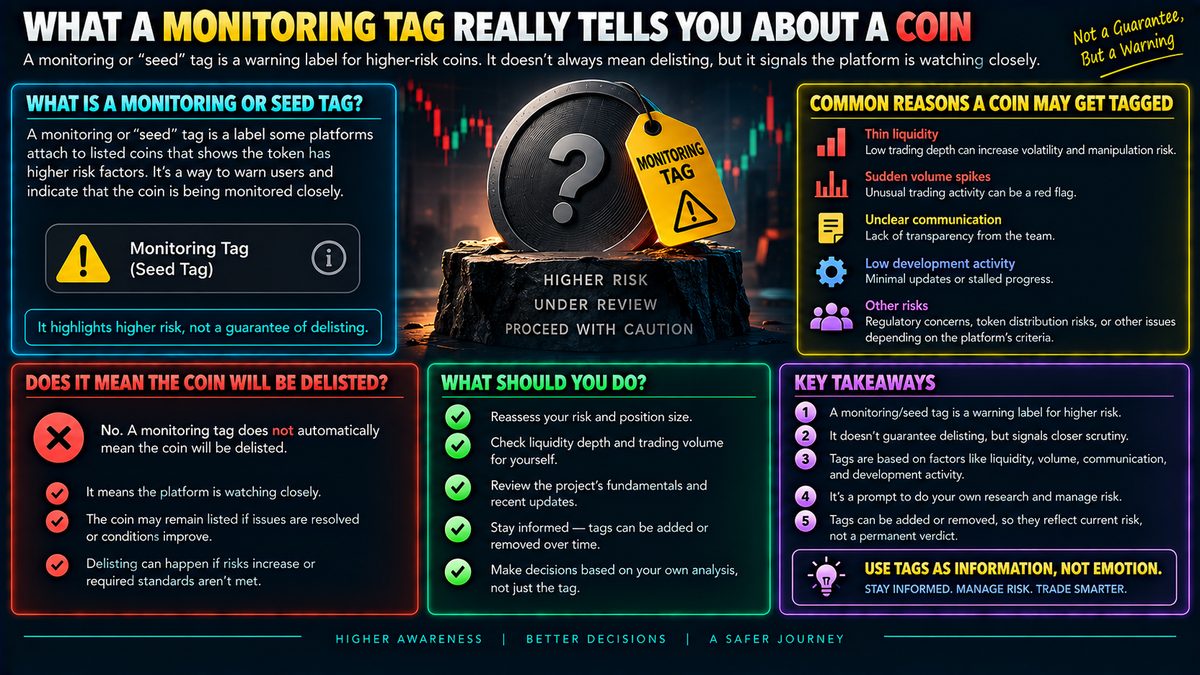
A monitoring or "seed" tag is a warning label some platforms attach to listed coins that show red flags like thin liquidity, sudden volume spikes, unclear team communication, or low development activity. It doesn't mean a token will be delisted, but it signals the exchange is watching closely and may act if conditions don't improve. Treat it as a prompt to reassess your risk, not panic-sell — check liquidity depth and project fundamentals yourself. Tags can be added or removed over time, so they reflect current risk, not a permanent verdict.
What The Tag Actually Signals
A monitoring or seed tag is not a judgment about whether a coin will succeed or fail. It is closer to a flashing light on a dashboard: something in the coin's trading pattern or project activity has crossed a threshold that the platform's risk team wants to keep an eye on. Common triggers include thin liquidity, meaning there is not much buy and sell depth in the order book so even modest trades can move the price a lot, sudden and unexplained volume spikes, a team that has gone quiet on updates, or a code repository that shows little to no ongoing development.
None of these triggers alone proves anything bad is happening. A small project can have thin liquidity simply because it is early or niche. A volume spike can come from genuine excitement rather than manipulation. The tag exists because these patterns, taken together, statistically correlate with higher risk, not because the platform has concluded the coin is doomed.
How These Flags Tend To Form
Exchanges generally use a mix of automated screening and human review. Automated systems track metrics like the ratio of trading volume to available liquidity, the concentration of holdings among a small number of wallets, and how often official channels post verifiable updates. When several of these metrics drift outside normal ranges at the same time, the system raises a flag for closer review.
This means a tag can appear quickly, sometimes within days of unusual activity, and it can also be removed relatively quickly if the underlying numbers normalize. The tag reflects a snapshot of current conditions, not a fixed history. A coin tagged today could lose the tag next month if liquidity deepens and communication resumes, or it could stay tagged for a long time if nothing changes.
How Traders Commonly Use The Information
Experienced traders treat a monitoring tag as a cue to slow down and re-examine their position rather than as an automatic sell signal. Practical steps include checking the order book depth directly to see how much size sits near the current price, looking at whether recent volume is spread across many wallets or concentrated in a few, and reviewing the project's own communication channels and development activity for signs of life or silence.
It also helps to separate short-term trading risk from long-term project risk. Thin liquidity mainly affects how easily you can enter or exit a position without slippage, which matters even if you believe in the project's fundamentals. Weak development activity speaks more to the project's long-term viability. These are different questions and deserve different research.
Common Mistakes To Avoid
A frequent mistake is treating the tag as equivalent to a delisting warning and panic-selling immediately, which can lock in losses at exactly the moment liquidity is worst. Another is the opposite error, ignoring the tag entirely because "the coin is still trading fine," without checking whether the underlying conditions have actually improved.
It also helps to remember that a tag is not a substitute for your own due diligence, and the absence of a tag is not a guarantee of safety either. Plenty of risky coins never get flagged simply because their metrics stay inside normal ranges even while other problems exist.
Fitting This Into A Risk Framework
A monitoring tag works best as one input among several, alongside your own liquidity checks, position sizing, and exit planning. No tag, indicator, or label can guarantee future outcomes, and risk conditions can change again after you've made a decision. Treating the tag as a prompt to reassess, rather than as advice to act on directly, keeps the responsibility for the decision where it belongs, with your own research and risk tolerance.