
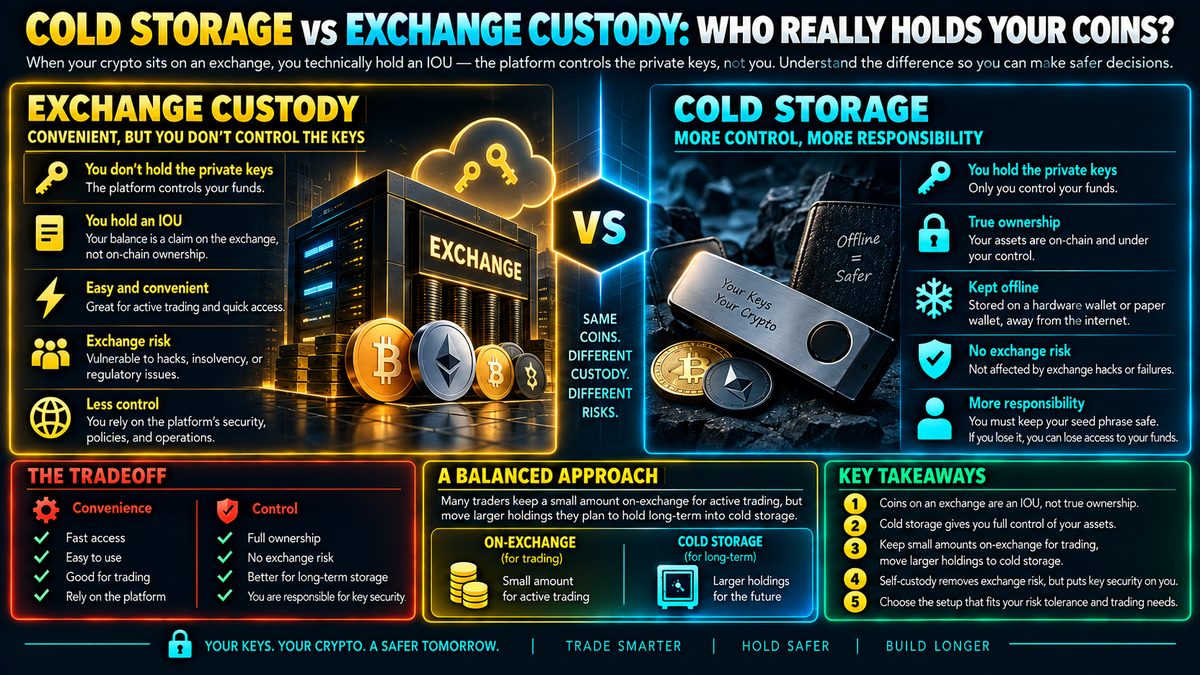
When your crypto sits on an exchange, you technically hold an IOU — the platform controls the private keys, not you. Cold storage means moving assets to a wallet where only you control the keys, usually a device kept offline. A common approach: keep small amounts on-exchange for active trading, but move larger holdings you plan to hold long-term into cold storage. The tradeoff is convenience vs. control — self-custody removes exchange risk but puts key security fully on you.
What Custody Actually Means
Every crypto asset exists as an entry on a blockchain, a shared public ledger. What proves ownership of that entry is not a username and password but a private key, a secret piece of data that lets whoever holds it move the coins. Custody simply means whoever controls that private key controls the coins. When you deposit crypto onto an exchange, the exchange generates and holds the private keys on its own servers. Your account balance is really a promise from the exchange that it will let you withdraw an equivalent amount later, similar to how a bank IOU represents money rather than being the money itself.
How Cold Storage Works
Cold storage means generating and storing private keys on a device that is not connected to the internet, such as a hardware wallet or even a piece of paper with keys written on it. Because the keys never touch an internet-connected computer, they are much harder for remote attackers to steal. To move funds, you typically connect the offline device briefly, sign a transaction, and disconnect again. This is often contrasted with a hot wallet, which is any wallet connected to the internet, offering convenience but a larger attack surface.
The Convenience Versus Control Tradeoff
Keeping coins on an exchange is convenient for active trading. You can buy, sell, or transfer instantly without managing hardware or worrying about losing a key. The cost is counterparty risk, the chance that the platform holding your assets fails, freezes withdrawals, gets hacked, or restricts access for regulatory reasons. Cold storage removes that specific risk because no third party holds your keys, but it shifts full responsibility onto you. If you lose the device, forget a recovery phrase, or make an error copying it down, there is usually no customer support line that can recover the funds. Self custody trades institutional risk for personal operational risk.
A Common Middle Ground
Many traders split their holdings by purpose rather than choosing one method entirely. Coins meant for active trading, meaning frequent buying and selling over short periods, often stay on an exchange where liquidity and speed matter. Coins meant to be held for a long time with no near term trading plan are often moved into cold storage, sometimes called a hardware wallet or offline wallet, to reduce exposure to platform failure. This is not a rule, just a widely used habit, and the right balance depends on how much a person trades, how much they hold, and their own comfort with managing keys.
Limitations and Common Mistakes
Cold storage is not a guarantee of safety, it only changes which risks apply. People lose funds by mishandling recovery phrases, storing them digitally where they can be copied, buying tampered hardware from unofficial sources, or simply forgetting where a device is stored. Cold storage also does not protect against sending funds to the wrong address or falling for a scam that tricks you into signing a malicious transaction. On the other side, treating an exchange as a long term vault ignores that platforms can be hacked, mismanaged, or restricted, and history has shown users can lose access without warning.
Fitting Into a Broader Risk Framework
Custody decisions are one part of overall risk management, alongside position sizing, diversification, and understanding what you actually own. Neither cold storage nor exchange custody is inherently correct, and no method eliminates risk entirely. Thinking through who holds the keys, what happens if that party fails, and how you would recover funds in an emergency is a useful exercise regardless of which approach you choose.